b2b-expert-advisor
B2B startup strategy advisor grounded in Lenny Rachitsky's 7-part series and April Dunford's positioning framework. This skill should be used when the user asks about B2B go-to-market, positioning, finding first customers, validating a B2B idea, identifying ICP, scaling growth en
Install
npx skills add https://github.com/SZoloth/skill-pack/tree/main/skills/b2b-expert-advisor
claude plugin marketplace add https://llmmart.ai/marketplace.json && claude plugin install szoloth-skill-pack@llmmart
git clone https://github.com/SZoloth/skill-pack.git
The skills CLI installs just this skill, for any of its supported agents. Claude Code installs the whole szoloth/skill-pack collection as a plugin from our marketplace. Git is the plain clone.
Skill manifest
B2B expert advisor
Overview
Provide B2B startup strategy advice grounded in specific frameworks and data from Lenny Rachitsky's 7-part B2B series and April Dunford's positioning methodology. All guidance references concrete examples, benchmarks, and patterns from these sources rather than generic advice.
Source library
The knowledge base lives in the resources/ directory alongside this file. Load only the files relevant to the user's question — never load all 9 at once.
Topic routing
| User question involves... | File to load |
|---|---|
| What successful B2B startups have in common, patterns, benchmarks | resources/successful-b2b-startups.md |
| Validating a B2B idea, testing demand, early signals | resources/validate-b2b-startup.md |
| ICP, ideal customer profile, who to sell to first | resources/identify-ideal-customer.md |
| First 10 customers, early sales, landing first deals | resources/win-first-10-b2b-customers.md |
| Product-market fit, PMF signals, when you have PMF | resources/finding-product-market-fit.md |
| Hiring, early team, first hires, team building | resources/hiring-early-team-b2b.md |
| Growth engine, scaling, channels, B2B growth | resources/scaling-b2b-growth-engine.md |
| Positioning (fundamentals), April Dunford, category design | resources/positioning.md |
| Advanced positioning, repositioning, positioning pitfalls | resources/advanced-b2b-positioning.md |
For questions spanning multiple topics (e.g., "how do I go from idea to first customers"), load 2-3 relevant files max.
Workflow
- Route the question — Match the user's question to 1-3 files from the topic routing table above.
- Load source material — Read the matched files from
resources/. - Extract relevant frameworks — Pull the specific frameworks, examples, benchmarks, or decision criteria that apply.
- Advise with citations — Give concrete guidance. Cite the source article and specific frameworks by name (e.g., "April Dunford's 5-step positioning process" or "Lenny's B2B validation ladder").
- Apply to user's context — When the user shares details about their specific product or market, cross-reference the frameworks against their situation.
Advisory principles
- Lead with the specific framework or data point from the articles, not generic B2B wisdom.
- When the articles provide concrete numbers (e.g., benchmarks for PMF, typical timelines, conversion rates), cite them.
- When the articles name specific companies as examples, use those examples.
- If the user's situation doesn't match any pattern in the source material, say so explicitly rather than extrapolating.
- Connect advice back to the user's specific context when they share it.
- Distinguish between "the article says X" and "based on the pattern, I'd suggest Y for your case."
Example interactions
User: "How should we think about positioning our product?"
- Load:
resources/positioning.md,resources/advanced-b2b-positioning.md - Apply April Dunford's framework to the user's specific situation
User: "What are the signals we've hit PMF?"
- Load:
resources/finding-product-market-fit.md - Extract the specific PMF indicators and benchmarks from the article
- Map them against whatever traction data the user shares
User: "How do we find our first 10 customers?"
- Load:
resources/win-first-10-b2b-customers.md,resources/identify-ideal-customer.md - Pull the specific playbooks and examples for early customer acquisition
- Contextualize for the user's target market
Quality checks
- Advice references specific frameworks or data from the source articles
- Source article cited by name when quoting benchmarks or frameworks
- Generic B2B platitudes replaced with article-specific guidance
- User's context applied when they share details about their product/market
- Gaps in source material acknowledged rather than filled with guesses
Files (skill-pack)
-
resources
-
advanced-b2b-positioning.md 21.1 KB
### 10 years, 300 companies, 4 non-obvious lessons on getting past the trickiest roadblocks *👋 Hey there, I’m Lenny. Each week, I answer reader questions about building product, driving growth, and accelerating your career. For more: [Lenny’s Podcast](https://www.lennysnewsletter.com/podcast) | [Lennybot](https://www.lennybot.com/) | [How I AI](https://www.youtube.com/@howiaipodcast) | My favorite [AI/PM courses](https://maven.com/lenny), [public speaking course](https://ultraspeaking.com/lennyslist?via=lenny), and [interview prep copilot](https://www.benerez.com/copilot/lenny)* *P.S. Get a full free year of Lovable, Replit, Manus, Gamma, n8n, Canva, ElevenLabs, Amp, Factory, Devin, Bolt, Wispr Flow, Linear, PostHog, Framer, Railway, Granola, Warp, Perplexity, Magic Patterns, Mobbin, ChatPRD, and Stripe Atlas [by becoming an Insider subscriber](https://www.lennysnewsletter.com/subscribe?plan=founding). [Yes, this is for real](https://www.lennysnewsletter.com/p/productpass).* --- As AI makes it trivial to build and launch products (and, soon, even come up with product ideas), **the biggest challenge for product teams is quickly becoming distribution**: getting people to pay attention to your product in the increasing cacophony of launches. One of the most powerful tools to cut through that noise is **positioning**. Strong, specific positioning grabs people’s attention and helps them instantly understand why your product is for them. [April Dunford](https://www.aprildunford.com/) is the world’s leading expert on the topic. She is the author of *the* book on positioning, *[Obviously Awesome](https://www.aprildunford.com/books)*, and has worked with over 300 B2B companies to nail their positioning. She’s also a two-time Lenny’s guest contributor and podcast guest. As she explained in [her previous, widely shared, guest post](https://www.lennysnewsletter.com/p/positioning), “a single shift in positioning can mean the difference between a product that flops and one that breaks through.” **In her latest guest post, below, April offers a guide to advanced B2B positioning—four lessons for getting past the trickiest and most common roadblocks that teams run into.** Let’s get into it. *P.S. April just published [an updated and expanded edition of Obviously Awesome](https://www.aprildunford.com/books). Grab a copy if you know what’s good for you. For more from April, [subscribe to her excellent Substack](https://aprildunford.substack.com/) (she’ll be dropping some new plug-and-play positioning templates in the next couple of weeks), and [follow her on LinkedIn](https://www.linkedin.com/in/aprildunford/).* *You can also listen to this post in convenient podcast form: [Spotify](https://open.spotify.com/show/0IIunA06qMtrcQLfypTooj) / [Apple](https://podcasts.apple.com/us/podcast/lennys-reads/id1810314693) / [YouTube](https://www.youtube.com/@lennysreads).* --- 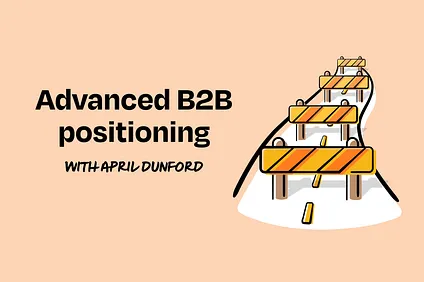 When I started out as a junior product marketer, positioning was something everyone understood but no one knew how to do, especially for tech companies. My work over the past 10 years has focused on developing a repeatable process that any B2B technology company can use as a starting point for creating strong positioning. I wrote a book, *Obviously Awesome*, about how a cross-functional team should work through the five components of positioning in a specific order. I’ve also covered it in [this article](https://www.lennysnewsletter.com/p/positioning) and [this podcast](https://www.youtube.com/watch?v=hdjlCLb9Hl8) with Lenny. Today, we have a much deeper understanding of how to develop good positioning—which is great for product marketers and great for the industry. But teams may encounter more advanced and challenging roadblocks that can slow momentum, derail collaboration, and break a project entirely. In this post, I’m looking beyond the basics of running a positioning process to address how to get past difficult roadblocks at different stages of the positioning development process to develop a positioning that clearly sets your product apart from your competition. 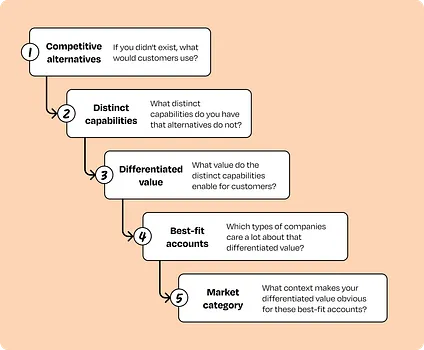 There are four patterns I see where teams encounter roadblocks during positioning development that are hard to see coming and to navigate around: 1. **Disagreement about what to position** ***against*** 2. **Product pessimism blinds the team to product strengths** 3. **The differentiated value is poorly defined** 4. **The company doesn’t know what they are positioning** These roadblocks are common, but they’re far from impossible to manage. In this post, I’ll give you a clear view of where they may appear down the road and how you can avoid them entirely or guide your team safely around them to achieve consistent, lasting success in your B2B positioning. You’ll walk away with a greater understanding of the positioning process and four real-world strategies that you can immediately take into your next project. Now let’s get into it. ## Four positioning roadblocks and how to move past them 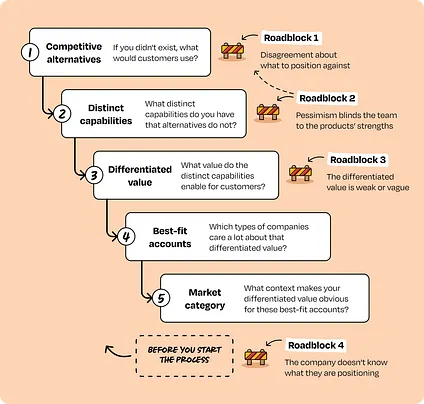 ## Roadblock 1: Disagreement about what to position against The first step in a positioning process is to look at the competitive alternatives. One of the most surprising things I have seen in positioning work is how often marketing, product, sales, and the founder/CEO have very different views on who they compete with. I’ve seen it so consistently that I believe disagreement about what to position against is the root of most weak positioning. Each function in a B2B tech company tends to have its own set of biases when it comes to thinking about “competition.” **Marketing:** Marketing is often overly influenced by a potential competitor’s marketing spend, regardless of the effectiveness of that spend (which is often completely unknown). Marketing teams watch how competitors show up in media, online, ads, and at conferences, and then often equate market visibility with competitive success—even if the sales team rarely encounters this competitor on a prospect’s short list and never loses deals to them. **Product Management:** The product team is focused a little further into the future than the marketing and sales teams. Product roadmap work requires an understanding of what I would call “horizon competitors,” products that aren’t causing any pain today but could in the future. In a positioning exercise, product teams will often list twice as many “competitors” as a sales team does, many of which are never seen on a prospect’s short list. **Sales:** Sales teams can have a skewed perception of competitors in two distinct ways. Firstly, they tend to have what I would call a “whale” bias. Sales can feel the sting of losing one very big deal and become overly focused on that winning competitor, even if they are never seen in more “normal” deals. The second bias is that they rarely define the status quo solution as a “competitor.” Deals lost to the status quo are often categorized as “no decision.” In the mind of a good salesperson, the customer’s “No” is mentally translated to “Not yet.” I have seen this even when the overwhelming majority of deals are lost to the status quo. **Founders:** Most founders I’ve worked with have a great gut feel for positioning. In fact, many positioning exercises I’ve led end up helping newer executives understand the nuances of what the founder already knows. However, in certain situations, founders might muddy the positioning waters by bringing a bias that the rest of the team doesn’t fully understand. Three situations where I see this happening: - **The founder was once heavily involved in closing deals but became less so.** The founder may be biased toward what the competitive landscape *used* to look like and less familiar with current market dynamics. - **Recent acquisitions** have opened opportunities in market segments that the acquiring team (including the founder) may not understand as well as the folks on the recently acquired team. - **The founder has recently been very focused on fundraising.** In fundraising, the company orients more toward the future state it is building. Often, that future state is not something the sales team can sell today. Too much focus on future capabilities the company does not yet deliver can result in stalled deals and customers saying, “We love that. Come back in two years when you have it.” ### The solution: Focus on the prospect’s view of the competition The prospect’s view of competitive alternatives is the only one that matters. Because different teams interact with customers in different ways and at different points in the sales process, their understanding of how customers view alternatives won’t always align. If we go into the positioning process understanding this, we can get past the roadblock in these ways: 1. **Imagine a world from the prospect’s POV:** Rather than have the team list conflicting sets of perceived competitors, ask, “If we didn’t exist, what would a prospect do?” That reframing helps the team focus on what is happening in sales deals out in the real world, rather than who they *should* or *could* compete with. 1. **Stay rooted in the near term:** As an old boss of mine used to say, “We have to sell what’s on the truck.” The path to success is to focus on the product as it exists, in the market as it exists, and selling to the customers we can win with today. We should expect our positioning to change over time as the product, competitors, and target customers evolve, but we should also accept that we are terrible at predicting how the changes will unfold. 1. **Don’t forget the status quo:** In B2B, vendors typically lose about half their sales opportunities to whatever the prospect is currently using. I’ve worked with companies where that number exceeds 80%. We need to understand the strengths and weaknesses of the status quo solution to convince buyers to move on. Research shows that about half the time, a status quo decision is more about customer indecision than a vote for the status quo solution (see Matt Dixon’s JOLT Effect research, for example). Still, we ignore the other half at our peril. Strong positioning wins both types of “no decision” deals. 1. **Work with a cross-functional team:** The first and most obvious way to ensure that the positioning accounts for different perspectives is to work with a cross-functional team. My recommendation is that we have the heads of marketing, sales, product management, and customer success, along with the founder, CEO, or head of the business (if it is a larger company). Often it helps to include a couple of very experienced account executives from the sales team to verify what is happening in the early sales stages. If we are positioning the company or a grouping of products (more on this later), we will need to make sure we have folks with product and commercial experience for each product. We might also need sales representation across different geographies if the competitive landscape varies. ## Roadblock 2: Pessimism blinds the team to the products’ strengths Some companies suffer from overly pessimistic product thinking—where teams convince themselves their product is an undifferentiated loser despite clear evidence that they’re winning in parts of the market. This can happen when teams are overly focused on closing perceived gaps with competitors or when product teams and sales teams don’t communicate well or often. The pessimism pattern is dangerous because it blinds teams to their competitive strengths and prevents the company from positioning around them. Also, this mindset tends to be contagious, spreading to marketing and sales teams, who may lose confidence in the product’s ability to deliver differentiated value. It’s hard to convince prospects to invest in a product that sellers don’t believe in. The pessimism manifests in four key ways: 1. **Defining ideal customers so broadly that every lost deal seems like a product failure:** I have worked with companies where product teams become over-exposed to bad deals and under-exposed to good ones. PMs get pulled in to try to save lost-cause deals, even when the prospect was a poor fit for the product in the first place. Meanwhile, deals with good-fit prospects are easily closed without any PM involvement. The result is that the product team begins to develop a skewed idea of what a good-fit prospect typically looks like. 2. **Maintaining long hypothetical competitor lists**:It’s hard to differentiate your product from an overly long list of competitors, particularly when we know little about many of them because we have never had to compete against them in a deal. For roadmap work, it makes sense to track future potential competitors. For positioning work, we have to stay oriented in the reality of the market—and be prepared to shift if and when a competitor begins to truly cause us pain. 3. **Dismissing sales team insights about why customers buy:** Sometimes this type of pessimism persists even in the face of proof that the product is doing well. In one workshop, a sales team listed a set of large accounts they had won because the product was superior in a particular way. The product team insisted that those prospects had failed to evaluate the other alternative properly. In another, despite the company generating hundreds of millions in revenue with solid growth, the product leader insisted that the sales team was winning through trickery and lies. I have seen salespeople who went too far in stretching the truth, but never one who was very successful with that strategy. 4. **Viewing the role of product management as “problem identification” rather than architecting true differentiated value:** Some companies get trapped in a cycle of competitive catch-up, to the point where the team becomes very adept at pointing out product problems and less attuned to where the product is leading. Often, there is a big, boring, long-standing differentiator hiding in plain sight. The product team takes it for granted (“Oh, we have *always* done that!”) while sales are selling the heck out of it. Each symptom reinforces the others, creating a toxic cycle that undermines the company’s ability to articulate and amplify its genuine competitive advantages. ### The solution: Keep coming back to what’s working To break the pattern for positioning work, expose the product team to what sales understands about what’s working in the majority of deals, and work through a positioning exercise to help both teams understand each other. We can get past this roadblock by: 1. **Focusing the whole team on strengths and the near-term competitive advantage:** A positioning process is really about finding the heart of why we win. To get there, we need to understand the product’s strengths and competitive advantages. We understand the product isn’t perfect and that we have competitive gaps. But we need to win business now, and we need positioning that tells a clear, compelling story about the product we have today (with the full understanding that that positioning will change and hopefully improve over time). Positioning is not a product strategy, nor does it set the product’s future direction. A discussion of the ways the product falls short does not lead to strong, differentiated positioning. 2. **Including experienced sales voices in the room:** Nobody understands how a customer behaves across a sales process better than your sales team does. For positioning work, we need to rely on that experience to understand who our true competitors are, what our true differentiators are, and which types of buyers care most about those differentiators. If the company’s CRO and VP of Sales do not have much experience with early-stage deals, it helps to have an experienced account executive in the room, and having two is generally better than just one, giving us a view across a broader set of deals. 3. **Preparing the moderator to challenge participants**: If you do a group positioning exercise, choose your moderator carefully. An experienced moderator can help the team stay grounded in reality and should be prepared to challenge participants if they become overly pessimistic. The moderator should remind the team that every day, customers spend months evaluating their options and then selecting the product. These customers can’t all be careless, gullible shoppers. Similarly, if a participant claims that many deals are won for a particular reason, they should be prompted to provide evidence and details. The team needs to agree on a position to work together and make it stick after the exercise. It’s not unusual for teams to get together to discuss product problems and gaps. However, a positioning exercise should focus on where the product outperforms the competition. Getting the team oriented around the differentiated strengths of the product is critical for great positioning. ## Roadblock 3: The differentiated value is poorly defined As vendors (and particularly product folks), it’s easy to focus on features and assume buyers will easily understand why those features matter. In my experience, a product’s most differentiated capabilities are often the most difficult for prospects to understand, precisely because they are uncommon. If we really want to answer the question “Why pick us over the alternatives?” We have to clearly articulate the value our product can deliver that other alternatives cannot. This step in the process is the one I see teams struggle with the most. There are four ways I see teams get stuck around differentiated value: 1. **Assuming prospects understand why a feature is important**: Today, a smartphone vendor can simply advertise that their phone has a 50-megapixel camera, and the audience knows what that means. However, 20 years ago, when few people had experience with digital cameras, you would have had to explain what a megapixel was, why anyone should care, and why 50 is better than 20. The more unique a feature is, the less likely a potential customer is to understand why it is important. 1. **Stopping short of capturing value the prospect actually understands:** I once worked for a database company with patented technology that enabled us to execute a specific type of query 1,000 times as fast as our competitors. We assumed anyone buying a database would find query speed valuable. Interestingly, many companies did not care. They were running the query for a monthly or quarterly report, so getting the answer in a day or two was perfectly fine. Our best-fit accounts, however, were running those types of queries to respond to a customer question. The real value lay in responding to customers more quickly, not executing the query faster. Recently, many of the teams I’ve worked with have a value point around efficiency. But their buyers may be much more focused on driving revenue—and can’t connect the dots between efficiency and revenue themselves. 2. **Going too far and losing the differentiation completely:** In B2B, we really only have two “pure” points of value. We are helping businesses make money or save money. (Insurance folks would add reducing risk, but that one is a special case!) Unlike consumer products, a successful B2B software project isn’t going to get you a date or make you look rich. We are increasing revenue or decreasing costs, and that’s it. If you abstract the value of your product all the way down to “This product saves you money,” you will sound exactly like every other product you compete with. 3. **Overwhelming customers by attempting to communicate too many differentiated value themes**: Differentiated value should succinctly answer the question “Why pick us over the alternatives?” If we give prospects a list of 10 reasons why, they aren’t likely to connect with a clear story or remember more than a couple of them (if we’re lucky). 4. **Confusing differentiated value with sales objection handling**: If there are people on the team who have never worked in sales, they might not understand what a sales objection is or how it differs from value. Value is a reason to buy. An objection is a reason a prospect might not buy, even if the value is something they really want. Often, objections come from constituents who are not the deal champion but can kill a deal if they have specific problems with the product. For example, I worked with a company whose product was very easy for the IT team to manage, which gave them an advantage over many competitors and the status quo. However, the purchase decision was driven by a business buyer who didn’t see any value in ease of management. In this case, ease of management was only used to handle the potential objection of the IT department *after* the business champion had selected the product. -
finding-product-market-fit.md 30.7 KB
### Part five of my seven-part series on kickstarting and scaling a B2B business *👋 Hey, I’m Lenny and welcome to a **🔒 subscriber-only edition 🔒** of my weekly newsletter. Each week I tackle reader questions about building product, driving growth, and accelerating your career.* --- 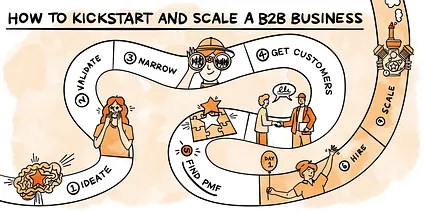 Welcome to part five of our ongoing series on how to kickstart and scale a B2B business: - **Part 1:** [How to come up with a great B2B startup idea](https://www.lennysnewsletter.com/p/how-the-most-successful-b2b-startups) - **Part 2:** [How to validate your idea](https://www.lennysnewsletter.com/p/how-to-validate-your-b2b-startup) - **Part 3:** [How to identify your ICP](https://www.lennysnewsletter.com/p/how-to-identify-your-ideal-customer) - **Part 4**: [How to find and win your first 10 customers](https://www.lennysnewsletter.com/p/how-to-win-your-first-10-b2b-customers) - **Part 5:** A guide for finding product-market fit *← This post* - **Part 6:** [How, and when, to hire your early team](https://www.lennysnewsletter.com/p/hiring-your-early-team-b2b) - **Part 7:** [How to scale your growth engine](https://www.lennysnewsletter.com/p/scaling-your-b2b-growth-engine) *A huge thank-you to **[Akshay Kothari](https://www.linkedin.com/in/akothari/)** (COO of Notion), **[Ali Ghodsi](https://www.linkedin.com/in/alighodsi/)** (CEO of Databricks), **[Andrew Ofstad](https://www.linkedin.com/in/aofstad/)** (co-founder of Airtable), **[Barry McCardel](https://www.linkedin.com/in/barrymccardel/)** (CEO of Hex), **[Boris Jabes](https://www.linkedin.com/in/borisjabes/)** (CEO of Census), **[Calvin French-Owen](https://www.linkedin.com/in/calvinfo/)** (co-founder of Segment), **[Cameron Adams](https://www.linkedin.com/in/themaninblue/)** (co-founder and CPO of Canva), **[Christina Cacioppo](https://www.linkedin.com/in/ccacioppo/)** (CEO of Vanta), **[David Hsu](https://www.linkedin.com/in/dvdhsu/)** (CEO of Retool), **[Eilon Reshef](https://www.linkedin.com/in/eilonreshef/)** (CPO of Gong), **[Eric Glyman](https://www.linkedin.com/in/eglyman/)** (CEO of Ramp), **[Guy Podjarny](https://www.linkedin.com/in/guypo/)** (CEO of Snyk), **[Jori Lallo](https://www.linkedin.com/in/jorilallo/)** (co-founder of Linear), **[Julianna Lamb](https://www.linkedin.com/in/juliannaelamb/)** and **[Reed McGinley-Stempel](https://www.linkedin.com/in/reed-mcginley-stempel-17362245/)** (co-founders of Stytch), **[Keenan Rice](https://www.linkedin.com/in/keenanrice/)** (founding team), **[Mathilde Collin](https://www.linkedin.com/in/mathilde-collin-bb59492a/en/)** (CEO of Front), **[Rick Song](https://www.linkedin.com/in/rick-song-25198b24/)** (CEO of Persona), **[Rujul Zaparde](https://www.linkedin.com/in/rujulz/)** and **[Lu Cheng](https://www.linkedin.com/in/lu-cheng-973b7830/)** (co-founders of Zip), **[Ryan Glasgow](https://www.linkedin.com/in/ryanglasgow/)** (CEO of Sprig), **[Shahed Khan](https://www.linkedin.com/in/shahedkhan/)** (co-founder of Loom), **[Shishir Mehrotra](https://www.linkedin.com/in/shishirmehrotra/)** (CEO of Coda), **[Sho Kuwamoto](https://www.linkedin.com/in/shokuwamoto/)** (VP of Product of Figma), **[Spenser Skates](https://www.linkedin.com/in/spenserskates/)** (co-founder and CEO of Amplitude), **[Tom Preston-Werner](https://www.linkedin.com/in/mojombo/)** (co-founder of GitHub), and **[Tomer London](https://www.linkedin.com/in/tomerlondon/)** (co-founder and CPO of Gusto) for contributing to this series. Art by [Natalie Harney](https://www.natalieharney.com/).* ---  If you’ve come here looking for a step-by-step guaranteed guide to finding product-market fit, you’re going to be disappointed. No such guide exists. Nor will one ever exist. Finding PMF is too squishy. As Rick Rubin said in his recent book *The Creative Act*, “If we’re aiming to create works that are exceptional, most rules don’t apply.” However, there is hope. Though there’s no formula for finding PMF, you can significantly increase your odds, and save yourself a lot of time and heartache, by studying the lessons of those who’ve made it. I interviewed more than 20 of today’s most successful B2B founders, and from their stories, I’ve found: 1. A simple framework for moving closer to PMF 2. Reliable signs that you’re approaching PMF 3. How long it should take you to find PMF 4. Advice for what to do if you aren’t finding PMF Let’s get into it. ### In B2B, it normally takes two years to start feeling product-market fit Here’s an overview of how long it took 24 of today’s top B2B startups to get to (1) a live product, (2) their first customer, and (3) their first feeling of PMF: 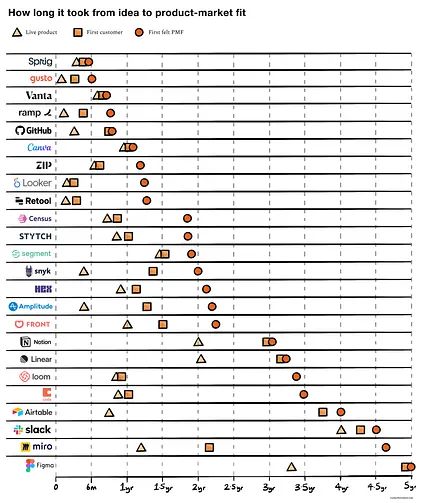 Timelines include pivots, e.g. Slack spent first 3.5 years working on a game called Glitch before pivoting 1. **The median time from idea to feeling product-market fit was roughly 2 years.** Start to worry if you’ve been working on your idea for over 2 years and not feeling PMF (see below what that feels like), and start to seriously worry if it’s been over 3 years. 2. **From a working product to feeling PMF typically took 9-18 months.** Expect to spend a year or so iterating before you finally have something people want. 3. **Most companies got an alpha product out the door in 1-3 months.** Unless you think you’re the next Figma, get your V1 out quickly. 4. **A few companies—Figma, Airtable, Slack—took 4+ years to find PMF**, but they were the exceptions, and Slack was working on a completely different product (a game) before [pivoting to what became Slack](https://www.lennysnewsletter.com/p/how-the-most-successful-b2b-startups#:~:text=And%20famously%2C%20for%20Slack%2C%20the%20big%20idea%20came%20from%20noticing%20one%20feature%20being%20incredibly%20popular%20within%20their%20ill%2Dfated%20video%20game%3A). 5. **Additional takeaways and surprises from the insights below** 1. If you build it, they *will* come—if you have strong product-market fit. 2. Stop thinking of product-market fit as a *yes* or *no* question—but instead as a process of finding fit with more segments of the market. 3. Surprisingly, no founders I spoke with used retention as their signal of PMF. It might have been implicit, but if you read the quotes, that wasn’t really ever the main story. 4. The journey to PMF starts by finding just one company to truly love your product. ### One of the most interesting takeaways from my interviews is how often founders never fully felt PMF [Shishir Mehrotra](https://www.linkedin.com/in/shishirmehrotra/) (co-founder and CEO of Coda) described this feeling so well: > **“My problem with the term is that you always have product-market fit with one group and not with the next. The group that you haven’t achieved product-market fit with is the one you really want to target.** > > It always surprises people to hear that, at YouTube, we never thought we had a product-market fit. We had 100 million DAUs and almost a billion monthly actives, and yet we did not have our desired audience. We had teenagers but not adults. We were envious of the satisfaction those folks were finding on Netflix, Facebook, or wherever. In my experience, you’re always stretching product-market fit. I don’t think there’s a moment where you’re done with product-market fit.” You may not feel like you have PMF even when you reach 100 customers: > “ **I remember with the first 100 or so customers, every customer kind of felt like the last customer we would get, to be honest.** We were like, I can’t believe DoorDash is using this product. That’s incredible! We were so proud. Unlike on the B2C side, there was no sort of viral loop that got going that made us think, ‘Okay, we found it.’ Instead, it really was kind of just pushing the boulder at a pretty steep trajectory uphill, over and over.” > > — [David Hsu](https://www.linkedin.com/in/dvdhsu/), founder and CEO of **Retool** Or at $100M/year in revenue: > “ **The fear of hitting a wall and collapsing was always there. Even when we were at 100 million in revenue, there was always this fear that we were suddenly going to crash into a wall and everything would stop.** > > There are all these horror stories in Silicon Valley of these companies who got to 150 or 200 million revenue and then didn’t grow. So there was always this fear that it was going to happen to us as well. **Your product-market fit is always with respect to a particular market.** It might be small companies, or medium-size companies, or enterprises. The small companies don’t want your stuff, or the U.S. market doesn’t want your stuff, or the Asian market, and so on. Eventually, at some point you become a multi-product company, so then the whole game repeats itself again and again and again. You have to revamp and change things significantly, which is its own challenge.” > > — [Ali Ghodsi](https://www.linkedin.com/in/alighodsi/), co-founder and CEO of **Databricks** In fact, you might never fully feel PMF: > “ **I never felt at any point of time like, ah, now I have product-market fit.** I always felt like there was always something for us to improve on—whether it was growth or product or customer care. I’m always seeing what more we can do to solve problems on behalf of our customers.” > > — [Tomer London](https://www.linkedin.com/in/tomerlondon/), co-founder and CPO of **Gusto** > “I’ve spent most of the history of Hex paranoid that we’re not at PMF, or there’s more to do. I think our vision is big enough and that, at any point, even when I have thousands of people telling us this thing is awesome, I still feel like, ‘Yeah, but there’s this bigger thing we want to do.’ **I don’t feel like we have product-market fit for the ultimate vision we have yet.** And so that’ll take time, obviously.” > > — [Barry McCardel](https://www.linkedin.com/in/barrymccardel/), co-founder and CEO of **Hex** > “ **I don’t even know if today we have true product-market fit.** If you’re going down the venture path, what I tell other founders is that anytime you raise, your product-market fit is gone, because whatever you raised, the next raise effectively demolished it. **You now have to hit the next bar of product-market fit.** What we have today at the series A and series B, I consider it strong product-market fit. But that’s because we were able to grow into the valuation and what the stature of the company should have been at those respective stages.” > > — [Rick Song](https://www.linkedin.com/in/rick-song-25198b24/), founder and CEO of **Persona** PMF is never a binary yes-or-no moment. It’s instead a gradual process of finding fit with larger and larger segments, as [Jori Lallo](https://www.linkedin.com/in/jorilallo/), co-founder of **Linear**, describes: > “PMF has been so gradual; I might even say... linear. There’s not just one hump that we got over and thought, ‘Okay, now it’s clicking.’ **It’s more like we’re chipping away at these obstacles and getting more and more people interested.** It’s more like, ‘Oh, this is really working for certain segments.’” ## A guide for finding product-market fit Though you may never feel everlasting product-market fit, you need to start somewhere. I asked every founder when they first felt product-market fit, and their answers fell along a spectrum that provides a useful guide to finding ever-increasing PMF: - **Step 1:** Get one company to love your product - **Step 2:** Get one company to pay (a meaningful amount of money) for your product - **Step 3**: Get more than one company to love and pay for your product - **Step 4:** Start noticing a shift from push to pull, and organic growth - **Step 5:** Keep growing consistently Below, I’ll explore each step in-depth, and share stories from founders of the moment they finally felt PMF. ### Step 1: Get one company to love your product Start your PMF journey by becoming obsessed with getting one company to love, use, and continue to use your product. Do whatever it takes to make them successful. In the case of **Figma**, co-founder Dylan Field became obsessed with the success of their first real user, Coda (originally called Krypton): > “There was a weekend when we had a bug and the product wasn’t working very well because it hadn’t been released yet; it was an alpha. And Dylan was freaking out. He’s like, ‘There’s a bug.’ And I’m like, ‘Yeah, we’ll fix it, but we’ve got other stuff going on.’ He’s like, ‘We have to call a red alert.’ I’m like, ‘Dude, what are you talking about? We haven’t shipped this thing yet. There’s no such thing as a red alert because it’s not shipped.’ **And he’s like, ‘You don’t understand. There are customers depending on us.** There’s this company called Krypton.’ So I was like, ‘Okay, they haven’t paid us any money, nobody even knows we exist, but I guess we’ll deal with it.’ > > I actually came to appreciate Dylan’s mindset, because a lot of founders don’t give a shit about their customers. They want to understand the customers, but just enough to figure out what features they would be willing to pay for. **But at the end of the day, Dylan was thinking about it in terms of trust. He was like, ‘Look, I convinced this guy to use our product. They’re actually trying to use it for work, and if we fuck it up for them, I don’t want that on my conscience. I want to do whatever I can to make sure that we’re holding up our end of the bargain. Because they believed in me.’** > > They’re still customers; they were our first customer.” > > — [Sho Kuwamoto](https://www.linkedin.com/in/shokuwamoto/), VP of Product **Coda** itself went through this same journey with their first customer, Springful: > “My former colleague Noam Lovinsky \[now CPO at Grammarly\] was starting a company called Springful. I said to him, ‘Hey, would you use Krypton \[our name at the time\]?’ They started using it, and for a while, it went well. They were getting a lot of use out of it. We had a chart of what the DAUs looked like, and because they had six employees, the chart basically sat at 6 every day, except for on the weekends. > > **Then one day, it dropped to zero on a weekday, and the following day, it stayed at zero. And so I texted Noam and said, ‘Hey, what happened? Are you at an offsite?’ I was trying to find some other excuse. He said, ‘Oh man, I’ve been putting off calling you, but I have good news and bad news. The bad news is we had a team meeting and I asked the team how things were going, and they said that if we made them keep using Krypton, they were all going to quit.’ And I was like, ‘Well, that’s pretty terrible news.’ He said, ‘The good news is they all completely believe in the vision. They’ve made a list \[in Krypton\] saying, ‘If you do these things, we’ll come right back.’ The list was like 25 things, all completely reasonable.** > > This led to a big internal debate. The team was basically divided in half. Half the folks had a mindset like, ‘What a gift. We have a customer and they have given us a clear list of requirements.’ The other half said, ‘He’s reacting to the wrong product—it’s not actually the shape of the thing we want. And if we do that, we’re going to dig a hole deeper and deeper into this part of the product.’ > > We decided not to finish his list. Instead, we built the doc that we originally envisioned. I thought it would take three or four months, but it took over a year to get back to his list.” > > — [Shishir Mehrotra](https://www.linkedin.com/in/shishirmehrotra/), co-founder and CEO [David Hsu](https://www.linkedin.com/in/dvdhsu/) at **Retool** built a tool to catch anyone running into issues with their early product so that they could fix the issues immediately: > “At the beginning of any startup, no one knows about your product, nor does anyone use it. We came to a point where we’re like, given that no one’s using the product, every time somebody’s using the product, we should go see what they’re doing. So we built this custom analytics server along with FullStory, and anytime anyone was in the app and using the app, we got notified immediately on Slack. > > Invariably, they’d run into a bunch of issues. And anytime they ran into any issue, we’d immediately reach out. We’d just call them. With sales, oftentimes when you call a customer, they don’t reply or they don’t want to talk to you. But in this case, they were literally using the product and they’re running into issues, and so they were super-likely to pick up. > > With DoorDash, for example, the product went through multiple iterations over three weeks, where they’d uncover an issue and we’d respond, ‘No problem, we’re on it.’ We’d ship the feature, they’d come back the next day, it would work. They wanted an on-prem option, which is at that point a pretty big feature, as you can probably imagine, putting a cloud product on-prem. We’re like, ‘No problem.’ And we shipped it in just 36 hours. So we were iterating very rapidly, even if the core idea was the same.” The founders of **Gong** did exactly the same thing: > “During the beta process, we had a bunch of systems that recorded the users’ screens using Gong. And we were watching these like maniacs, every day. I would probably spend two hours watching people interact with the system, reverse engineering them based on their role or what they were trying to do, and then go on thinking, ‘So this is what this person is doing?’ And if needed, I would give them a call. This approach is an underutilized product management tool, because in some areas it gives you more information than a quantitative survey or a discussion, because this is what the person actually does versus what they tell you and what they think they’re doing.” > > — [Eilon Reshef](https://www.linkedin.com/in/eilonreshef/), co-founder and CPO The founders of **Gusto** literally sat next to their early customers watching them send payroll day after day: > “ **For the first 30 customers, I was with them in their offices seeing them do payroll, or I was on the phone with them, watching them and then seeing them send payroll, and their reactions and seeing feedback.** What’s working, what’s not working, what’s intuitive, what’s not intuitive. Every time they added an employee, I was there on the phone with them or in their office.” > > — [Tomer London](https://www.linkedin.com/in/tomerlondon/), co-founder and CPO The founders of **Looker** are famous for going even further and “forward deploying” their engineers to sit in the customer’s offices and work alongside their team to make sure they’re set up for success: > “The best way to show a prospect or customer the real value of Looker was to show them on their own data. Its power came from being designed as both a language and a development platform, but that also came with a lot of overhead to learn how to be powerful with it. It wasn’t rocket science; it just took time. > > Therefore, **we created a team of data analysts to serve as our technical customer-facing teams (sales engineers, customer support, and implementation analysts) to quickly deploy and develop instances of Looker for our customer.** Early on, this enabled us to see and know everything that our customers and prospects wanted to achieve with analytics. Having that insight, we were able to both develop features and ways to use Looker, almost daily, to ensure we would be the best choice for a powerful analytics platform. This also helped us ensure that our customers would find value from Looker on day 1 after purchasing.” > > — [Keenan Rice](https://www.linkedin.com/in/keenanrice/), founding team One of the biggest recurring lessons from my conversations is to talk to customers more. I know you hear this a lot, but you are probably *still* not talking to customers enough. Here’s [Spenser Skates](https://www.linkedin.com/in/spenserskates/) ’s(co-founder and CEO of Amplitude) hard-won lesson: > “We spent about a year building, when in retrospect, we should have spent half that time talking to customers. And if we had, we would’ve wasted a lot less time on customers who were never going to buy. > > **The biggest thing I will tell founders is, you have to spend half your time talking to your customers. If you’re a B2B company, that means becoming a salesperson. Figure out how to spend the collective time of your founding team: 50% needs to be talking to customers. If you’re a consumer company, that just means talking to them and meeting them. Airbnb was very famous for doing this. And spend the other 50% of your time building.** > > I’m an engineer. My two co-founders, Curtis \[Liu\] and Jeffrey \[Wang\], are engineers. And so our instinct is to always build the product because we know how to solve those problems. But we wasted a lot of time solving problems that didn’t really exist or didn’t have money or traction behind them. And so that was a huge lesson for us.” At this stage, you may not even have true “product”-market fit, if your product is early. Instead, you can look for “message”-market fit, as in the case of **Ramp**: > “When we launched, in mid-2020, I think we had ‘message-market fit.’ We were able to differentiate and have people be interested in our unique messaging, but we didn’t have the product there yet. > > I think it’s hard to have true product-market fit when you’re public. When you’re operating just on friends and founders you meet and VC introductions. You need to have people out in the world who you don’t know you but are using you, and the product is what’s doing the selling. > > And in terms of the product itself, where suddenly it was spreading, that came later, probably fall of 2020, when it was finally delivering on the messaging we had. > > In terms of feeling market-message fit, there’s a few ways you can test it. One, based on launch press coverage, e.g. who wants to talk about it. You send an email using cold outbound and look at response rates. SDRs can do that all the time, and we were testing that all the time, even in an elevator pitch. Would people get it or would they be turned off? You can be very technical about it. You measure it or you can just sort of go by feel.” > > — [Eric Glyman](https://www.linkedin.com/in/eglyman/), co-founder and CEO Or “product-user fit,” as in the case of **Snyk**: > “I separate the ‘product-user fit’ from ‘product-buyer fit.’ We got the former pretty quickly, I’d say within a year after we launched our Git integration. The latter— getting people to pay for it and aligning with their commercial needs—took a full extra year to happen.” > > ***—*** [Guy Podjarny](https://www.linkedin.com/in/guypo/), co-founder and CEO Remember, [trust is your secret weapon](https://www.lennysnewsletter.com/i/115245373/important-takeaway-trust-is-your-secret-weapon) early on. ### Step 2: Get one company to pay (a meaningful amount of money) for your product The next PMF milestone is to get one company to pay a meaningful amount of money for your product. This should be five to six figures per year. I’ll share pricing advice below. For **Vanta**, getting the first five-figure verbal agreement, and then a $500k deal, convinced [Christina Cacioppo](https://www.linkedin.com/in/ccacioppo/) that she had found PMF: > “During the pricing research, when **folks overwhelmingly said they’d pay five figures** for the Wizard of Oz prototype of a real-time security report. They thought it was generated by code, but I definitely wrote them by hand. > > Then, when I was able to **sell the first $500k** of Vanta by myself, when I didn’t really know how to sell. I joke that prior to Vanta, the last thing I sold was Girl Scout cookies. I knew it wasn’t my sales skill that was getting these deals closed; it was a testament to the problem we were solving and the product we were building.” For **Stytch**, it was getting their first six-figure deal: > “For me, it was probably our first six-figure deal when it was like, ‘Oh crap, a company will actually pay us for this.’ I just remember being consistently surprised that they didn’t say no to the prices that we were putting in front of them.” > > — [Julianna Lamb](https://www.linkedin.com/in/juliannaelamb/) and [Reed McGinley-Stempel](https://www.linkedin.com/in/reed-mcginley-stempel-17362245/), co-founders If you have early users telling you that you need to take their money, like with **Figma** and **GitHub**, you’re in a good spot: > “I think I didn’t admit it to ourselves until we had a customer, Microsoft, that told us, ‘Hey, you have to start charging for this thing.’ I thought we might have product-market fit. In reality we’d had it for like a year, and I wish that I had recognized that sooner, because I think I would have acted differently.” > > — [Dylan Field](https://www.linkedin.com/in/dylanfield), co-founder and CEO of **Figma**, via [fireside chat with Elad Gil](https://blog.eladgil.com/p/transcript-and-video-fireside-w-dylan?publication_id=1119759&post_id=103105470&isFreemail=true) > **“** When we launched our private beta, we were offering it for free.To our surprise, **users started writing to us asking, ‘Can we pay for this?’ They liked it so much, they wanted to pay for it. That was the first sign this was going to work.”** > > — [Tom Preston-Werner](https://en.wikipedia.org/wiki/Tom_Preston-Werner), first CEO and co-founder of **GitHub** When thinking about pricing, the best advice is to charge more than you think you should. > “I was talking to this company called Super Lucky Casino. I went through the demo and the whole pitch, and we got to the end of it, and they asked me a question I’d never been asked. They’re like, ‘This is great, how much does it cost?’ And I’m like, holy shit, someone wants to pay money for the software I built. I am blown away. And the first thought that popped into my head was like, okay, what’s SaaS supposed to cost? I’m thinking $50 a month. > > But then I remember [Patrick McKenzie’s advice](https://www.kalzumeus.com/2006/08/14/you-can-probably-stand-to-charge-more/), which is, ‘Charge more.’ So I’m like, all right, what’s the biggest number I can think of? Well, let me double that number. So maybe $100 a month? Then I thought, wait, no, no, no, no, no. Let me try adding another zero to it. I said ‘$1,000 a month.’ And the guy who we were pitching, the CTO of Super Lucky Casino, was like, ‘Holy smokes, wow, that’s so cheap, amazing.’ And I’m like, oh my god, all my dreams have been fulfilled. Someone wants to buy the software that I wrote for $1,000 a month. This is incredible.” > > — [Spenser Skates](https://www.linkedin.com/in/spenserskates/),co-founder and CEO of **Amplitude** And it goes without saying, if these early customers leave, they don’t count. [Retention is key](https://www.lennysnewsletter.com/p/what-is-good-retention-issue-29), especially early on. ### Step 3: Get more than one company to love and pay for your product Next, you need to get multiple companies paying for your product. For most founders, hitting 3 to 10 paid customers was the moment they felt like they had real PMF. For **Amplitude**,[Spenser Skates](https://www.linkedin.com/in/spenserskates/) felt PMF once they signed their first half-dozen customers (at increasingly higher prices): > “After our first customer, Super Lucky Casino, signed, came Keepsafe, which we sold for $2,000 a month. Then it was The Hunt for $3,000 a month. And then we sold to HERE Maps, which is a division of Nokia, for $4,000 a month. And then we did a few more deals. Rdio and QuizUp were the two big deals; those were $10,000 a month. We were really cranking. We got from zero to a million in ARR in less than nine months. And so that was really where we started taking off.” **Gong** felt like they had product-market fit when 11 out of 12 of their design partners chose to buy the product: > “We had 12 design partners. We gave them the software in January. In May, we made a decision to tell them the betas were over and that we’d start charging for it. Out of 12, 11 ended up buying. So that’s a pretty big signal. > > By the way, the reason why we decided to charge money is that during beta, the product wasn’t always working very well. It wasn’t robust in any way or form, and people were complaining left and right when it wasn’t working. So we were like, well, if they are complaining that it doesn’t work, that means they care. If my iPhone doesn’t work, I freak out. But if home speakers don’t work, I don’t give a shit, just like whatever. So that gave us the confidence that at least they use it. > > Then we went to charge money for it. With 11 out of the 12 buying, it should have been obvious. But it wasn’t obvious to us. It was like, how come the 12th didn’t buy it? > > We later learned that the 12th one’s CRO left while we were doing the beta, and they bought Gong a year later and are still a customer. > > One of 11: the salespeople at one point decided they didn’t need it, and turned it off. A day later, we got a call from the CEO saying, who the fuck told you to turn it off? That’s the type of feedback you want to hear to feel like you have product-market fit.” > > — [Eilon Reshef](https://www.linkedin.com/in/eilonreshef/?originalSubdomain=il), co-founder and CPO For both **Zip** and **Persona**,they finally felt they found PMF after closing their 10th customer: > “I don’t think we felt PMF until we had our first 10 customers live and very successful. This took just over a year from the time we committed to the idea. I distinctly remember a deal where our champion cried because her manager hadn’t approved budget for Zip. She actually quit her job because of it (and is now a customer). That was a telling moment.” > > — [Rujul Zaparde](https://www.linkedin.com/in/rujulz/) and [Lu Cheng](https://www.linkedin.com/in/lu-cheng-973b7830/), co-founders > “In the earliest early phases, the only really meaningful measure of product-market fit is whether you can close more than 10 customers, and you think you can close more.” > > — [Rick Song](https://www.linkedin.com/in/rick-song-25198b24/), founder and CEO With each new customer, you’ll start to feel more and more confident that you’ve got something special, and you should start to feel a pull. -
hiring-early-team-b2b.md 19.5 KB
### Part six of my seven-part series on kickstarting and scaling a B2B business *👋 Hey, I’m Lenny and welcome to a **🔒 subscriber-only edition 🔒** of my weekly newsletter. Each week I tackle reader questions about building product, driving growth, and accelerating your career.* --- 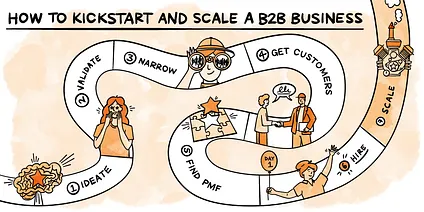 Welcome to part six of our ongoing series on how to kickstart and scale a B2B business. Here’s where we’re at: - **Part 1:** [How to come up with a great B2B startup idea](https://www.lennysnewsletter.com/p/how-the-most-successful-b2b-startups) - **Part 2:** [How to validate your idea](https://www.lennysnewsletter.com/p/how-to-validate-your-b2b-startup) - **Part 3:** [How to identify your ICP](https://www.lennysnewsletter.com/p/how-to-identify-your-ideal-customer) - **Part 4**: [How to find and win your first 10 customers](https://www.lennysnewsletter.com/p/how-to-win-your-first-10-b2b-customers) - **Part 5:** [A guide for finding product-market fit](https://www.lennysnewsletter.com/p/finding-product-market-fit) - **Part 6:** How, and when, to hire your early team *← This post* - **Part 7:** [How to scale your growth engine](https://www.lennysnewsletter.com/p/scaling-your-b2b-growth-engine) *A huge thank-you to **[Akshay Kothari](https://www.linkedin.com/in/akothari/)** (COO of Notion), **[Ali Ghodsi](https://www.linkedin.com/in/alighodsi/)** (CEO of Databricks), **[Andrew Ofstad](https://www.linkedin.com/in/aofstad/)** (co-founder of Airtable), **[Barry McCardel](https://www.linkedin.com/in/barrymccardel/)** (CEO of Hex), **[Boris Jabes](https://www.linkedin.com/in/borisjabes/)** (CEO of Census), **[Calvin French-Owen](https://www.linkedin.com/in/calvinfo/)** (co-founder of Segment), **[Cameron Adams](https://www.linkedin.com/in/themaninblue/)** (co-founder and CPO of Canva), **[Christina Cacioppo](https://www.linkedin.com/in/ccacioppo/)** (CEO of Vanta), **[David Hsu](https://www.linkedin.com/in/dvdhsu/)** (CEO of Retool), **[Eilon Reshef](https://www.linkedin.com/in/eilonreshef/)** (CPO of Gong), **[Eric Glyman](https://www.linkedin.com/in/eglyman/)** (CEO of Ramp), **[Guy Podjarny](https://www.linkedin.com/in/guypo/)** (CEO of Snyk), **[Jori Lallo](https://www.linkedin.com/in/jorilallo/)** (co-founder of Linear), **[Julianna Lamb](https://www.linkedin.com/in/juliannaelamb/)** and **[Reed McGinley-Stempel](https://www.linkedin.com/in/reed-mcginley-stempel-17362245/)** (co-founders of Stytch), **[Keenan Rice](https://www.linkedin.com/in/keenanrice/)** (founding team), **[Mathilde Collin](https://www.linkedin.com/in/mathilde-collin-bb59492a/en/)** (CEO of Front), **[Rick Song](https://www.linkedin.com/in/rick-song-25198b24/)** (CEO of Persona), **[Rujul Zaparde](https://www.linkedin.com/in/rujulz/)** and **[Lu Cheng](https://www.linkedin.com/in/lu-cheng-973b7830/)** (co-founders of Zip), **[Ryan Glasgow](https://www.linkedin.com/in/ryanglasgow/)** (CEO of Sprig), **[Shahed Khan](https://www.linkedin.com/in/shahedkhan/)** (co-founder of Loom), **[Shishir Mehrotra](https://www.linkedin.com/in/shishirmehrotra/)** (CEO of Coda), **[Sho Kuwamoto](https://www.linkedin.com/in/shokuwamoto/)** (VP of Product of Figma), **[Spenser Skates](https://www.linkedin.com/in/spenserskates/)** (co-founder and CEO of Amplitude), **[Tom Preston-Werner](https://www.linkedin.com/in/mojombo/)** (co-founder of GitHub), and **[Tomer London](https://www.linkedin.com/in/tomerlondon/)** (co-founder and CPO of Gusto) for contributing to this series. Art by [Natalie Harney](https://www.natalieharney.com/).* ---  For this step, I’ll focus on the four most common hiring questions I get from early-stage founders: 1. **Who should I hire first?** 2. **Where do I find them?** 3. **How do I convince them to join?** 4. **When should I hire a salesperson (and what should I look for)?** ## 1\. Who to hire I asked all the founders I interviewed who their first 10 hires were: 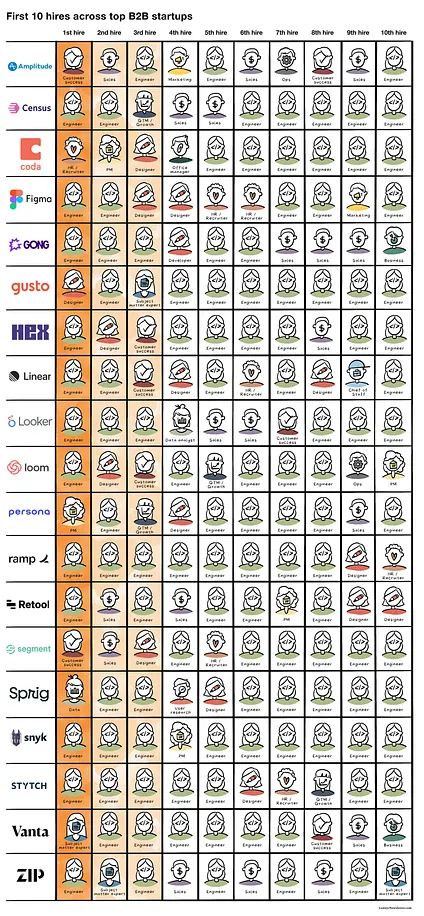 Let’s break this down by your first hire, first three hires, and first 10. ### Who to hire as employee #1 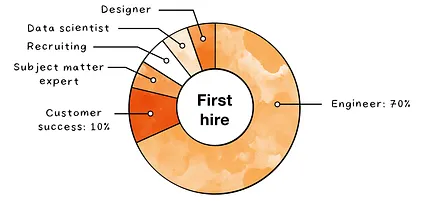 **Takeaway:** Developers, developers, developers, developers. Over two-thirds of the companies hired an engineer as employee #1. Not a big surprise.  In the rare case when an engineer wasn’t the first hire, it usually came down to the founding team having enough horsepower to build the V1. > “ **Having four founders who could stretch across the business helped a** ***lot*** **here.** Each of us could write code, handle customer success, write product specs, and work across the stack.” — [Calvin French-Owen](https://www.linkedin.com/in/calvinfo/), co-founder of Segment Founders were instead able to de-risk, or un-bottleneck, something else. **Vanta** hired a compliance subject-matter expert as their first employee: > “ **We could build, but we wanted the check on are we building the right thing**, given our background wasn’t in the space. The worst case would have been promising to get a company ‘secure and compliant’ and then failing to do so!” > > — [Christina Cacioppo](https://www.linkedin.com/in/ccacioppo/), co-founder and CEO of Vanta **Coda** hired a recruiter: > “I’d say that our first hires were all fairly typical, except for hiring a Head of Recruiting at such an early stage of development. It was earlier than anticipated, but a good friend introduced me to [Kenny Mendes](https://www.linkedin.com/in/kennymendes) and said, **‘I know it’s early, but people like Kenny don’t come along often, so you should probably pull him in.**’That turned out to be a fantastic choice, as Kenny has turned out to be an amazing generalist and quickly became chief operating officer for us.” — [Shishir Mehrotra](https://www.linkedin.com/in/shishirmehrotra/), co-founder and CEO **Sprig** hired an AI data scientist, and **Segment** and **Amplitude** hired a customer success/support person as employee #1. Here’s [Calvin French-Owen](https://www.linkedin.com/in/calvinfo/) (co-founder of Segment) on why they did this: > “ **There’s something really magical when you write in to a startup and they fix your issue within a few hours. It’s something you’d never, ever expect from a big company, and it was one way for us to differentiate.** > > So initially, the four of us basically round-robined support. We’d log in to Help Scout and answer as many emails as possible. We’d switch off whoever answered the handful of Olark live chats that would pop in throughout the day. By the middle of the year, we were getting slammed with fairly technical support requests from users. They’d run the gamut from the relatively easy ‘What analytics tool should I use?’ to the more technical ‘I’m running Python on App Engine; why aren’t my events making it to Segment?’ > > To give us extra engineering bandwidth, Peter \[Reinhardt, the CEO\] spent about eight weeks handling all the support volume on his own. But it basically meant he couldn’t do anything else. > > **We wanted to find someone who could handle most of these requests on their own and synthesize any new requests. Jake \[Peterson\] (who we hired for the role) was a bit of a unicorn in that respect. He had run his own analytics consultancy that was focused on helping customers reduce their costs and had a little bit of technical ability to read code. He wrote good docs and authored a bunch of our early blog content.** > > Given the breadth of integrations we supported, and the fact that we had four technical co-founders, we hired early here.” ### The first three hires 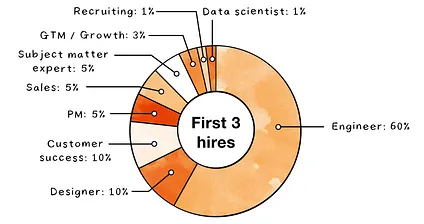 **Takeaways:** 1. Engineers continued to be the predominant function across the first three hires. Not shown in the chart, but **100% of companies hired at least one engineer among their first three hires**. 2. Interestingly, customer success/support continues to be a popular role for the first three hires. **Of the non-engineer hires, almost a quarter of them are customer success/support.** For me, this ties directly to the core lesson from part five— [get companies to love your product](https://www.lennysnewsletter.com/i/119122450/step-get-one-company-to-love-your-product). 3. **Subject-matter experts also continue to be a surprisingly common early hire**, particularly for startups building in a complex regulatory-oriented market (e.g. Gusto, Zip, and Vanta). 4. Although only 10% of hires were designers, and this isn’t shown in the pie chart above, **over 40% of companies hired a designer in their first three hires, or had a designer co-founder.** 5. **Very few companies hired a salesperson among the first three.** 6. **Three companies hired a PM within their first three hires**: Coda, Persona, and Snyk. Here’s [Guy Podjarny](https://www.linkedin.com/in/guypo/), founder and CEO of Snyk, on why they hired a PM so early: > “I believed the fact that security products weren’t fit for developers **was a product problem, not a tech problem**, needing breakthroughs more in the UX world than tech algorithms. Furthermore, I had two technical co-founders that I knew would lead the security and tech aspects well, so felt I’m well-covered there. > > **I could have done the product work myself (and in practice, I did a portion of it), but I wanted to free myself up to build the company as a whole, and not be too focused on one aspect of it. I did hire someone with deep UX skills, better than mine, who complemented me, not just offloaded work.** > > In general, I intentionally took the path of building a strong leadership team early on. It was always a very hands-on leadership team, who initially spent most of their time as ICs but were also building teams and practices. This is a personal choice, and many founders prefer to directly manage most of the team until it grows. For me, however, I perceive myself as a better leader and innovator than I am a manager, and I wanted to focus my attention there.” And here’s [Rick Song](https://www.linkedin.com/in/rick-song-25198b24/), founder and CEO of Persona, on hiring a PM as employee #1: > “We hired Vincent \[Tsao\] because Charles and I believed his professional experience and willingness to give it his all were a perfect fit. We would’ve wanted to work with him whether at Persona or elsewhere, and that speaks highly of our rapport. He had experience from a previous startup and understood the fluid nature of a company’s early stages—he wasn’t tied to a specific role, title, or set of responsibilities and understood that we were all going to do whatever it took to succeed. In fact, his very first project had nothing to do with product- he spent the first evening setting up payroll! > > **We also believe that many founders, in their eagerness to launch and iterate, often swing too far on the pendulum of no documentation or process. While Charles and I were confident in our product and market insights as well as our ability as engineers to create a MVP, we were also self-aware about our shortcomings.** We knew we needed someone with not only sharp product intuition but also someone who could anchor our product operations and knowledge base, synthesizing insights from chaos and ultimately helping us move faster. Vincent was invaluable in building the foundation that enabled us to smoothly go from MVP to product market fit, and eventually, to scaling our team.” ### The first 10 hires 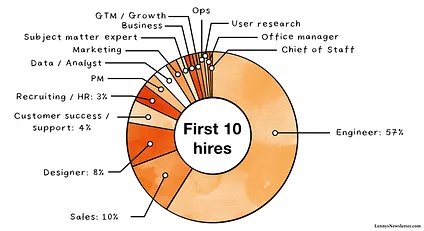 **Takeaways:** 1. **Sales becomes the second most common hire**, after engineering. 2. **A quarter of companies hired a product manager** at this point. 3. **Recruiters become a surprisingly common hire.** I did not expect that. This is particularly true across some of the most unique startups, like Linear, Figma, Ramp, and Coda. Here’s [Jori Lallo](https://www.linkedin.com/in/jorilallo/), co-founder of Linear, on why they hired a recruiter so early: > “Initially all of us three founders ran the recruiting process, and while it worked for a little while, it wasn’t something we were necessarily particularly good at or passionate about. **We cared about hiring the best people, not about the first person who came knocking at our door. Also, we didn’t really have the tools or the time to reach outside our own networks, so we needed help to expand outside the inbound applicant pool.** > > At first we experimented with a couple of external boutique recruiting agencies, but it didn’t feel natural. This was mainly due to a consulting recruitment model where incentives are often tied to closed hires, so the recruiters are incentivized to make the hires as fast as possible. This is good for growing the team fast but hard when you want to hire only the best talent. The best and most sought-after people are often hard and slow to hire, and the process looks more like leadership recruiting. > > So building the function in-house and investing into it made sense to us. We probably weren’t great at it at first but have since come a long way. Today we have a four-person recruiting function at a 50-person company.” ## 2\. Where to find your early employees Once you have a sense of which roles to hire, how (and where) do you find amazing people? I asked each founder how they found their early employees. Their answers all fell into four channels: #### Channel 1: Friends and former colleagues Unsurprisingly, hiring friends and former colleagues was by far the biggest channel. This also in part explains why multi-time founders, and anyone with a large network (e.g. Y Combinator), have an advantage: > “All of our early hires were friends/ex-coworkers.” > “First hires were practically all former colleagues. Several people who worked with me in my previous company reached out when they heard I was into something new, with my co-founder.” > “About half the early hires came from my personal network (friends from school, ex-coworkers, etc.).” > “I thought about the hardest-working people I knew and reached out to them.” But not so fast. There’s also a downside to this path, as shared by **Segment** and **Linear**: > “We tried for a long time to hire former classmates (we were fresh out of college, so had no former colleagues), but we had pretty rotten luck. **Believe it or not, there was little appetite to join four crazy guys in a room who had been failing for two years straight**:)” — [Calvin French-Owen](https://www.linkedin.com/in/calvinfo/), co-founder of Segment > “We didn’t end up hiring people from our past jobs, which might be more common for others. **All of us founders worked for more established startups before Linear, and we looked for people who would do well in an early-stage environment**. Among our first 10 hires were several founders (including two who had gone through YC). We still look for generalists and people with experience and who deeply care about their craft.” — [Jori Lallo](https://www.linkedin.com/in/jorilallo/), co-founder of Linear #### Channel 2: Cold outreach I was surprised to learn that the second most common channel for finding early employees is cold outreach—finding people you want to hire and reaching out to them directly. These outreaches happened mostly through LinkedIn and GitHub, and unlike channel #1, this is something anyone can do. > “We filled many roles through **cold hard outbound on LinkedIn**.” > “ **We reached out directly to people (mainly engineering) that had significant public experience** with parts of the product we were developing, i.e. visualizations.” > “ **We had great luck finding people off GitHub**. These were folks who had contributed to repos we were watching, and we had decent evidence that they were good. They didn’t come from FAANG, they had solid contributions in open-source land, they paid a lot of attention to abstractions and were really productive. Most of them had worked at one or two prior startups, but in general we bet on people looking to make their next big leap.” #### Channel 3: Job boards Also, surprisingly, a lot of early hires were found by posting roles on public job boards—again, something every founder can do. By far the most mentioned job board was AngelList. Also mentioned were Triplebyte, Facebook groups, and VCs’ internal job boards. Shoutout: If you’re looking for the best jobs in town, check out [Lenny’s Job Board](https://www.lennysjobs.com/)! 😅 #### Channel 4: Friends and former colleagues of your employees A final channel, which, if you recall, was also useful for [finding your early customers](https://www.lennysnewsletter.com/i/115245373/start-by-reaching-out-to-your-personal-network-looking-for-people-who-match-your-icp), was tapping the networks of your early employees. > “Many of our early hires were people from my network or the n **etwork of the very first employees.**” > “Our second sales hire was a **former colleague of our first salesperson.**” I didn’t get many interesting quotes for this channel, but it was a fruitful one for many founders, and worth spending time on. ## 3\. How to convince people to join your startup [I actually researched and covered this in a previous issue](https://www.lennysnewsletter.com/p/early-stage-hiring), so go read that post. Here’s the high-level summary of what you need to get right: 1. **Captivating vision** —Make it easy for candidates to visualize what you are building toward and to feel like their work will be meaningful. 2. **A++ early team** —The best talent attracts the best talent. 3. **Put in the time—** Be prepared to commit 50 to 100 hours for each hire you make. 4. **Grow your network** —It’ll be an easier sell if they know you (or know someone who knows you). 5. **Love bomb—** Go the extra mile when trying to close a candidate: > “We see the actual offer stage as a big place you can stand out. We do a Zoom to surprise the candidate with everyone from their interview panel to share why they’re excited about the candidate potentially joining.” > > — [Julianna Lamb](https://www.linkedin.com/in/juliannaelamb/), co-founder and CTO of Stytch ## 4\. When to hire a salesperson, and what to look for #### Always start with founder-led sales Every founder I spoke to started with founder-led sales—doing the sales themselves until they reached a certain milestone. [David Hsu](https://www.linkedin.com/in/dvdhsu/) (founder and CEO of **Retool**) shared why he found this so valuable: -
identify-ideal-customer.md 15.3 KB
### Part three of my seven-part series on kickstarting and scaling a B2B business *👋 Hey, I’m Lenny and welcome to a **🔒 subscriber-only edition 🔒** of my weekly newsletter. Each week I tackle reader questions about building product, driving growth, and accelerating your career.* --- 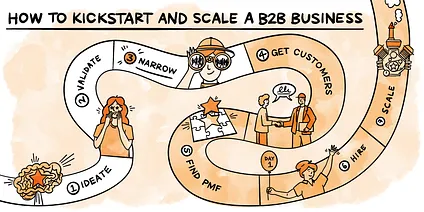 Welcome to part three of our series on how to kickstart and scale a B2B business: - **Part 1:** [How to come up with a great B2B startup idea](https://www.lennysnewsletter.com/p/how-the-most-successful-b2b-startups) - **Part 2:** [How to validate your idea](https://open.substack.com/pub/lenny/p/how-to-validate-your-b2b-startup?utm_campaign=post&utm_medium=web) - **Part 3:** How to identify your ICP *← This post* - **Part 4:** [How to find and win your first 10 customers](https://www.lennysnewsletter.com/p/how-to-win-your-first-10-b2b-customers) - **Part 5:** [How to find product-market fit](https://www.lennysnewsletter.com/p/finding-product-market-fit) - **Part 6:** [How, and when, to hire your early team](https://www.lennysnewsletter.com/p/hiring-your-early-team-b2b) - **Part 7:** [How to scale your growth engine](https://www.lennysnewsletter.com/p/scaling-your-b2b-growth-engine) Let’s jump right in. *A huge thank-you to **[Akshay Kothari](https://www.linkedin.com/in/akothari/)** (COO of Notion), **[Ali Ghodsi](https://www.linkedin.com/in/alighodsi/)** (CEO of Databricks), **[Barry McCardel](https://www.linkedin.com/in/barrymccardel/)** (CEO of Hex), **[Boris Jabes](https://www.linkedin.com/in/borisjabes/)** (CEO of Census), **[Calvin French-Owen](https://www.linkedin.com/in/calvinfo/)** (co-founder of Segment), **[Cameron Adams](https://www.linkedin.com/in/themaninblue/)** (co-founder and CPO of Canva), **[Christina Cacioppo](https://www.linkedin.com/in/ccacioppo/)** (CEO of Vanta), **[David Hsu](https://www.linkedin.com/in/dvdhsu/)** (CEO of Retool), **[Eilon Reshef](https://www.linkedin.com/in/eilonreshef/)** (CPO of Gong), **[Eric Glyman](https://www.linkedin.com/in/eglyman/)** (CEO of Ramp), **[Guy Podjarny](https://www.linkedin.com/in/guypo/)** (CEO of Snyk), **[Jori Lallo](https://www.linkedin.com/in/jorilallo/)** (co-founder of Linear), **[Julianna Lamb](https://www.linkedin.com/in/juliannaelamb/)** and **[Reed McGinley-Stempel](https://www.linkedin.com/in/reed-mcginley-stempel-17362245/)** (co-founders of Stytch), **[Keenan Rice](https://www.linkedin.com/in/keenanrice/)** (founding team), **[Mathilde Collin](https://www.linkedin.com/in/mathilde-collin-bb59492a/en/)** (CEO of Front), **[Rick Song](https://www.linkedin.com/in/rick-song-25198b24/)** (CEO of Persona), **[Rujul Zaparde](https://www.linkedin.com/in/rujulz/)** and **[Lu Cheng](https://www.linkedin.com/in/lu-cheng-973b7830/)** (co-founders of Zip), **[Ryan Glasgow](https://www.linkedin.com/in/ryanglasgow/)** (CEO of Sprig), **[Shahed Khan](https://www.linkedin.com/in/shahedkhan/)** (co-founder of Loom), **[Shishir Mehrotra](https://www.linkedin.com/in/shishirmehrotra/)** (CEO of Coda), **[Sho Kuwamoto](https://www.linkedin.com/in/shokuwamoto/)** (VP of Product of Figma), **[Spenser Skates](https://www.linkedin.com/in/spenserskates/)** (co-founder and CEO of Amplitude), and **[Tomer London](https://www.linkedin.com/in/tomerlondon/)** (co-founder and CPO of Gusto) for contributing to this series. Art by [Natalie Harney](https://www.natalieharney.com/).* ---  We’ve so far spent all of our time finding and validating a problem, but surprisingly, many (perhaps most?) of the B2B companies I researched spent just as much time on picking the problem as they did on figuring out *who* to solve the problem for. When they didn’t do this, they often regretted it. If you’ve got a killer idea but you’re talking to the wrong people, you’ll come away thinking your idea stinks, and give up. But the same idea pitched to different people can change everything. Below, I’ll share a guide for nailing your ideal customer profile (ICP), dozens of stories of how founders identified their ICP, and as always, templates and tons of examples. ### A few of my biggest takeaways and surprises from this step 1. Most founders initially got their ICP wrong. 2. Everyone landed on at least *three* attributes to describe their ICP. 3. Data from *outbound sales* is the best signal for what’s working, versus leads from investors and friends. 4. There are four common signs that you’re getting closer to your ICP: 1. A significant increase in your conversion rate 2. A significant increase in enthusiasm 3. A much stronger desire to take action now 4. The nod (see below) ### Initial ICPs for some of today’s biggest B2B companies Through my interviews, I’ve gathered the initial ICPs of over a dozen startups. In the chart, and in the stories below, notice how most companies landed on exactly three attributes. Some had more, but no one had fewer. Also notice how specific these attributes get. 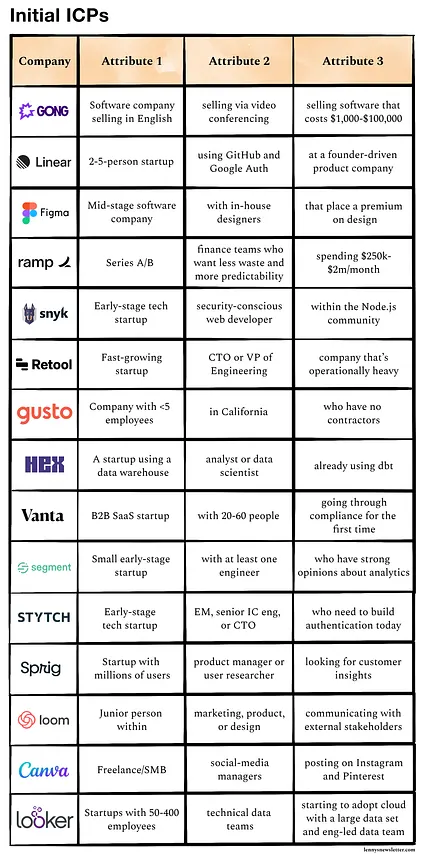 ## How to identify your ICP To identify your own ICP, go through the list below and take your best guess at picking the three most *unique* and *important* characteristics of your potential ideal customer ([here’s a template to get you started](https://docs.google.com/spreadsheets/d/1DAajOv4KKm_cVMFgA694sP7mfFvieAPasWZVK_9TOcg/edit#gid=0)): 1. Company size (e.g. 1,000-5,000 employees) 2. Job title (e.g. engineering manager, social media manager) 3. Pain point you’re solving (e.g. compliance, internal transparency) 4. Company’s unique way of working (e.g. design-driven, operationally heavy) 5. Specific tech used (e.g. data warehouse, GitLab) 6. Type of business (e.g. B2B SaaS, e-commerce) 7. Price point (e.g. sells software that’s $10k ARR) 8. Geo (e.g. urban centers, LatAm) 9. A unique place the user spends time (e.g. Node.js community) #### Try to get super-specific and super-narrow with your ICP. Almost comically narrow. **Gusto** found the most success with *six* ICP attributes initially: > “We started really, really, really, really, really, really, really narrow. Here’s how narrow: > > 1. Only companies that are five or fewer employees > 2. in California > 3. that offer no benefits > 4. that have only salaried employees and no contractors > 5. that have any other deductions > 6. and that agree to get paid eight days after they run payroll > > That ended up being a specific set of companies. The reason they chose us, and why we went after them, is because of the value that we provided. > > Slowly, we expanded to where we felt ready. Let’s begin to serve hourly employees. Okay, now let’s help businesses provide benefits. Okay, now let’s move to additional states. We knew we were ready to expand when we felt like, one, we were getting customer love and, two, we had sufficient engineering bandwidth to go and build the features and products without letting go of the previous customer audience. > > Today Gusto handles the bulk of what HR teams do, as well as some work of finance teams—payroll, insurance, benefits, onboarding, performance reviews, state registrations, tax credits, and more—for over 300,000 businesses with 1 to 500 employees in the U.S. and in 120 other countries. We’re 11 years in, but I still feel we are just getting started.” > > — [Tomer London](https://www.linkedin.com/in/tomerlondon/), co-founder and CPO The founders of **Gong** landed on three highly nuanced attributes: > “We tried to narrow it down as much as possible. We said we’re only going to sell to software companies that are: > > 1. Selling in the U.S. in English, so we could start with just one language. > 2. Selling via video conferencing (it was Webex at the time), so we had the most amount of data to analyze. > 3. Selling software that is worth somewhere between $1,000 to $100,000, because beyond $100k, we assumed it was going to be a different sales cycle, and less than $1,000, it would be too transactional. > > There are probably 5,000 companies with this profile in the world. And exactly like the book *Crossing the Chasm* suggests, we thought, let’s get this small group working and get them excited. They would be the early adopters. We knew that we would understand their pain, and they’re typically advanced, so they would be early adopters. > > And then of course, over time, we went wider, adding phone calls versus video conferencing, and then different company categories and geographies.” > > — [Eilon Reshef](https://www.linkedin.com/in/eilonreshef/?originalSubdomain=il), co-founder and CPO As did **Snyk**: > “Our initial target audience was a developer building with Node.js who was very security-conscious. > > This depth-first approach was really important to validate the solution on the path to product-market fit. A JavaScript developer won’t care if you support Golang or Rust. Nailing the narrow and deep use case before expanding wider was critical. > > The initial problem Snyk set out to solve was specific too: tracking and securing dependencies in the Node ecosystem. The community there would often discuss the inadequacies of the NPM dependency management capabilities. At the time, Node.js was gaining traction with increasing adoption in the enterprise, dedicated conferences, and the like, but it was still small enough that Snyk could meaningfully influence things. [Here’s actually the first public showing of Snyk](http://Yep, developers - but much more specific. The focus at the very beginning was on the community of) at Velocity Amsterdam in late 2015.” > > — [Ben Williams](https://www.linkedin.com/in/semanticben/), former VP of Product And **Looker**: > “Looker was a technical product, created right at the very start of data moving to the cloud and large, event style data being treated as business critical for analysis. So in 2013-2015, our core ICP was technical data teams—not end users or business analysts—who were starting to adopt cloud with large data sizes and complex analytical requirements AND the need to support a larger base on less technical end users within all functions of the company. These data teams tended to look at themselves more as engineering vs analysts, which aligned very well to our engineering first product design (code LookML, github built in, and all aspects of the product accessible via APIs). The companies tended to be startups with around 50-400 employees, with either engineering leading data or the data team being very technical.” > > — [Keenan Rice](https://www.linkedin.com/in/keenanrice/), founding team #### Don’t stress if you can’t figure out your ICP for a while. Here’s [Ali Ghodsi](https://www.linkedin.com/in/alighodsi/), co-founder and CEO of **Databricks (**which is now worth over $30B) on their complete lack of an ICP early on: > “We didn’t have an ICP at all. In those years at Berkeley, we just wanted to change the world, honestly. We just wanted to have impact. That was the most important thing. We worked with all kinds of different companies. We worked with a hospital that was using this stuff, and they were doing genomic stuff. We worked with folks that were using us to determine earthquake magnitudes using Twitter. These are completely different customers and different user profiles. So, no, we didn’t have an ideal customer profile. We were just trying out whoever wanted to use it.” And [Rick Song](https://www.linkedin.com/in/rick-song-25198b24/), co-founder and CEO of Persona: > “We did the ICP exercise 17 times in the early days. So many times. Because at that time, all of the advice we ever got was like, ‘Know your ICP.’ So we kept trying to know who it was, and I also desperately did not want our ICP to just be startups. So we tried a lot. I think in earnest we never really had one, but we tried for sure.” #### But the sooner you figure out your ICP, the faster things will fall into place. > “I didn’t think about ICPs whatsoever. However, looking back, that’s part of the reason PMF took so much time.” — [Boris Jabes](https://www.linkedin.com/in/borisjabes/), co-founder and CEO of Census > “We did not think about ICP. I wish we did earlier on. It’s one of my biggest mistakes.” — [Mathilde Collin](https://www.linkedin.com/in/mathilde-collin-bb59492a/en/), co-founder and CEO of Front #### Eventually, you’ll be forced to figure it out. > “We didn’t focus on ICP at all, but once we did our public launch, we started getting a flood of different people coming in. Filtering through the leads spurred me into putting a much tighter definition around qualification for deals.” — [Barry McCardel](https://www.linkedin.com/in/barrymccardel/), co-founder and CEO of Hex #### Start by paying attention to who gets most excited about what you’re building. For **Canva**, here’s [Cameron Adams](https://www.linkedin.com/in/themaninblue/?originalSubdomain=au), co-founder and CPO, sharing their path to identifying an ICP: > “We didn’t have any target persona until about six months into building the product. **Through the conversations that we had with people, we began to see a certain segment really get excited about it. These social media managers, these people who were (a) figuring out what social media actually was, and then (b) having to scale this work across multiple clients and customers.** > > In 2012, Instagram had only really started. Pinterest had just come out. This whole notion of visual social media was still emerging. And Canva was, I think, the perfect tool at the right time for people who were grappling with what visual social media was. **The social media manager/blogger audience was definitely the perfect one for us to start building a community around—especially freelancers, who were building their own social media management business.** We gave them early demos of the product and then helped shape the feature set through their feedback. They were probably the ideal launch customer.” For **Sprig**,[Ryan Glasgow](https://www.linkedin.com/in/ryanglasgow/), founder and CEO, on narrowing in on their unusual initial segment: > “We found pretty early that our ICP was companies with millions of users. Being an early-stage startup selling to larger companies was actually one of our biggest early challenges. You have product-market fit for companies that are more difficult to sell to. > > Our first customer, Thunkable, had millions of users. Square and Robinhood—also two of our early customers—had millions of users. I was getting very strong pull with companies like these. **The larger the user base, the more excited they were about Sprig.** **Robinhood agreed to a large contract even though we were early. They’re like, ‘We love it. We’ll install tomorrow.’** They installed it as we were building the first version, basically. So that told us to go after these larger companies, with millions of users.” -
positioning.md 26.9 KB
### By April Dunford *👋 Hello, I’m [Lenny](https://twitter.com/lennysan) and welcome to a ✨ **once-a-month free edition** ✨ of my newsletter. Each week I humbly tackle reader questions about product, growth, working with humans, and anything else that’s stressing you out at the office.* *If you’re not a paid subscriber, here’s what you missed this month:* 1. *[15 ways to increase your team’s velocity](https://www.lennyrachitsky.com/p/increasing-velocity-issue-61)* 2. *[The most important consumer subscription metrics to track](https://www.lennyrachitsky.com/p/the-most-important-consumer-subscription)* 3. *[Should you become a product manager?](https://www.lennysnewsletter.com/p/become-a-product-manager)* --- > ## Q: I keep hearing that I need to improve my product’s positioning, but I’m not sure what that means and how to do this. Where do I start? When I think positioning, I immediately think of one person: [April Dunford](https://twitter.com/aprildunford). April is the author of the best-selling book *[Obviously Awesome](https://www.amazon.com/Obviously-Awesome-Product-Positioning-Customers/dp/1999023005/)*, which to me is the definitive book on positioning, and spends her days working with companies of all shapes and sizes helping them nail their positioning. When I received this question, I cold-DM’d April to see if she’d be interested in tackling it, and thankfully she agreed 🎉 Below, you’ll find what I believe is the most succinct and practical guide to nailing your product’s positioning. Let’s dive in! *For more from April, check out her [Twitter](https://twitter.com/aprildunford), [website](https://www.aprildunford.com/), and [book](https://www.amazon.com/Obviously-Awesome-Product-Positioning-Customers/dp/1999023005/ref=tmm_pap_swatch_0?_encoding=UTF8&qid=&sr=).* --- ## A quickstart guide to positioning by [April Dunford](https://twitter.com/aprildunford)  My first job out of school 20 years ago was as a product marketer at a startup. I was assigned to work on a product that had been conceived as a “Microsoft Access killer” that supported SQL and could run on people’s desktops. Back then, SQL databases only ran on big servers. But after a significant marketing effort, we had barely sold 200 copies. We knew it was time to wind it down, but before we did, we decided to check in with buyers to see how upset they would be when we did. Being the new gal, I got the job to make the calls. The first 20 conversations I had were exactly the same: > ***Me:** Hi, I’m calling to find out how you’re using our product.* > > ***Customer:** Sorry, lady, we don’t have that.* > > ***Me:** Um, well, my records show you paid $100 for it on Jan 22nd?* > > ***Customer:** Oh,* that *thing—yeah, we tried it, we don’t use it now.* Our decision to kill the product was going to be easy. But then I did call 21. “Your product made me the hero of the sales team!” the customer shouted. At his company, sales folks traveled to their customer, took orders on paper, and then returned to the office to enter them in the order system. Orders were often incomplete or full of errors. Our product was installed on laptops with the order system, allowing sales to take orders in the field and then sync with the SQL database back in the office. “We’re doubling sales! That SQL feature was a game changer for us!” he raved. I thanked him and carried on with my calls. I had 20 more conversations with 20 more customers who barely remembered purchasing before I hit another fan of the product. His story was similar—he used our product on mobile devices for field service agents who could update their system in the field, then sync with the database at headquarters. “We’ve increased service capacity by 60%. Your product is a game changer!” he said. In the end, I talked to 100 customers: 94 didn’t even know they had it, 6 had transformed their business with it. We didn’t exactly have product-market fit [in the Sean Ellis sense](https://pmfsurvey.com/). I relayed my findings back to the exec team. Instead of killing the product straight away, they decided to take a shot at repositioning our “Microsoft Access killer” as an “ **embeddable database for mobile devices**.” The product took off. A year of massive growth later, we were acquired by a big database company, where the product spawned a product family that generated hundreds of millions in revenue. Over 20 years later, this “failed” product [still runs](https://www.sap.com/products/sql-anywhere.html) on mobile devices all over the world. ### Positioning isn’t new—but it’s deeply misunderstood This experience sparked my lifelong obsession with positioning. How could we have known in advance that our product was simply mispositioned? Was there a way for us to figure out what really set our product apart, what our value for customers really was, and what customers we should be targeting? Positioning is not as well understood as you might think. If I put a dozen senior marketers in a room together and asked them to define positioning, I’d get a dozen different answers. When I talk about positioning at conferences, I sometimes start by defining what positioning is *not*: Positioning is not equivalent to messaging. It isn’t a tagline. It’s not your [brand story](https://www.aprildunford.com/post/storytelling-vs-positioning), nor is it your vision or your “why.” It is not, as one CEO attempted to convince me, “everything you marketers cook up over there.” So what is it, and, more importantly, how do we *do* it? ### Defining positioning Here’s how I define positioning: > **“Positioning defines how your product is a leader at delivering something that a well-defined set of customers cares a lot about.”** Yeah, that sounds a bit complex, but positioning is made up of a distinct set of components. Those components and their relationship to each other is where the magic happens. We will get to that in a minute. ### Positioning as context setting Positioning is like [context setting](https://www.aprildunford.com/post/how-to-transform-your-product-by-giving-it-context) for products. It’s a bit like the opening scene of a movie. The opening scene gets us oriented. It answers the big questions: Where are we? What year is this? What’s happening? How should I feel? Who are these people? Once we have established some context, we can settle in and pay attention to the story’s finer details. Let’s take the opening scene of *Apocalypse Now*. We see a grove of peaceful palm trees swaying the breeze and maybe you’re thinking, “Hey, maybe it’s not apocalypse right now,” but then you notice some smoke and a helicopter quickly flies past. Suddenly the palm trees burst into flames as Jim Morrison screams, “This is the end, my friend!”  We realize we are in the middle of the Vietnam War and it’s the apocalypse right now alright. Then slowly, the scene shifts and we see Martin Sheen’s face. He’s drinking and smoking, his hotel room is a total mess, and he’s clearly in psychological distress. He walks over to the window and we get the first line of dialogue in the movie: “Saigon. Shit. I’m still only in Saigon. Every time I think I’m gonna wake up back in the jungle.” We are exactly 4 minutes and 45 seconds into the movie, but we know a lot about what’s happening. We are in the middle of the Vietnam War, and in Saigon specifically. Our lead character has been there before and has some pretty bad PTSD as a result. We also get the tone of the movie and we know it’s going to be an intense couple of hours. The opening scene positions the movie by answering our big questions about who, what, where, and why so that we can settle in and focus on the details of the story within that context. **Similarly, positioning your product in a market orients the customers and conveys a lot of valuable information.** Your positioning context sets off a really powerful set of assumptions about who your product competes with, what features your product should have, who the product is intended for, and even things like what the product should cost. Suppose I pitch you my product, and all I tell you is that it’s a “CRM” and that’s it. What assumptions would you make about my product before I got to page two of my pitch? You would assume my competition is Salesforce—they are the leader in that market. You would assume I sell to the head of sales. You would assume my product has a set of features—tracking deals and accounts, for example. You would even make pricing assumptions. Salesforce is the leader in the market, so you would assume my product costs less than that. > #### Good positioning sets off a set of assumptions about my product that are true. Bad positioning sets off a set of assumptions about my product that aren’t true—leaving your sales and marketing teams to do the work of undoing the damage your positioning has already done. If I were to tell you my product was “email,” you would have a very different set of assumptions than if I positioned it as “chat.” There is a large overlap in features between the two, but as buyers, we expect email to filter spam, allow us to organize and store conversations, and integrate with a calendar. Our expectations for chat are different. We expect instant delivery, a way to see if someone has received or viewed our message, etc. A new product could be positioned in either market, but great chat is lousy email and vice versa. **A shift in positioning can completely transform how we perceive a product and can mean the difference between success and failure.** ### A positioning statement can’t help you So if positioning is so important, how do we do it? Let’s start with what not to do. For many people, positioning was taught to them in school using the “positioning statement.” It’s a sort of Mad Libs fill-in-the-blanks exercise. The blanks are things like market category, value, competitors, etc. Typically it looks something like this: 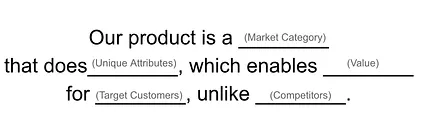 **I believe this exercise is not only pointless but potentially dangerous**. The exercise assumes that there is only one answer for each of the blanks and you simply “know” what it is. However, most products could easily be positioned in multiple different market categories, with different competitors, providing a different value for different kinds of customers. How would this exercise help me understand that my “Microsoft Access killer” was really an “embeddable database for mobile devices?” The answer is that it would not. ### The 5 components of positioning So how do we find the best positioning for our offerings? This question vexed me as a marketing executive across seven successful startups (and the six big companies that acquired them). I read books! I took courses! Everyone agreed that positioning was the marketing bedrock we built our entire go-to-market strategy around, and yet there didn’t seem to be a methodology for actually getting it done. I decided to figure it out. I started with an engineering mindset. I decided we could break positioning up into its component pieces, find the best answer for each piece, bring the pieces back together, and voilà—great positioning. Breaking positioning up isn’t hard, because we generally agree on the components. These are, in essence, the blanks in the positioning statement. The components are: > 1. **Competitive alternatives** > 2. **Differentiated “features” or “capabilities”** > 3. **Value for customers** > 4. **Target customer segmentation** > 5. **Market category** Easy. Now all we have to do is figure out how to get the best answer for each component. Here’s where things get a little tricky. ### Each component depends on the others If you look at the pieces, you quickly understand that each component has a relationship with the others. For example, the unique value that you can provide to customers is completely dependent on your differentiated features. Your differentiated features are only “differentiated” when you compare them to competitive alternatives. Your best-fit target customers are customers who really care a lot about your unique value. And lastly, your best market category is the context you position your product in such that your unique value is obvious to your target customers. So if every piece has a relationship to every other piece, where do we start? For two years, I didn’t think there was a starting point. I attempted to find the best positioning for my products by picking an arbitrary starting point (for example, differentiated features) and then working my way through the others to get a “candidate positioning.” I would then test it on prospects, and if it worked, we ran with it. If it didn’t, I tossed it out and repeated the process to get another candidate to test. The drawback to this method are obvious to anyone who’s worked at a startup: it just took too long! While I was out testing candidate after candidate, the sales, marketing, and product teams were stuck in a holding pattern waiting. ### A customer-centric methodology Eventually, Clayton Christensen solved this problem for me. I was reading everything I could get my hands on about the Jobs to Be Done theory, and I had the realization that the starting point had to be competitive alternatives. If it wasn’t, what we ended up with was positioning that sounded good in the office but didn’t work with customers because it wasn’t differentiated. The flow has to look like this: 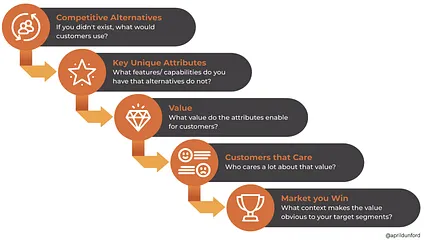 We start with **competitive alternatives**, or what customers would do if our solution didn’t exist. Once we have that, we can ask ourselves, “What do we have that the alternatives do not?” That gives us a list of differentiated features or **key unique attributes**. We can then go down that list and ask ourselves, “ *So what* for customers?” Put another way, what is the **value** those capabilities enable for our buyers? Once we understand what our differentiated value is, then we can move to customer segmentation, or who the **customers who care** a lot about our value are. There is likely a wide range of buyers who care about that value, but certain customers care a lot more than others. What are the characteristics of a customer that makes them care a lot about your differentiated value? That gives us an idea of who our best-fit customers are. Lastly, we move to market category. Our best market category is the context we position our product in such that our value is obvious to our target customers. Put another way, it is the definition of the **market we intend to win**. **An example: Janna Systems** Let’s walk through an example of how this works. Early in my career, I ran marketing for a company that positioned its product as an enterprise CRM. This was ages ago when Salesforce was still focused on SMBs, and the gorilla in the enterprise CRM market at the time was Siebel Systems. Unsurprisingly, every time we got a meeting with a customer we got the question, “So how are you better than Siebel?” That was a bad question for us because, by almost every measure, they were better than we were. They had 8,000 employees and we had a couple dozen. They had $2 billion in revenue; we did less than $2 million. They had 400 customers and we had 6. We did, however, have two differentiators. The first was a feature that they couldn’t match. Specifically, we could model relationships in a different way. Most CRMs model the relationship between people and an organization. Our CRM let you model relationships between people, independent of their organization. An example would be that we could show that two people sat on a board together even though they work for separate companies. No CRM then (or even today, for that matter) could do that. The problem was that, for the most part, we didn’t do a good job of articulating the value of that. We showed the feature in every demo, and when customers asked us what they would do with that feature, our reply was “Anything you want!” Coming back to the process I laid out in the previous section—our competitor was obvious; it was Siebel. Our differentiator was the ability to model relationships in a different way. What we hadn’t figured out was what the value of that feature was and what types of customers cared a lot about it. Eventually, we landed a deal with an investment bank. Working with that customer helped us understand that the value of our feature was that companies could get insight into interpersonal relationships, which sales teams could use to start new sales conversations and understand who might have influence over a deal in process. For companies that relied heavily on personal relationships (e.g. investment banking, private client services), our product was a game changer. Going back to the positioning process, we could now fill in **value** and **customers who care**. This was super-important for our go-to-market strategy. We shifted our sales and marketing efforts to selling to investment banks, where we had a distinct advantage over Siebel. Lastly, we decided to make a change to the market category. Clearly, we couldn’t win Enterprise CRM, but we could win CRM for Investment Banks. Positioning ourselves that way helped banks find us and helped us clearly differentiate from Siebel. This shift in positioning allowed us to grow very quickly over the next 18 months, from under $2M to close to $80M. Our plan was to shift the positioning to CRM for Financial Services as we expanded to retail banks and insurance companies. We didn’t get the chance to test that positioning evolution, however—Siebel acquired us for $1.3B. ### Common mistakes Once you understand the flow conceptually, it’s pretty easy. But that doesn’t mean there aren’t a lot of ways you can mess this process up. Here are the three most common traps: **Trap 1: Defining competitive alternatives as any possible competitor** The most common mistake I see startups make is in how they define the competitive alternatives in the first step. A better way to think about competitive alternatives is to ask yourself, “What would a customer do if your offering didn’t exist?” Sometimes the answer to that question is “Do nothing.” What that really means is the customer would stick with their current way of solving the problem. That could mean using a spreadsheet, using a manual process, or hiring an intern to do it. In enterprise software, we typically lose 25% of deals to “no decision.” Your positioning needs to position you against the status quo if you want to convince customers to act. **Trap 2: Creating “phantom competitors”** Next, I see companies listing what I would call “phantom competitors” in step 1. [Phantom competitors](https://twitter.com/aprildunford/status/1334143529573081089?s=20) are companies that theoretically could compete with you; you just never actually see them or lose to them in deals. Until you do, you are watering down your positioning by trying to position against them. Step 1 in the positioning process is to identify what your customers see as alternatives. This isn’t a test of your internet research skills, and just because a company could compete with you doesn’t mean they ever will. The product team might want to keep an eye on them as a future competitive threat, and if you do start to see them in deals, you can adjust your positioning at that time. Until then, you will weaken your positioning by trying to position against competitors your customers never even consider. **Trap 3: Assuming that you have to create a new market category to grow** When selecting a market category, you can either choose to position your product in an existing market category or attempt to create a new category in customers’ minds and then position your product as the leader in it. The first option allows you to use what customers already know and understand about a market to help them understand what your product is and what makes it uniquely special. If I tell you my product is an “embeddable database for mobile devices,” you have the benefit of understanding what a database is. “Embeddable” and “for mobile devices” narrows down the field of alternatives to a market niche where this product is not only different from the leaders in the more generic “database” market category, but much better for a particular kind of buyer. Creating a new market category, on the other hand, is where you invent a new frame of reference for customers. The obvious downside to this strategy is that you first have to make the category mean something in the customer’s mind before it can serve as a meaningful context. So instead of being an “embeddable database for mobile devices,” you choose to be a fluflommer. Yep, a fluflommer. Customers have no idea what that is because you’ve just invented it, so be prepared to spend a significant amount of time and effort making that term mean what you want it to mean. There is an assumption that the payoff for creating a new market category is that you will dominate the market as it grows. [In my book](https://www.amazon.com/Obviously-Awesome-Product-Positioning-Customers/dp/1999023005/), I tell the story of Eloqua and how founder Mark Organ created the Marketing Automation category and did exactly that. > #### Unfortunately, history teaches us that companies that create market categories often lose in the long run to companies that gained a market foothold after the hard work of creating the category was already done. This is why we use Google and not Ask Jeeves. This is why we use Facebook and not Myspace. In fact, 90% of tech companies that have gone public over the past five years have been positioned in existing markets rather than creating new ones. Many of the examples of category creators started out positioning themselves in existing markets before they later stretched the boundaries of that category. Salesforce was a niche play in the CRM space until it had hundreds of millions of revenue. Gainsight was in the survey software market until it had hundreds of millions of revenue. It’s much more common for startups to start out positioning themselves in an existing category until they have the money and momentum required to re-draw the lines around that category. ### Positioning—you’ve got this! Positioning is a misunderstood concept, but I believe that if you master it, it can be the most powerful strategic tool you have at your disposal. If you are interested in learning more, I go deeper on this topic in my [book](https://www.amazon.com/Obviously-Awesome-Product-Positioning-Customers/dp/1999023005/), and I’ve got a set of [templates](https://www.aprildunford.com/obviously-awesome) to go with it that you might find helpful. --- ## 🔥 Job opening of the week: Airtable > **✨ Airtable is hiring for a [Full-Stack Engineer](https://grnh.se/0725e0b52us) and an [Engineering Manager](https://grnh.se/402aac172us)** ✨ **Additional opportunities:** 1. **Product**: [Cerebral](https://boards.greenhouse.io/cerebral/jobs/4313154003), [Kudo](https://kudo.bamboohr.com/jobs/view.php?id=32), [Plume](https://www.linkedin.com/jobs/view/2344670919/?refId=1558494581609287620959&trackingId=YHvRTxoetClV7013SkxEAQ%3D%3D), [Prenda](https://apply.workable.com/prenda/j/63270A44BB/), [Rocketplace](https://jobs.ashbyhq.com/Rocketplace/11bc424f-e80f-4bab-aa96-517c01a6d511), [UserLeap](https://boards.greenhouse.io/userleap/jobs/4279026003) 2. **Growth**: [Alloy](https://apply.workable.com/alloy-automation/j/A0909506B0/), [BasisOne](https://www.basisone.com/careers/growth-strategy-lead), [Prenda](https://apply.workable.com/prenda/j/AC98C5FDFB/), [SpaceX Starlink](https://boards.greenhouse.io/spacex/jobs/5032353002?gh_jid=5032353002&gh_src=seekorswimcom) 3. **Design**: [Ashby](https://jobs.ashbyhq.com/ashby/145ff46b-1441-4773-bcd3-c8c90baa598a), [Berbix](https://jobs.lever.co/berbix/ba8af3cd-d797-492b-9849-13b37df0f6b2), [Office Hours](https://jobs.lever.co/office-hours/13d73541-b5b7-405a-9ad8-1d3f0edf9c92), [Levels](https://www.notion.so/levelshealth/Join-Levels-Remote-Lead-Designer-14ceaa685100486b824665e1320fc9af), [Primer](https://www.notion.so/Designer-San-Francisco-CA-327a70b082714933aef3c58ef63b54ab), [Runway](https://www.notion.so/A-Product-Designer-baa24543701f472bb291d4429812064a), [Watershed](https://www.notion.so/Designer-Watershed-7cb7bf8bd750432399d36e83e4e32391) 4. **Engineering manager**: [Cerebral](https://boards.greenhouse.io/cerebral/jobs/4076598003) 5. **Frontend engineer**: [Levels](https://www.notion.so/levelshealth/Join-Levels-Remote-Developer-58454f0db7e3466692f7b75db6237ddf), [Practice](https://www.notion.so/Front-end-Developer-929e1933b9b4432a851043adbb7bff04), [Tome](https://www.linkedin.com/jobs/view/2323962506/) 6. **Backend engineer**: [Driveway](https://www.notion.so/Driveway-Senior-Engineer-758d5ce4ce764f9ea920c5728ee136f3), [Pogo](https://www.notion.so/Senior-Software-Engineer-Backend-6d954206f00b446289f18bf51960ca34), [Transform](https://transformdata.io/careers/) 7. **Fullstack engineer**: [Alloy](https://apply.workable.com/alloy-automation/j/27639ECE80/), [Cascade](https://www.cascade.io/jobs/full-stack-product-engineer), [Centered](https://www.notion.so/Software-Developer-e7cad269968e4d5aaeb1f6da9e282626), [Icebreaker](https://icebreaker.video/product-engineer), [Iggy](https://www.notion.so/askiggy/Full-Stack-Engineer-IggyAPI-5a8c1825028e421b9587538718f370b4), [Primer](https://www.notion.so/Senior-Software-Engineer-Full-stack-web-San-Francisco-CA-3a0af35008104def82836a5b9a5a88e1), [Runway](https://www.notion.so/A-Product-first-Full-stack-Engineer-5e056689b68048aeb1ccfea6ac73eb9e), [Snackpas](https://jobs.lever.co/snackpass/7c3bb72b-70d3-45ca-9dea-eea57ed5333d) s, [Stytch](https://jobs.lever.co/stytch/00c92a1b-36c2-46f6-8af1-885a6bbd6bd4), [Sunroom](https://jobs.wrkhq.com/sunroom/17233) 8. **iOS engineer**: [Primer](https://www.notion.so/Senior-Software-Engineer-iOS-San-Francisco-CA-87f0fd3ee3dc4c3f8d0419c07fcdd434), [Stytch](https://jobs.lever.co/stytch/d3bf3860-4aaa-4a23-8e28-dad20957be44) --- **If you’re finding this newsletter valuable, consider [sharing it with friends](https://www.lennyrachitsky.com/), or subscribing if you aren’t already.** Sincerely, Lenny 👋 -
scaling-b2b-growth-engine.md 15.3 KB
### Part seven of my seven-part series on kickstarting and scaling a B2B business *👋 Hey, I’m Lenny and welcome to a **🔒 subscriber-only edition 🔒** of my weekly newsletter. Each week I tackle reader questions about building product, driving growth, and accelerating your career.* --- Welcome to part seven of our (now complete!) seven-part series on kickstarting and scaling a B2B business 🥳 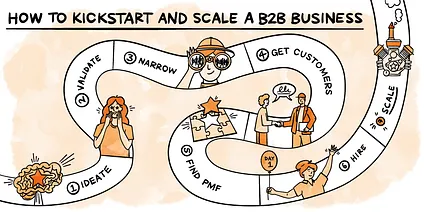 Here’s an overview of the series so far: - **Part 1:** [How to come up with a great B2B startup idea](https://www.lennysnewsletter.com/p/how-the-most-successful-b2b-startups) - **Part 2:** [How to validate your idea](https://www.lennysnewsletter.com/p/how-to-validate-your-b2b-startup) - **Part 3:** [How to identify your ICP](https://www.lennysnewsletter.com/p/how-to-identify-your-ideal-customer) - **Part 4**: [How to find and win your first 10 customers](https://www.lennysnewsletter.com/p/how-to-win-your-first-10-b2b-customers) - **Part 5:** [A guide for finding product-market fit](https://www.lennysnewsletter.com/p/finding-product-market-fit) - **Part 6:** [How, and when, to hire your early team](https://www.lennysnewsletter.com/p/hiring-your-early-team-b2b) - **Part 7:** How to scale your growth engine *← This post* Let’s do this. *A huge thank-you to **[Akshay Kothari](https://www.linkedin.com/in/akothari/)** (COO of Notion), **[Ali Ghodsi](https://www.linkedin.com/in/alighodsi/)** (CEO of Databricks), **[Andrew Ofstad](https://www.linkedin.com/in/aofstad/)** (co-founder of Airtable), **[Barry McCardel](https://www.linkedin.com/in/barrymccardel/)** (CEO of Hex), **[Boris Jabes](https://www.linkedin.com/in/borisjabes/)** (CEO of Census), **[Calvin French-Owen](https://www.linkedin.com/in/calvinfo/)** (co-founder of Segment), **[Cameron Adams](https://www.linkedin.com/in/themaninblue/)** (co-founder and CPO of Canva), **[Christina Cacioppo](https://www.linkedin.com/in/ccacioppo/)** (CEO of Vanta), **[David Hsu](https://www.linkedin.com/in/dvdhsu/)** (CEO of Retool), **[Eilon Reshef](https://www.linkedin.com/in/eilonreshef/)** (CPO of Gong), **[Eric Glyman](https://www.linkedin.com/in/eglyman/)** (CEO of Ramp), **[Guy Podjarny](https://www.linkedin.com/in/guypo/)** (CEO of Snyk), **[Jori Lallo](https://www.linkedin.com/in/jorilallo/)** (co-founder of Linear), **[Julianna Lamb](https://www.linkedin.com/in/juliannaelamb/)** and **[Reed McGinley-Stempel](https://www.linkedin.com/in/reed-mcginley-stempel-17362245/)** (co-founders of Stytch), **[Keenan Rice](https://www.linkedin.com/in/keenanrice/)** (founding team), **[Mathilde Collin](https://www.linkedin.com/in/mathilde-collin-bb59492a/en/)** (CEO of Front), **[Rick Song](https://www.linkedin.com/in/rick-song-25198b24/)** (CEO of Persona), **[Rujul Zaparde](https://www.linkedin.com/in/rujulz/)** and **[Lu Cheng](https://www.linkedin.com/in/lu-cheng-973b7830/)** (co-founders of Zip), **[Ryan Glasgow](https://www.linkedin.com/in/ryanglasgow/)** (CEO of Sprig), **[Shahed Khan](https://www.linkedin.com/in/shahedkhan/)** (co-founder of Loom), **[Shishir Mehrotra](https://www.linkedin.com/in/shishirmehrotra/)** (CEO of Coda), **[Sho Kuwamoto](https://www.linkedin.com/in/shokuwamoto/)** (VP of Product of Figma), **[Spenser Skates](https://www.linkedin.com/in/spenserskates/)** (co-founder and CEO of Amplitude), **[Tom Preston-Werner](https://www.linkedin.com/in/mojombo/)** (co-founder of GitHub), and **[Tomer London](https://www.linkedin.com/in/tomerlondon/)** (co-founder and CPO of Gusto) for contributing to this series. Art by [Natalie Harney](https://www.natalieharney.com/).* --- 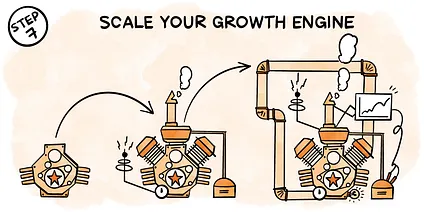 Although we’ve reached the end of this journey, we’re on a journey that never ends. Building a venture-scale business means endless challenges, surprises, and an unrelenting need for growth. I like to think of the startup journey as a huge puzzle board, where every challenge, decision, and opportunity is a piece of the puzzle. My job is to (slowly but surely) fill in this board and help you through every challenge, decision, and opportunity you’ll face. For reference, here are some puzzle pieces I’ve already put into place to help you scale your B2B startup prior to this series: - **On growth and GTM** - [GTM motions of 30 B2B SaaS companies](https://www.lennysnewsletter.com/p/gtm-motions) - [Picking a wedge](https://www.lennysnewsletter.com/p/wedge) - [Differentiating](https://www.lennysnewsletter.com/p/how-to-differentiate) - [Positioning](https://www.lennysnewsletter.com/p/positioning) - [The Racecar Framework](https://www.lennysnewsletter.com/p/the-racecar-growth-frameworkexpanded) - [What is good retention](https://www.lennysnewsletter.com/p/what-is-good-retention-issue-29) - [What is a good activation rate](https://www.lennysnewsletter.com/p/what-is-a-good-activation-rate) - [What is a good payback period](https://www.lennysnewsletter.com/p/payback-period) - **On sales** - [How to do founder-led sales](https://www.youtube.com/watch?v=cZd5234Eem0&source_ve_path=OTY3MTQhttps://www.youtube.com/watch?v=cZd5234Eem0&source_ve_path=OTY3MTQ) - [How to build a killer sales pitch](https://www.lennysnewsletter.com/p/how-to-build-a-killer-sales-pitch) - [Layering sales on top of a PLG motion](https://www.lennysnewsletter.com/p/sales-bottom-up) - [Adding a PLG motion on top of a sales-led motion](https://www.lennysnewsletter.com/p/five-steps-to-starting-your-plg-motion) - [How to hit revenue targets in a recession](https://www.youtube.com/watch?v=pYZ0S7a72po&t=1s) - **On pricing strategy** - [The art and science of pricing](https://www.youtube.com/watch?v=A6veeCbKIzw) - [Pricing strategy for your SaaS product](https://www.lennysnewsletter.com/p/saas-pricing-strategy) - **On fundraising** - [A playbook for fundraising](https://www.lennysnewsletter.com/p/a-playbook-for-fundraising) - [Your startup idea probably isn’t venture-scale](https://www.lennysnewsletter.com/p/your-startup-idea-probably-isnt-venture) Today, I’ll answer four additional questions: 1. **What’s a good timeline to get to $1 million ARR?** 2. **What are the most common growth channels for B2B startups?** 3. **When should you start charging for your product?** 4. **What should you charge?** Let’s get into it. ## Typical times to get to $1M ARR 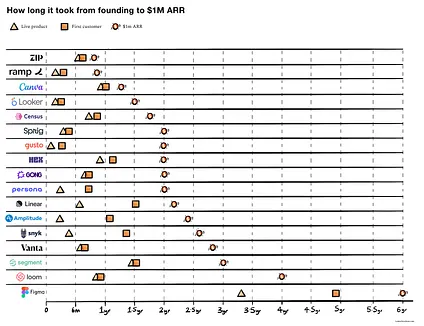 On average, it took top B2B startups ~ **2 years** from founding to hit $1m ARR, and roughly **1.5 years after closing their first customer.** There are exceptions, like Ramp, Linear, Census, and Zip, that got there more quickly (some within months), and also companies like Loom and Vanta that took 2+ years. My takeaway is that once you’ve signed your first customer, you should **strive to hit $1m ARR within 1.5 years** if you want to be on pace with the top B2B companies. Interestingly, there isn’t a large difference in timelines between companies with large ACVs (e.g. Looker, Gong, Sprig, Vanta) and low ACVs (e.g. Loom, Figma). Also, in some instances, there’s good reason to push out monetization. In the case of Loom, co-founder Shahed Khan shared, “We didn’t monetize Loom for several years intentionally, as **our focus was to become a ubiquitous tool within organizations**. Thus it took us four years to hit $1m ARR.” With the [recent acquisition news](https://techcrunch.com/2023/10/12/atlassian-to-acquire-former-unicorn-loom-for-975m/), seems like a good call. ## How B2B startups grow as they scale 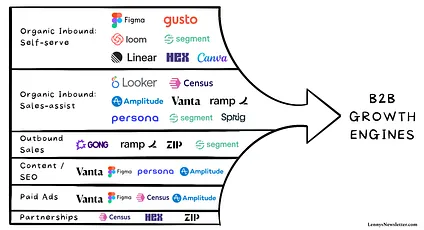 Primary growth channels for top B2B companies Broadly, the biggest growth channel for top B2B companies (at least the 20+ I researched) is **organic** **inbound**. Essentially, word of mouth. This connects with a key lesson from part five of this series—that strong product-market fit often looks like [strong organic growth](https://www.lennysnewsletter.com/i/119122450/step-start-noticing-a-shift-from-push-to-pull-and-organic-growth). That being said, as we saw in [part six](https://www.lennysnewsletter.com/i/135973645/when-to-hire-a-salesperson-and-what-to-look-for), eventually 100% of B2B businesses build a sales team. Below I’ll explore all six B2B growth channels: self-serve organic inbound, sales-assist organic inbound, outbound sales, content/SEO, paid ads, and partnerships. This summary doesn’t get into revenue expansion (e.g. growing revenue from existing customers), since it didn’t come up in my interviews, but this is also a massive growth lever for scaling B2B SaaS companies, and I’ll spend more time here in future posts. Use this list not as “we should do all of these,” but instead as inspiration for one new channel to explore for your own product. You’re likely already growing primarily through one of the first three channels; ask yourself which of the remaining channels might be a new opportunity. #### 1\. Organic inbound: Self-serve (aka Product-Led Growth) This channel is simply users hearing about your product from someone else (or being invited) and signing up on their own. No one from your company helps them through the funnel. This isn’t to say salespeople never talk to these leads (check out [this podcast episode](https://www.lennyspodcast.com/the-ultimate-guide-to-product-led-sales-elena-verna/) on product-led sales), but it does mean new customers come primarily from them first trying the product on their own. Companies like Loom, Figma, Segment, Gusto, Hex, and Linear grow primarily in this way. **What this looks like:** - “People in trials are checking out with credit cards, without us talking to them.” - “Signing up for Loom after watching someone else’s Loom (typically coworkers), within Slack or in Salesforce, Linear task, or Notion doc.” - “We’ve always had a strong stream of inbound users who had found out about us via our open source work and propelled us through our early revenue milestones.” #### 2\. Organic inbound: Sales-assist Similar to the above channel, new customers come to you, but in this case, your sales team hand-holds leads through the process. Companies like Looker, Ramp, Vanta, Hex, Census, Persona, and some portion of Amplitude and Segment grow through this channel. The key determinant of whether you go self-service or sales-assist is how successfully new users can get activated without handholding. **What this looks like:** - “Our biggest growth channel by far is organic, with visitors to our site clicking the ‘Request a demo’ button.” - “Customer referrals continues to be one of our strongest channels, which funnels into our inbound sales pipeline.” - “All of our growth is inbound, but it’s all sales-touch.” #### 3\. Outbound sales This is what you think of when you think of sales-led growth—your sales team reaches out to prospects, pitches them, and closes them. Companies that grow primarily through this channel include Gong and Zip, along with a meaningful portion of growth for Ramp and Segment. I’ll be doing more writing on this topic in the coming months, so stay tuned. #### 4\. Content/SEO A surprisingly popular growth channel for top B2B companies is content. Companies like Vanta, Amplitude, Figma, Persona, and, famously, HubSpot have all found success using content (aka SEO) to grow. I’ve covered this topic in depth previously, so [go read this](https://www.lennysnewsletter.com/p/content-driven-growth-strategy) if you’re looking to invest here. #### 5\. Paid ads They may be boring, but paid ads work. For B2B, this means running ads on Google, Facebook, and LinkedIn, along with the occasional ad on podcasts, newsletters, and other less-scalable channels. Companies that have found success here include both large (Figma and Amplitude) and smaller (Vanta and Census). For advice on running paid ads, [here’s a good podcast episode](https://www.lennysnewsletter.com/p/mastering-paid-growth-jonathan-becker) to check out. #### 6\. Partnerships Partnerships: huge if successful, massive time suck if not. This is a meaningful growth channel for companies like Census, Hex, and Zip, but as one founder shared, “We have a big channel partnership with Snowflake, and though this doesn’t drive a big percentage of our leads, it does help to have that relationship.” I’ve written about channel partnerships before, [so go read this](https://www.lennysnewsletter.com/i/31258917/channel-partnerships) if you’d like more examples and advice. #### A few additional takeaways 1. Most of your growth will come from one of the top three: inbound self-service, inbound sales-assist, or outbound sales. Spend most of your time optimizing that channel. 2. No matter how you start, you’ll be building a sales team. It’s a question of when, not if. 3. Creating content (e.g. blog posts, LinkedIn posts, viral tweets, a great podcast) seems to be effective for a number of companies, so it’s worth exploring. But think about the system that can allow this to scale, versus one-off efforts. [Think engines, not turbo boosts](https://www.lennysnewsletter.com/i/75292796/the-growth-engine). 4. Be careful about forcing PLG. Here’s [Ali Ghodsi](https://www.linkedin.com/in/alighodsi/) (founder and CEO of Databricks)’s cautionary tale: > “The whole vision of Databricks was we don’t want to have sales in the company. It’s going to all be product-led growth. So it’s a hundred percent product-led-growth motion. And in 2015, we kind of doubled down on it. We actually said, ‘Let’s do what Amazon did. Let’s just make it really slick, and you swipe your credit card and you can start using this stuff.’ We called it the zero-touch effort. We were going to touch the customers zero times from a sales perspective. No human needed to touch the customer. We’re very excited about that and we built it all, we automated it all. And I think around Q2 of 2015, we told sales, ‘Stop engaging with the customers. This is going to be zero-touch. Focus all your attention on automating this stuff and let’s set it up for that kind of motion.’ > > **And actually, revenue flatlined. Revenue was growing, and then in Q2, Q3 of 2015, it started flattening. So around Q4 it was starting to become kind of clear that, okay, this product-led-growth thing—nice story, but in practice, it doesn’t really work.** Which is actually, by the way, my view. I think for all practical purposes, PLG doesn’t work. It’s a ‘don’t try it at home’ kind of thing. Maybe it works for Atlassian. Maybe if you can swipe a credit card and use the product in five minutes, it’ll work. But if you think this is how you can sell to enterprises, without a sales force, good luck.” ## When and how much to charge These are the four key lessons that came up again and again when I talked to founders about their pricing strategy: -
successful-b2b-startups.md 54.5 KB
### Part one of my seven-part series on kickstarting and scaling a B2B business *👋 Hey, [Lenny](https://twitter.com/lennysan) here! Welcome to this month’s ✨ **free edition** ✨ of Lenny’s Newsletter. Each week I tackle reader questions about building product, driving growth, and accelerating your career.* *If you’re not a subscriber, here’s what you missed this month:* 1. [How today’s top consumer brands measure marketing’s impact](https://www.lennysnewsletter.com/p/how-todays-top-consumer-brands-measure) 2. [How Shopify builds product](https://www.lennysnewsletter.com/p/how-shopify-builds-product) 3. [What is good free-to-paid conversion](https://www.lennysnewsletter.com/p/what-is-a-good-free-to-paid-conversion) *Subscribe to get access to these posts, and every post.* --- My paternity leave has come to an end, and I’m kicking things up a notch. Over the next two months, I’m going to share a multi-party in-depth playbook for kickstarting and scaling a B2B business. This series took hundreds of hours of work and is based on dozens of 1:1 interviews with the founders of two dozen of today’s most successful B2B companies—including Gong, Notion, Figma, Amplitude, Retool, Canva, and many more. In addition to these juggernauts, I’ve also pulled in a handful of my favorite up-and-coming B2B startups, including Linear, Vanta, Stytch, Zip, Census, Persona, and Hex.  This series builds on my two previous playbooks—for [consumer businesses](https://www.lennysnewsletter.com/p/kickstarting-and-scaling-a-consumer) and [marketplace businesses](https://www.lennysnewsletter.com/p/how-to-kickstart-and-scale-a-marketplace) —and brings me one step closer to my goal of giving every founder a tactical guide for turning their idea into reality. Even if you’re not building a B2B startup right now, you’ll find inspiration, new ideas, and frameworks that will help you with the product you’re building right now. Here is what’s in store: 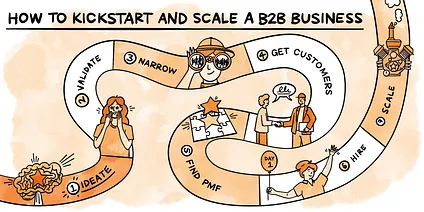 - **Part 1:** How to come up with a great B2B startup idea *← This post* - **Part 2:** [How to validate your idea](https://www.lennysnewsletter.com/p/how-to-validate-your-b2b-startup) - **Part 3:** [How to identify your ICP](https://www.lennysnewsletter.com/p/how-to-identify-your-ideal-customer) - **Part 4:** [How to find and win your first 10 customers](https://www.lennysnewsletter.com/p/how-to-win-your-first-10-b2b-customers) - **Part 5:** [How to find product-market fit](https://www.lennysnewsletter.com/p/finding-product-market-fit) - **Part 6:** [How, and when, to hire your early team](https://www.lennysnewsletter.com/p/hiring-your-early-team-b2b) - **Part 7:** [How to scale your growth engine](https://www.lennysnewsletter.com/p/scaling-your-b2b-growth-engine) You’ll find never-before-shared stories, surprising lessons, and, as usual—a ton of tactical and actionable advice you can use to grow your own product today. **Here’s a peek at a few of the more surprising takeaways:** 1. The majority of founders had no special skill or background in the problem space they went after. 2. Most B2B startup ideas did not come from the founder feeling the pain at their last gig (though many did). 3. *Every* prosumer product (e.g. Notion, Figma, Airtable, Miro, Slack, Coda) took two to four years of wandering in the dark before they found something that worked. 4. Founders spoke to a median of 30 potential customers to validate their idea before committing. 5. ~40% of startups pivoted at least once before landing on their winning idea—oftentimes more than once. 6. About 20% were solo founders. 7. Cold outbound works—it’s the second most common way to get your early customers. This series should probably be a book, but instead I’m sharing it with you all here. I’m excited to hear what you think and evolve this work further. And remember: following these steps (or any steps!) won’t guarantee success. But it’ll certainly improve your odds. Let’s get started with step one: coming up with a great idea. *A huge thank-you to **[Akshay Kothari](https://www.linkedin.com/in/akothari/)** (COO of Notion), **[Ali Ghodsi](https://www.linkedin.com/in/alighodsi/)** (CEO of Databricks), **[Barry McCardel](https://www.linkedin.com/in/barrymccardel/)** (CEO of Hex), **[Boris Jabes](https://www.linkedin.com/in/borisjabes/)** (CEO of Census), **[Calvin French-Owen](https://www.linkedin.com/in/calvinfo/)** (co-founder of Segment), **[Cameron Adams](https://www.linkedin.com/in/themaninblue/)** (co-founder and CPO of Canva), **[Christina Cacioppo](https://www.linkedin.com/in/ccacioppo/)** (CEO of Vanta), **[David Hsu](https://www.linkedin.com/in/dvdhsu/)** (CEO of Retool), **[Eilon Reshef](https://www.linkedin.com/in/eilonreshef/)** (CPO of Gong), **[Eric Glyman](https://www.linkedin.com/in/eglyman/)** (CEO of Ramp), **[Guy Podjarny](https://www.linkedin.com/in/guypo/)** (CEO of Snyk), **[Jori Lallo](https://www.linkedin.com/in/jorilallo/)** (co-founder of Linear), **[Julianna Lamb](https://www.linkedin.com/in/juliannaelamb/)** and **[Reed McGinley-Stempel](https://www.linkedin.com/in/reed-mcginley-stempel-17362245/)** (co-founders of Stytch), **[Mathilde Collin](https://www.linkedin.com/in/mathilde-collin-bb59492a/en/)** (CEO of Front), **[Rick Song](https://www.linkedin.com/in/rick-song-25198b24/)** (CEO of Persona), **[Rujul Zaparde](https://www.linkedin.com/in/rujulz/)** and **[Lu Cheng](https://www.linkedin.com/in/lu-cheng-973b7830/)** (co-founders of Zip), **[Ryan Glasgow](https://www.linkedin.com/in/ryanglasgow/)** (CEO of Sprig), **[Shahed Khan](https://www.linkedin.com/in/shahedkhan/)** (co-founder of Loom), **[Shishir Mehrotra](https://www.linkedin.com/in/shishirmehrotra/)** (CEO of Coda), **[Sho Kuwamoto](https://www.linkedin.com/in/shokuwamoto/)** (VP of Product of Figma), **[Spenser Skates](https://www.linkedin.com/in/spenserskates/)** (co-founder and CEO of Amplitude), and **[Tomer London](https://www.linkedin.com/in/tomerlondon/)** (co-founder and CPO of Gusto) for contributing to this series. Art by [Natalie Harney](https://www.natalieharney.com/).* ---  ## What makes a great B2B startup idea If you boil it down, there are essentially three elements to a great B2B startup idea: 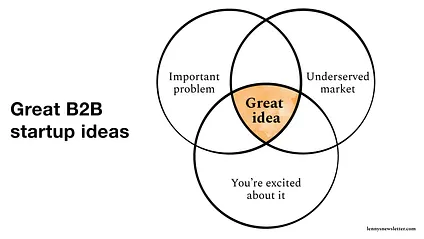 #### Ingredient 1: The problem is important to people There need to be a lot of people willing to spend a lot of money to solve the problem. Most startups fail not because the idea isn’t good but because the market for the solution is just too small. If you want to build a venture-scale business, a rule of thumb is that there needs to be a clear path to $100m in revenue per year, and eventually a path to $1B a year. Here’s a great example of what you want to see, as told by [Ryan Glasgow](https://www.linkedin.com/in/ryanglasgow/), CEO of Sprig: > *“Robinhood agreed to a large contract even though we were early. They’re like, ‘We love it. We’ll install tomorrow.’ They installed it as we were building the first version.”* Hunter Walk has a great framework called [LUV](https://hunterwalk.com/2017/04/12/why-i-care-about-problem-size-more-than-market-size/). Also, [here’s my take on what makes a venture-scale idea](https://www.lennysnewsletter.com/p/your-startup-idea-probably-isnt-venture), and [a guide](https://medium.com/sequoia-capital/the-market-curve-44097b626f6d) to help you think through your market size. #### Ingredient 2: The market is underserved Existing solutions need to be doing a subpar job of solving the problem. The founder of CRED, [Kunal Shah](https://www.linkedin.com/in/kunalshah1/), has a great framework for evaluating potential new solutions, called Delta-4: 1. What would a customer rate the *existing* solution on a scale of 1 to 10? 2. What would they rate *your* solution? Your solution needs to be +4 better for anyone to care about your product. This also means that if the existing solution gets a 6 or higher, it’ll be very hard to replace (e.g. Excel). Here’s what you’d love to see, as shared by [Tomer London](https://www.linkedin.com/in/tomerlondon/), co-founder of Gusto: > *“As soon as we asked them the simple question of how they feel about their current payroll provider, they started cursing. More than half of the people we talked to just started cursing, unprompted. Two people voluntarily told me, ‘I use \[competitor name\], and my password is fuck\[competitor name\].’”* #### Ingredient 3: You’re excited about solving this problem Finally, the problem needs to be something *you* are willing to spend many years of your life solving. This advice from Dylan Field, co-founder of Figma, captures the sentiment perfectly: > *“There are actually a lot of good ideas out there. It’s kind of the weird part, especially if you’re searching for one; it feels like it’s not the case, but there are so many different markets that are underserved. The more important thing, actually, is to find something that you are personally passionate about, because any good company takes a long time to build.* > > *If you are, let’s say, three to four years in on an idea that you hate, you’re just going to burn out and you’re going to quit. It won’t feel good and you’ll be hating life. Don’t just go for an idea because it’s kind of working. Go for an idea that you really care about, because even if it doesn’t work, you’ll still learn from it and you’ll still have one.” — [Dylan Field](https://www.linkedin.com/in/dylanfield/), co-founder and CEO of Figma, [via Elad Gil](https://blog.eladgil.com/p/transcript-and-video-fireside-w-dylan?publication_id=1119759&post_id=103105470&isFreemail=true)* **Takeaway:** Find an idea that solves a problem that is important, underserved, and that you’re excited about. You’ll hear a lot more about how to do this, and what this looks and feels like, below. “ *It’s essential to work on something you’re deeply interested in. Interest will drive you to work harder than mere diligence ever could. When in doubt, optimize for interestingness.” —* [Paul Graham](http://paulgraham.com/greatwork.html#f1n) ## Finding a great B2B startup idea Across all of the interviews I did, I found three reliable paths for discovering a great idea: 1. **Past pain:** Identify a large pain you experienced at a previous company—then build a solution. 2. **Ponder and probe:** Pick a space you’re interested in, then whiteboard and tinker while talking to dozens of potential customers—looking intently for pain and pull. 3. **Present pull:** Identify something you’ve built that is showing signs of pull—and pivot fully to that. Here’s an overview of how today’s biggest B2B companies found their ideas: 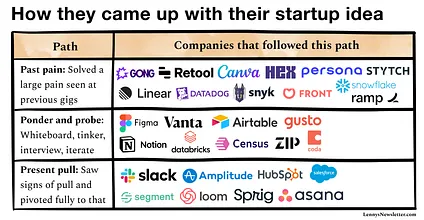 No matter which path you take, you are looking for two things: *pain* and *pull*. Pain tells you there’s an opportunity to solve a problem, and that it’s important. Pull tells you that you’re actually solving the problem. Let’s explore each of the three paths, illustrated by founder stories. ### Path 1: Past pain—Identify a large pain you experienced at a previous company. Then build a solution. When I first started this research, I was expecting this path to be the way that *all* great startups found their ideas. Surprisingly, it only accounts for about 40% of great ideas. Let’s consider five successful startups that found their big idea following the path of past pain: Gong, Retool, Linear, Persona, and Hex. The CEO of **Gong** experienced the pain of being unable to understand what was going wrong within the sales process at his previous company: > “Amit, now my co-founder, ran a company in the BI space called Sisense. He ran into a problem—when sales didn’t work well—and it was very hard to understand why. **He realized that essentially all of the knowledge about what was working and not working was hidden inside people’s heads: ‘The CRM was showing me stuff, but it wasn’t anything meaningful. Yes, you didn’t close that deal, but why?’** > > He left Sisense and looked around to see if anybody was addressing this problem. I was on sabbatical doing nothing, learning deep learning, so we figured: let’s try to come up with a system that takes the stuff from salespeople’s heads, captures the information, and gives visibility and guidance to the rest of the organization.” > > — [Eilon Reshef](https://www.linkedin.com/in/eilonreshef/?originalSubdomain=il), co-founder and CPO David Hsu, the founder of **Retool**,found himself building the same product over and over at each company he worked at: > “Perhaps a little-known fact is that I had actually started a couple of other companies and products before Retool. And every time the team built any of these products, we had to go build our own tools for it. **Eventually, when you build enough of the same things—in this instance, internal tools for different projects—you kind of realize they actually all have the same building blocks.** We thought, ‘There’s got to be a better way of doing this.’ And we’re lazy engineers and we thought other engineers would be lazy as well. So that’s how the idea \[for Retool\] first came about.” > > — [David Hsu](https://www.linkedin.com/in/dvdhsu/), founder and CEO The founders of **Linear** felt deeply disappointed every time their companies defaulted to Jira: > “ **Linear emerged out of the pain we all felt with issue tracking project management**, when it comes to building software. I was at the time at Coinbase, Karri \[Saarinen, co-founder\] was at Airbnb, Tuomas \[Artman, co-founder\] was at Uber. We were all at these growth-stage companies and saw how they both grow and operated as they grew. > > I very vividly remember the time around 2016 at Coinbase, when we were closing in on 100 people and we hired a VP of engineering. There was a desire to start unifying the teams using a single tool. And Jira started coming up in the conversations. > > I was maybe a little bit naive and tried to keep my team using Trello, but I very quickly realized that it is a losing battle. You’ve just got to go with it and there’s no other solution, basically, on the market. And so we ended up going with Jira. But it just stayed with me as this nagging feeling of disappointment. > > Separately, Karri at Airbnb had created a Chrome extension to re-skin their Jira, and Tuomas was building developer tools at Uber, using Fabricator. We all had similar experiences of ‘This doesn’t feel right and we should do something about it.’” > > ***—*** [Jori Lallo](https://www.linkedin.com/in/jorilallo/), co-founder **Persona** ’s founder noticed how inadequate identity tooling was when having to build this technology at Square: > “ **I worked on identity over at Square for a fair bit of time. We actually used to joke as a collective team over on Square, ‘I’m sure in 10 years there will be someone who does this well for us.’** Importantly, while we were building it, we noticed that there was this disconnect between existing identity vendors thinking that there was going to be one technique that’ll solve all of a customers’ identity problems, while in reality, every business had a multi-modal approach: a bunch of different techniques to verify different people in different contexts. So we saw an opportunity to go after this problem in a unique way.” > > — [Rick Song](https://www.linkedin.com/in/rick-song-25198b24/), co-founder and CEO **Hex** ’s founder realized that no one was going to build what he needed, so he had to do it himself: > “I actually started this journey as a buyer. I was looking for something like Hex and I couldn’t find it. It took me a few months of going around and talking and asking people like, ‘Oh, what are you using for this? What are you using for that? Have you found anything good for this?’ Everyone said, ‘No, but if you do, let us know.’ It kind of clicked one day. I was like, ‘Well, maybe we should do this.’ > > I didn’t set out to be a founder. There are a lot of people out there who are like, ‘I want to be a founder. I just need an idea and a co-founder.’ I was almost the opposite. The idea was very obvious to me. I had two great co-founders that I had met at Palantir whom I loved working with. It almost took us a while to be like, ‘All right. I guess we have to do this. Don’t we? No one else is doing this, while we have to do it.’” > > — [Barry McCardel](https://www.linkedin.com/in/barrymccardel/), co-founder of Hex **Takeaway questions to reflect on:** 1. What did you or others build at previous jobs that proved to be incredibly valuable to the company, or your teammates? 2. What’s a tool you wish you had (and would have paid a lot of money for) at your previous companies? 3. What internal products have you built again and again at past companies? ### Path 2: Ponder and probe—Pick a space you’re interested in, then whiteboard and tinker, while talking to many potential customers looking for pain and pull. A surprisingly large number of founders came up with their startup idea by doing something that’s often discouraged: sitting around and whiteboarding. As you’ll see below, there’s a wrong way of whiteboarding and a right way (i.e. ideating and building in a silo versus quickly talking to potential users to validate your idea). But most importantly, if you want to find a great idea, again, focus on finding a problem space with three traits: (1) it’s important, (2) it’s underserved, and (3) you’re excited about it. Ideally your idea is also rooted in some experience you’ve had in the space, but it doesn’t have to be. **Figma** ’s founders narrowed their focus to two areas they saw potential in and then started tinkering with the one they were most excited about—design: > “After we got the Thiel Fellowship, I called Evan \[Wallace, co-founder\] and said, ‘Hey, you know, we’ve got actual funding now: $100,000 over two years. Do you want to go do this thing for real?’ > > When you’re starting a company, it’s really useful to ask the question: why now? It’s a really useful framework. It can be societal; maybe there’s some new cultural trend. Perhaps it’s regulatory; some law has been passed or repealed. I like the technological version. For us, we saw drones in 2012 and WebGL as a few technologies that were happening. Because of them, new possibilities were suddenly there. > > On the drone side, we didn’t get very far. Evan in particular was not that interested in doing hardware. He’s like, hardware sucks, run debug cycles are really long, and then we focused on WebGL instead. > > We were also excited about computational photography for a bit, but quickly realized that with photos, that ends up leading to a consumer sort of application. And the entire purpose of WebGL was to be in the browser. Why would you do anything in photo editing if you’re not on the phone? And so we felt like we were kind of building in the wrong place and then eventually sort of shifted our attention to design. I had been a design intern at Flipboard, and that kind of helped me realize what would be possible there.” > > — [Dylan Field](https://www.linkedin.com/in/dylanfield/), co-founder and CEO, [via Elad Gil](https://blog.eladgil.com/p/transcript-and-video-fireside-w-dylan?publication_id=1119759&post_id=103105470&isFreemail=true) **Vanta** ’s [Christina Cacioppo](https://www.linkedin.com/in/ccacioppo/) similarly narrowed down her thinking to two spaces that felt ripe for opportunity that she was excited about (security and collaboration), and kept talking to customers to find the biggest source of pain and pull: > “Our first couple of ideas were just total garbage. There was a lot of whiteboarding. I think the failure mode in this part of the process with the whiteboard is that it’s just all so abstract. There were no customers or users. > > Back then, I tended to be a shiny-object person, so left to my own devices, my natural inclination was just to go find all the shiny objects on the surface. So I was, okay, no, don’t do that. Pick one or two spaces and go really deep. You’re not allowed to look at anything else. Not allowed. > > I chose (1) team collaboration tools, because I thought, I don’t know if I truly love this but I know it from my Dropbox days, and (2) security, because it seemed interesting and I wanted to learn it. **They both seemed big and important, and interesting**, and I had all kinds of security and compliance challenges at Dropbox. I also felt like I’d be happy learning about that space, and I also wanted to work with startups. > > Within collaboration, we were asking ourselves, ‘What are the macro trends and new technologies shaping the world?’ It’s late 2016, and so... voice! Team collaboration software is also emerging, and so the answer is B2B Alexa. **At the whiteboard stage, it makes so much sense. And in reality, zero sense. We recognized that if you can do it on a whiteboard, someone has probably done it. There’s no $20 bills on the sidewalk.** > > Also, when you’re changing context from B2B Alexa to other ideas like, I’m going to make a better wiki, to solving security, to whatever, you’re spreading yourself too thin and you’re not going deep enough to actually learn anything that someone else hasn’t. > > So within the security bucket, I started asking all the startups I knew about security, and they all looked at me really guiltily and said, ‘We don’t really do anything. We know we should, but we don’t.’ Everyone wanted to do security, but it was hard to prioritize until customers asked for it. So I started doing it for them scrappily and manually, and that led to what Vanta is today. > > When I tell founders this, sometimes they’re like, ‘Well, how did you know security was going to work?’ You don’t. If you know the answer to that, go for it. But it’s only obvious if you look back.” > > — [Christina Cacioppo](https://www.linkedin.com/in/ccacioppo/), founder and CEO **Notion** started with the general idea of a no-code app builder and eventually (four years later!) noticed pull for a specific set of features: > “Early Notion was basically a no-code website builder. [Some of the videos actually exist in YouTube](https://youtu.be/FPYl7nIKRbA?t=305). It didn’t go anywhere for years. It was very unstable, the tech stack we had used in the early iterations of it was fairly buggy, and user feedback was not great. **But as we peeled the onion, talking to users and using it ourselves, we realized that for the people that continued to use it, they liked some elements of the editor and the collaborative features that the product had.** And through that, we realized that we should double down on docs and wiki. > > The turning point was in early 2017 (four years in), when we launched Notion 1.0, focused around just docs and wikis. At the same time, we made a few different templates ourselves so that you can click a button and start using the product. Instead of telling people to build software using our tool, you can now click a button and get this modern docs/wiki product, without any work. It proved to be a great wedge into the market, because notes is the simplest unit of work, and it got people in the door and using the product. And then once people actually started using it, some people went down to the lower stack and they were like, ‘Huh, I can actually change these things. I can modify it, I can build my own template.’ We took a little bit of a roundabout way of getting there, but that’s the story.” > > — [Akshay Kothari](https://www.linkedin.com/in/akothari), co-founder and COO For **Zip**, [Rujul Zaparde](https://www.linkedin.com/in/rujulz/) and [Lu Cheng](https://www.linkedin.com/in/lu-cheng-973b7830/) went through a variety of ideas, looking for a big and underserved market they were excited about. They eventually focused on procurement (and their company is currently valued at over $1B): > “This was actually our sixth or seventh idea. Some earlier ideas included allowing people in India (and then other countries) to be able to buy U.S. equities in a fractional way, and an accounting staffing platform (which generated $200k of revenue!). > > **Eventually, as we were thinking through our next pivot, the advice we got from our Y Combinator partner was to look for a market that was large and had entrenched companies that weren’t great. This led us to the procurement space.** > > And then we thought back to this problem at Airbnb. In hindsight, we both adjacently ran into it a couple of times, but we didn’t realize it until later.” > > — [Rujul Zaparde](https://www.linkedin.com/in/rujulz/) and [Lu Cheng](https://www.linkedin.com/in/lu-cheng-973b7830/), co-founders For **Databricks**,[Ali Ghodsi](https://www.linkedin.com/in/alighodsi/) noticed a new technology emerging that was underutilized and kept talking to users until he realized how to turn it into a real company: > “We were doing research for a bunch of years at U.C. Berkeley and had started seeing what was happening in Silicon Valley tech companies, how they were solving data scalability problems, and how different their approach was from what we were seeing in the rest of the industry. At that time, the rest of the industry was leveraging this technology called Hadoop, and that was the best thing since apple pie for them. **But we were seeing that the Silicon Valley tech companies were using a different technology (what is now Apache Spark) and were in fact doing AI and machine learning on data, and they were getting magical results. We knew this technology could be game-changing for the rest of the industry.** > > Our initial thought was, ‘Can we just take what we’re seeing over there, open source it, and publish the research, and then the whole world will adopt it and we’ve changed the world?’ We didn’t really intend to start a company. But then over the years, it was frustrating to see that we had found this software, and we had open-sourced it, and we thought it was so amazing, but it wasn’t getting the uptake that we thought it deserved. And people kept telling us, ‘This is some academic project. How do we know that we can really rely on it? Is it really enterprise-ready?’ And so on. There was frustration around 2012 where we thought, if we start something, if we ourselves get behind it and we raise some money, maybe we can really actually ourselves make it happen. So that was the journey.” > > — [Ali Ghodsi](https://www.linkedin.com/in/alighodsi/), co-founder and CEO **Takeaway questions to reflect on:** 1. What’s a trend that’s emerging but underserved (e.g. security, collaboration)? 2. What’s a transformative technology that’s emerging that’s underutilized (e.g. data scalability)? 3. How many potential customers have you spoken with about your idea? 4. How important to potential customers is the problem you’re exploring, on a scale of 1 to 10? 5. How underserved is the current market, on a scale of 1 to 10? And where would your solution rank? Look for a delta of at least 4. ### Path 3: Present pull—Identify something you’ve built that is showing signs of pull. Pivot fully to that. A final path is simply to keep building what you’re building, but pay special attention to features or functionality that are showing strong pull from existing users. This may lead to shifting your approach slightly, or it may lead to a completely different product. In the case of **Amplitude**, the big idea came from noticing other founders wanting access to their internal analytics tool: > “We started with a different company before Amplitude, called Sonalight, which was a voice recognition application that allowed you to send and receive text messages by talking to your phone. **One of the things that was really clear to us at the time was that you should look at what people are doing in your product in order to figure out how to make it better.** Figure out where people are getting stuck, what keeps them coming back, what they like to use, and what they don’t like to use. > > We tried out tons of products on the market. I remember Flurry, Google Analytics, Adobe, Kissmetrics, and others. And none of them were able to answer the questions I just posed. And so we said, ‘All right, well, we’ve got to build it ourselves.’ A bunch of engineers with a lot of hubris, haha. So we ended up doing that. And as **we shared those insights with other companies that we knew (we were at Y Combinator at the time), they were like, ‘Wow, that’s amazing. I really need to understand that about my business.’”** > > — [Spenser Skates](https://www.linkedin.com/in/spenserskates/), co-founder and CEO **Sprig** followed a very similar story— [Ryan Glasgow](https://www.linkedin.com/in/ryanglasgow/) was building one product, but then noticed a side project seeing much more pull: > “I was exploring a startup idea, but I wasn’t quite getting the pull I expected. I went back to what I knew, which is product management, and I started asking users tough questions, like ‘Would you pay for this?’ and ‘Why do you not use this?’ In this discovery process, I wanted to add more rigor, knowing that this was a high-stakes decision (e.g. I’d be spending 10-plus years of my life on it), and I found a technique called [outcome-driven innovation](https://jobs-to-be-done.com/outcome-driven-innovation-odi-is-jobs-to-be-done-theory-in-practice-2944c6ebc40e), which adds rigor to product innovation. I was like, ‘Wow, this is mind-blowing. What if I could build a tool to help other people go through the idea maze and not build something before they de-risk the idea?’ > > **So I built a little SDK that people could plug into their apps**, with a very simple front end, that would just rotate through three questions about functionality, usability, and quality (the core questions in the framework I mentioned). It used Airtable as the back end, actually; it was so simple. > > **I shared this with other founders that I knew who were also trying to get their business off the ground, and gave them this spreadsheet of quality, usability, functionality, using this framework. And they were like, ‘Wow, I’m learning so much. I’d be your first customer if this was a product.’** It immediately clicked. They would say, ‘I’ll pay you for this.’ This was the market pull I was looking for, and I quickly pivoted to surveys.” > > — [Ryan Glasgow](https://www.linkedin.com/in/ryanglasgow/), co-founder of Sprig The **Loom** founders went through two completely different products before seeing obvious pull within one unexpected feature of their app: > “Loom was the result of two previously failed attempts in the video space. Our first was a marketplace for companies to hire subject-matter experts (i.e. product managers, designers, engineers, etc.) for feedback on checkout flows, UX, sales funnel, onboarding, and more. While we saw initial revenue here, this failed to get the traction to warrant additional build time (we were already four months in at this point). The second was a SaaS tool that any company can embed on their website and get instant feedback from their users in the form of a user test. Similar to the first iteration, this failed to get any real momentum after three months, although it led us to a remarkable insight from one of our few design partners. > > **Three months into this second idea, we had an aha moment when a client used the product to record a video of himself summarizing all of the user tests his team had collected. That’s when it occurred to us that there could be** ***something*** **here.** > > A month later, we launched on Product Hunt and had thousands of people who’d downloaded the extension by day’s end. That made it clear to us that we should double down on this new direction, and we’ve never looked back.” > > — [Shahed Khan](https://www.linkedin.com/in/shahedkhan/), co-founder With **Segment**,nothing was working for a year and a half, and while throwing ideas against the wall, one idea finally stuck: > “We originally applied to YC with the idea for a university classroom lecture tool (we were college students at the time), and we built that out over the course of the summer. It failed because we aren’t good at identifying real problems, and we decided that one reason is that we didn’t understand our users. > > We spent about 15 months pivoting and building various analytics products to help better understand users. None of them really took off, and we keep chasing the next idea that will get us users. **As a growth hack, my co-founder Ilya built a little library called Analytics.js. The idea was that users can use it as a ‘drop-in replacement’ for Mixpanel or Kissmetrics and send us the exact same data as you would to each of them via one library. Users didn’t care much about our tool, but they seemed to like the idea of Analytics.js.** > > Finally, we have about six months of runway left and we haven’t launched anything. My co-founder Ian \[Storm Taylor\] thinks that the idea behind Analytics.js could actually be a big deal. We could effectively be the ‘API layer’ over all these annoying and similar, but inconsistent, data tools. > > We’re split on the decision. Peter thinks it’s the worst idea he’s ever heard and that there’s zero chance a company could be made from 100 lines of JavaScript. **We all agreed to build it for a week and launch it on Hacker News. That day, it goes straight to the top of HN, and the rest is history.”** > > — [Calvin French-Owen](https://www.linkedin.com/in/calvinfo/), co-founder of Segment And famously, for **Slack**, the big idea came from noticing one feature being incredibly popular within their ill-fated video game: > “We came to the conclusion that Glitch \[the game he was working on\] was never going to be the kind of business that would have justified the $17.2 million in venture capital investment \[that we raised\]. It might have been a neat project for a half-dozen people if we had spent a million dollars to get there, but by the end of 2012, there were 45 people working on it, we had spent many millions of dollars, and it just wasn’t ever going to scale. So we decided to shut it down without knowing what we were going to do next. > > The company still had millions of dollars left in the bank, and one of the possibilities was to return that money to the shareholders and call it a day, maybe start something else up. But because we had that money, we had the flexibility to shut it down in what we felt like was a humane way. We spent a long time working on reference letters for the employees who built the website, essentially to make sure that they all got jobs. > > We also gave users the choice to get a refund for everything they had spent, to let us keep the money, or donate it to charity. We kind of had our hands full for a little while in shutting the game down, and while we did that, we were thinking about what we might want to do next. There were all kinds of ideas. > > It took us a little while to settle on the idea that would become Slack. > > That was really born out of the style of communication that developed while we were working on the game. We used an older technology called IRC, and because IRC is very limited, over the years we added the little features here and there that we wanted. > > For example, in IRC, if you’re not online at the same time as me, I can’t send you a message. I have to wait until you are also connected. So one of the first things we did was build a way of archiving messages so that you could catch up when you came back online, and in those archives we wanted to be able to search them, so we added search, and so on. There was no good iPhone client, so we made an HTML5 front end for our archive viewer. > > This interesting dynamic happened. By the time we shut down the game, again there were 45 people at the company, we had been in operation for three and a half years, and we had a companywide email list. After more than three years, it only had 50 messages on it, so about one every three weeks. That wasn’t a deliberate decision, that wasn’t ideologically driven. But it just happened that everyone paid attention to IRC, and the more people paid attention to it, the more information we routed to it; and the more information we routed to it, the more people paid attention to it. So eventually, everything from database alerts to daily sales figures were being pumped into IRC. Every time someone uploaded a file to the file server, that would be posted into IRC. While we weren’t successful in making the game, we were very efficient in being unsuccessful to make the game.” > > — [Stewart Butterfield, founder, via](https://www.businessinsider.com/slack-ceo-stewart-butterfield-interview-2015-4) *[Business Insider](https://www.businessinsider.com/slack-ceo-stewart-butterfield-interview-2015-4)* **Takeaway questions to reflect on:** 1. Of all the things you’ve built, what one feature is showing the most pull? 2. What problem are you currently facing with your startup that you wish someone would solve? Explore solving it yourself. 3. What’s a side project you’ve been wanting to build that you haven’t? ## To summarize, if you’re trying to come up with a great B2B startup idea: 1. Look for ideas that are (1) **important**, (2) **underserved**, and (3) **you’re excited** to solve. 2. Pick one of these routes and ask yourself these questions: 1. **Past pain** 1. What did you or others build at previous jobs that proved to be incredibly valuable to the company or your teammates? 2. What’s a tool you wish you had (and would have paid a lot of money for) at your previous companies? 3. What internal products have you built again and again at past companies? 2. **Ponder and probe** 1. What’s a trend that’s emerging but underserved (e.g. security, collaboration)? 2. What’s a transformative technology that’s emerging that’s underutilized (e.g. data scalability)? 3. How many potential customers have you spoken with about your idea? 4. How important to potential customers is the problem you’re exploring, on a scale of 1 to 10? 5. How underserved is the current market, on a scale of 1 to 10? And where would your solution rank? Look for a delta of at least 4. 3. **Present pull** 1. Of all the things you’ve built, what one feature is showing the most pull? 2. What problem are you currently facing with your startup that you wish someone would solve? Explore solving it yourself. 3. What’s a side project you’ve been wanting to build that you haven’t? 3. You know you’re on to something when you notice *pull* and *pain*. Now that you have a framework for coming up with an idea, the next step is to figure out if the idea is worth going all-in on. ### Next: How to validate your idea *Have a fulfilling and productive week 🙏* --- ## Appendix: Bonus origin stories not included in above (for brevity) but also incredibly interesting #### Past pain **Snyk** ’s [Guy Podjarny](https://www.linkedin.com/in/guypo/) noticed a couple of emerging trends and pain points in two previous jobs and began tinkering with the idea: > “Between 2002 and 2010, I helped build and manage some of the very first Application Security (AppSec) products, which customers used to find and fix AppSec vulnerabilities. Since it was very expensive to fix flaws you found at the end of a year-long release cycle, we tried to get security to ‘shift left’—to find issues during development where it’s cheaper to fix them. > > I left that path to found my first startup, Blaze, building a real-time web page compiler that made websites faster. Blaze was acquired by Akamai, where I became the CTO of the web performance business. DevOps played a key role in that journey, and the perspective helped me appreciate the impact it will have on the industry—and the opportunities it brings. > > These two lenses made me realize two things: > > 1. At the pace of DevOps, getting developers to embrace security has gone from an efficiency and costs play to a necessity. It’s the only way for software to be secure. > 2. If you build the right solution, developers can and will embrace security. DevOps had proven that by getting developers to embrace ops, with tools like New Relic, Heroku, and others paving the way. > > So after leaving Akamai, I set out to build a developer tooling company that tackled security.” > > — [Guy Podjarny](https://www.linkedin.com/in/guypo/?originalSubdomain=uk), founder and CEO All three of **Canva** ’s founders noticed a gap in the design space: > “Mel \[Melanie Perkins, co-founder and CEO\] was teaching design through university, including how to use different types of design software, and through that experience, she realized that it was quite complicated and really hard for people with no design background to start approaching these tools and actually get something useful out of them. > > And I’d created a lot of creative tools over the previous decade, which I found unlocked people’s creativity in a whole bunch of different ways, like with music and drawing, and other creative tools. I’d worked at Google on a product called Google Wave, which was all about communication and collaboration, and again, being able to unlock people’s creativity through new technology and new experiences. > > When I met Mel and Cliff \[Obrecht, co-founder and COO\] in 2012, the idea of unlocking design and creativity really captured all of our imaginations, and so we decided to band together in July 2012 and start building that first product. We eventually launched Canva in August 2013, about a year later.” > > — [Cameron Adams](https://www.linkedin.com/in/themaninblue/?originalSubdomain=au), co-founder and CPO Same story for **Stytch**: > “We had a monthly coffee chat on our calendar after Julianna \[Lamb, co-founder\] left Plaid to go to Very Good Security. We were always just catching up and often complaining about work, what we were banging our heads against the wall on. And that week, we were both banging our head against the wall on authentication. It was the number one thing I worked on at Plaid. And so I was particularly frustrated. And then Julianna had just finished a project to rip out Auth0. A project had gone on for six months before she joined, and then it was taking so long that they’d stopped doing it and then later picked it up again. It was like a meme within the company because of how annoying a project it was and how much time it was taking. > > Julianna was talking about how frustrating it was internally there, I was talking about how we just had a really bad experience with Auth0 and AWS Cognito at Plaid. And we were just surprised that everything assumed you’re using a password in terms of how the APIs were designed, but also, you didn’t have much flexibility. > > And so that was the first time we were both complaining about the same thing, which led it to being the first company idea where I think what we said was: we just presumed there would’ve been a Stripe for authentication in terms of how easy it was to work with an API, to do this rip and replace Julianna was doing or add the password-less features that we were trying to add in the Plaid. > > So December 2019 was the coffee. We had left our jobs at Plaid and Very Good Security at end of April, early May, I want to say, to go full-time on this. And we raised our seed round in June of 2020.” > > — [Reed McGinley-Stempel](https://www.linkedin.com/in/reed-mcginley-stempel-17362245/), co-founder The founders of **Snowflake** noticed looming challenges with companies relying on Hadoop: > “In 2012, Thierry Cruanes and I were working at Oracle, and there was not a single day without discussions on how Hadoop \[a developer of open-source computer software\] was about to make \[our work\] completely obsolete. I even remember one day interviewing a young engineer who \[was\] so excited about Hadoop that he didn’t listen to anything we said about Oracle. We realized then that we were missing something. > > This made us think a lot about the future \[of what we were doing\]. Big data was taking over the world, and data warehouses as we knew them were having a really hard time competing. They were—and often still are—rigid, expensive, and difficult to use. At the same time, we were convinced that Hadoop was not a good solution either. Hadoop systems were really too hard to use for most—very inefficient, slow, and missing key features that I would consider must-haves. > > This is the point we realized we could \[build\] a new type of data warehouse system... that would master the elasticity of the cloud. \[What we built ran\] 10 times faster than any other system for the same cost \[and freed\] users from any management tasks.” > > — [Benoit Dageville](https://www.linkedin.com/in/benoit-dageville-3011845/), co-founder, [via Yahoo Finance](https://finance.yahoo.com/news/snowflake-co-founder-reveals-multi-100000340.html?guccounter=1&guce_referrer=aHR0cHM6Ly93d3cuZHJpZnQuY29tLw&guce_referrer_sig=AQAAAMtq-hBrHr75ASPOhdNGZrj6-UB6mW6ugY-r5WpmdMieaC2oQrt_VM2BEVJmVXk6ALd9m1cX_iEfisO2g4HB6OVam23O3tQcghQXocL4nMRWNJ7cOA0yr2k_kqJs-qY2_jc7SzwEMzSVqPWa900cOVTUMQEIlpmntIIchoSqm9TE) **Ramp** ’s founders found that credit card companies were solving the wrong problem, through working at Capital One and their previous startup: > “Ramp is a continuation of a lot of things we’ve been working on for a while. I had a company before this called Paribus, which helped people save money on things they were buying online. Within the year, we had about a million customers. Then we got what was a life-changing offer from Capital One to buy the company and went for it. So that was about 2016. > > We then spent the next two and a half years there scaling the company. We learned a lot more about how to turn data into savings at scale, and about all the ways that you can use fragments of data processes to automate processes, save people money, and save people time in various ways. > > We also ended up in the credit card division within Capital One, where we learned about how credit cards work, how rewards work, and all that. I just remember we talked to customers and asked them, ‘Did you want points, cash back, something different for rewards?’ And what jumped out is people didn’t really want any of that. They wanted to be better-off. And we were just struck by this idea of rewards versus not spending that dollar in that first place. > > Pretty quickly we got obsessed with an idea: what if your card was smart enough to help you spend less? It actually might be better for the customer. You might be able to have a better shot at breaking out of the price-based competition. > > And fintech was becoming a thing then, where you could actually start these businesses relatively cheaply. > > There was only so much we could do inside of Capital One, and we helped what was Capital One Shopping become a thing and grow, and now it’s a big part of what they do, but we also concluded we couldn’t quite do what we were hoping to do inside of the company. So we left and then set out to build Ramp. That’s the story.” > > — [Eric Glyman](https://www.linkedin.com/in/eglyman/), co-founder and CEO #### Ponder and probe **Coda** ’s [Shishir Mehrotra](https://www.linkedin.com/in/shishirmehrotra/) had been thinking about this idea for years: > “Coda started as a series of brainstorms. And at the time, I was reasonably happy at Google. I wasn’t going anywhere. But I had this long list of ideas of just stuff I’d like to see different in the world. This idea is one that’s been on my list for 20-plus years. And in some way or the other, I’ve actually worked on it three different times. > > I had a good friend, Alex \[DeNeui, eventual Coda co-founder\], who was busy starting a company and had decided to pivot to a new idea. He asked me for help brainstorming what he should work on, and we ended up talking about the core ideas behind Coda—that the line between docs and apps is artificial, and that it was time for a new blinking cursor. And in that process, I ended up basically falling in love with the idea again myself. Despite all reasonable indicators of why you shouldn’t start a company, I just couldn’t stop thinking about it. And so I jumped in, and it was kind of funny, when I was talking to my wife: we were driving up to Napa for this wedding, and we’re in the car, and I was like, ‘I think I’m going to do this company with Alex.’ And she says, ‘Yeah, I already knew that.’ And I said, ‘How?’ And she’s like, ‘Because you took every free moment and you’re spending all that time with him on this idea.’” > > — [Shishir Mehrotra](https://www.linkedin.com/in/shishirmehrotra/), co-founder and CEO **Gusto** ’sthree founders had secondhand experience with the challenges of running a small business and after ideating, focused on payroll as a great place to start: > “My parents have a clothing store. It’s a small business, and I just grew up there in the store every day after school, going and organizing and selling and answering the phone calls and helping in the store. So I have this kind of small-business experience throughout my family. My grandfather has another store down the street. My aunt had another store. All in the same street in Haifa. So I really grew up around these small businesses, and one thing that’s really, really, really clear is that they don’t have the tools that big companies have in order to be successful. If you think about it, they are the ones who actually need the tools more than anyone else. > > So this idea of, what can you do to help this underserved group who need the help and what can you do to level the playing field for small business, is something that was always top of mind for me. Josh \[Reeves\], Eddie \[Kim\], and I \[co-founders\] all share a similar story with small businesses in our families. So when we got together, we wanted to build something. > > **We kicked around a bunch of ideas for a couple of months. We had this massive whiteboard, and we kind of plotted a lot of different problems that we felt ourselves personally in our lives in different moments and different things, but very quickly we got focused on small businesses and then started talking with people.** > > We learned that a third of companies make payroll mistakes every year, and they get fines for it every year. That’s insane. The system is incredibly broken, so that’s where the idea came from.” > > — [Tomer London](https://www.linkedin.com/in/tomerlondon/), co-founder and CPO For **Census**,[Boris Jabes](https://www.linkedin.com/in/borisjabes/) noticed a big pain point at his previous job and couldn’t stop thinking about it: > “Where the idea came from (eventually): I sold my previous startup (Meldium) to a company called LogMeIn, and I ended up working with a bunch of sales and marketing people there. Working with them was a struggle because they didn’t seem to have the same fountain of usage data that we did on the product and engineering side. That planted a seed in my mind. I thought, ‘There really should just be one version of who is your user, what did they do, and what do we know about them?’ My brain kept coming back to it, and my co-founders found it intriguing as well. But who was it for? In what form? That part was super-vague. > > We started to get together in the metaphorical basement, which was my house some days and my co-founder Anton \[Vaynshtok\]’s house other days. We kept asking, ‘What’s something that is customer data- or CRM-related?’ For a couple of months, we worked on ideas in the domain, even going as far as building the prototype of a CRM for marketplaces. > > We realized it was better for us to say, ‘All right, marketplace CRM, let’s do this.’ We did it for two months. We didn’t want to raise on this right away. Instead let’s see if there ‘is a there there.’ We were looking for the combo of something we liked *and* excited potential users before building in earnest. A sensation that there’s a big problem that I would be willing to spend the next decade of my life pursuing. > > Looking back, sitting in a room and trying to come up with a great startup is really bad. We played that exercise for a month, and it’s just bad because we should have been talking to people who had problems. What I realized was all our ideas sounded great, but they were not connected to a specific user pain. For us, writing code, even though it’s not the most efficient use of time, helped us explore ideas best. Maybe we did it in a less efficient way; it forced us to talk to people and build a mental model of the real world.” > > — [Boris Jabes](https://www.linkedin.com/in/borisjabes/), co-founder of Census --- ## 📣 Join Lenny’s Talent Collective 📣 If you’re hiring, [join Lenny’s Talent Collective](https://www.lennysjobs.com/talent/welcome) to start getting weekly drops of world-class product and growth people who are passively open to new opportunities. I hand-review every application, and accept less than 10% of candidates who apply.  If you’re looking for a new gig, apply to join! You’ll get personalized opportunities from hand-selected companies. You can join anonymously, hide yourself from companies, and leave anytime. --- **If you’re finding this newsletter valuable, share it with a friend, and consider subscribing if you haven’t already. There are [group discounts](https://www.lennysnewsletter.com/subscribe?group=true), [gift options](https://www.lennysnewsletter.com/subscribe?gift=true), and [referral bonuses](https://www.lennysnewsletter.com/leaderboard) available.** Sincerely, Lenny 👋 -
validate-b2b-startup.md 20.4 KB
### Part two of my seven-part series on how to kickstart and scale a B2B business *👋 Hey, I’m Lenny and welcome to a **🔒 subscriber-only edition 🔒** of my weekly newsletter. Each week I tackle reader questions about building product, driving growth, and accelerating your career.* --- 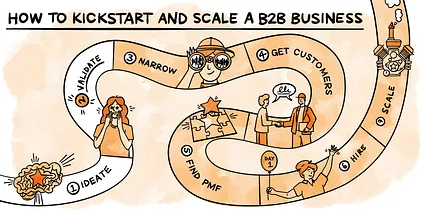 Welcome to part two of kickstarting and scaling a B2B business. Here’s where we’re at: - **Part 1:** [How to come up with a great B2B startup idea](https://www.lennysnewsletter.com/p/how-the-most-successful-b2b-startups) - **Part 2:** How to validate your idea *← This post* - **Part 3:** [How to identify your ICP](https://www.lennysnewsletter.com/p/how-to-identify-your-ideal-customer) - **Part 4:** [How to find and win your first 10 customers](https://www.lennysnewsletter.com/p/how-to-win-your-first-10-b2b-customers) - **Part 5:** [How to find product-market fit](https://www.lennysnewsletter.com/p/finding-product-market-fit) - **Part 6:** [How, and when, to hire your early team](https://www.lennysnewsletter.com/p/hiring-your-early-team-b2b) - **Part 7:** [How to scale your growth engine](https://www.lennysnewsletter.com/p/scaling-your-b2b-growth-engine) Let’s get into it. *A huge thank-you to **[Akshay Kothari](https://www.linkedin.com/in/akothari/)** (COO of Notion), **[Ali Ghodsi](https://www.linkedin.com/in/alighodsi/)** (CEO of Databricks), **[Barry McCardel](https://www.linkedin.com/in/barrymccardel/)** (CEO of Hex), **[Boris Jabes](https://www.linkedin.com/in/borisjabes/)** (CEO of Census), **[Calvin French-Owen](https://www.linkedin.com/in/calvinfo/)** (co-founder of Segment), **[Cameron Adams](https://www.linkedin.com/in/themaninblue/)** (co-founder and CPO of Canva), **[Christina Cacioppo](https://www.linkedin.com/in/ccacioppo/)** (CEO of Vanta), **[David Hsu](https://www.linkedin.com/in/dvdhsu/)** (CEO of Retool), **[Eilon Reshef](https://www.linkedin.com/in/eilonreshef/)** (CPO of Gong), **[Eric Glyman](https://www.linkedin.com/in/eglyman/)** (CEO of Ramp), **[Guy Podjarny](https://www.linkedin.com/in/guypo/)** (CEO of Snyk), **[Jori Lallo](https://www.linkedin.com/in/jorilallo/)** (co-founder of Linear), **[Julianna Lamb](https://www.linkedin.com/in/juliannaelamb/)** and **[Reed McGinley-Stempel](https://www.linkedin.com/in/reed-mcginley-stempel-17362245/)** (co-founders of Stytch), **[Mathilde Collin](https://www.linkedin.com/in/mathilde-collin-bb59492a/en/)** (CEO of Front), **[Rick Song](https://www.linkedin.com/in/rick-song-25198b24/)** (CEO of Persona), **[Rujul Zaparde](https://www.linkedin.com/in/rujulz/)** and **[Lu Cheng](https://www.linkedin.com/in/lu-cheng-973b7830/)** (co-founders of Zip), **[Ryan Glasgow](https://www.linkedin.com/in/ryanglasgow/)** (CEO of Sprig), **[Shahed Khan](https://www.linkedin.com/in/shahedkhan/)** (co-founder of Loom), **[Shishir Mehrotra](https://www.linkedin.com/in/shishirmehrotra/)** (CEO of Coda), **[Sho Kuwamoto](https://www.linkedin.com/in/shokuwamoto/)** (VP of Product of Figma), **[Spenser Skates](https://www.linkedin.com/in/spenserskates/)** (co-founder and CEO of Amplitude), and **[Tomer London](https://www.linkedin.com/in/tomerlondon/)** (co-founder and CPO of Gusto) for contributing to this series. Art by [Natalie Harney](https://www.natalieharney.com/).* ---  Forty percent (nearly half!) of the companies I spoke with went through at least one failed idea before discovering something that worked. Some went through 10. As [Christina Cacioppo](https://www.linkedin.com/in/ccacioppo) eloquently put it, “Our first couple of ideas were just total crap.” Many shared the same sentiment. Here’s how some of today’s biggest B2B startups began: - **Retool** started as Venmo for the U.K. - **Amplitude** started as a voice recognition application that allowed you to send and receive text messages by talking to your phone - **Segment** started as a university classroom lecture tool - **Vanta** started as B2B Alexa - **Notion** started as a no-code website builder - **Loom** started as a marketplace for companies to hire subject-matter experts - **Slack** started as a game called Glitch - **Box** started off as a “box” to put photos and content in on Facebook The question we’ll be tackling in today’s post is this: Once you have your startup idea, how do you know if it’s a big idea or... total crap? Below, I’ll share: 1. How the best founders validated their idea 2. What specifically convinced them to go all-in 3. How many people they spoke to before committing to the idea 4. What true pull looks like 5. Which companies pivoted and which had the right idea from the start #### Some of my biggest takeaways and surprises: 1. Founders spoke to a median of 30 potential customers before feeling like their idea was solid. 2. Outbound sales is consistently the best signal for validating your idea (versus friends using your product, incubator batch-mates, or investor leads). 3. Only about a third worked with design partners. 4. There are four ways to validate your startup idea—and it’s fairly clear which path you should take depending on your product and your experience in the problem space. 5. There are four signs your idea has legs: 1. **People pay you money:** Several people start to pay for your product, ideally people you don’t have a direct connection to 2. **Continued usage:** People continue to use your prototype product, even if it’s hacky 3. **Strong emotion:** You’re hearing hatred for the incumbents (i.e. pain) or a deep and strong emotional reaction to your idea (i.e. pull) 4. **Cold inbound interest:** You’re seeing cold inbound interest in your product 6. *Every* prosumer collaboration product, including Figma, Notion, Coda, Airtable, Miro, and Slack, spent *three to four years* wandering in the dark until they stumbled on something that clicked. I’ll share these stories below. 7. As I mentioned, about 40% of startups pivoted at least once before landing on their winning idea—oftentimes more than once. This rate is a lot higher than [in B2C](https://www.lennysnewsletter.com/i/48316625/high-level-takeaways), where it’s closer to 20%. 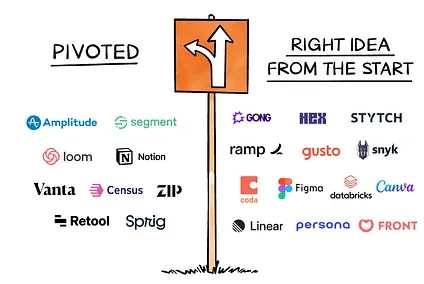 ## Four strategies for validating your B2B startup idea Across two dozen interviews, I noticed four distinct paths to effectively validating a startup idea: 1. **The do-it-manually path:** Don’t build anything—solve the problem manually first, for a small number of companies 2. **The listening path:** First talk to tons of potential users, and then start building 3. **The prototype path:** Start building a prototype and then co-create it with a small number of design partners 4. **Just launch and see how it goes** If you look closely, all four paths are just different ways to validate the same things we focused on in [part 1](https://www.lennysnewsletter.com/p/how-the-most-successful-b2b-startups) — *pull* and *pain* —with varying degrees of up-front investment. Here’s what pain and pull look like in practice: 1. **People pay you money:** Several people start to (or offer to) pay for your early product, ideally people you don’t have a direct connection to. 2. **Strong emotion:** You’re hearing hatred for the incumbents (i.e. pain) or a deep and strong emotional reaction to your idea (i.e. pull). 3. **Cold inbound interest:** You’re seeing cold inbound interest in your product. 4. **Continued usage:** If you’ve got a prototype running, people continue to use your product even if it’s bad. ### 1\. The do-it-manually path: Solve the problem manually for a small number of companies This path is a great choice for founders who are unclear whether the problem they are going after is important, or even solvable. Though it was the least common path, when done right, it can unlock huge lessons with very low up-front investment. In the case of **Vanta**,Christina Cacioppo sensed there was a big opportunity in the compliance/security space but wasn’t confident the pain was that bad. So she manually created compliance reports for a few companies and noticed (surprisingly) that they all found them very valuable: > “ **There was about a six-month process before we started coding where we talked to about two dozen companies.** **Initially I simply answered security questionnaires for a company myself. They sent me their old questionnaires and they would send me new ones, and I would manually do the copy and paste.** > > At the time, no one really got SOC 2 certifications, and we didn’t know anything about them. I went and read two dozen SOC 2s and then went to a company and did a readiness assessment for them. We made them a SOC 2 report card in a spreadsheet, interviewed all their people, and wrote out, ‘Here’s all the stuff you have to do for a SOC 2.’ **And the test there, honestly, was: one, would they spend time with us, and two, would they believe us? Would they think the spreadsheet was useful?** > > We did this first with Segment, and they really liked it. We were like, ‘Wait, really? Are you serious?’ Then we went and took our spreadsheet to Front, and we basically gave it to Front. We did a find-and-replace in the doc from ‘Segment’ to ‘Front.’ And that was a test of whether that’s useful to Front. Can we standardize this? And that actually was useful to Front. > > **And then we got an email from an old Dropbox colleague who was like, ‘I hear you guys have become SOC 2 consultants. That’s super-weird. I thought you were going to do other things with your life. But also, can you come do this for my company?’ And that’s when it was like, no, but I’ll start writing code. That was the validation process for us.**” > > — [Christina Cacioppo](https://www.linkedin.com/in/ccacioppo), founder and CEO The founders of **Ramp** did the same thing with savings reports: > **“** We came at it with this theory of: We’re experts in savings, and we’re really interested in this idea of a credit card that would save your business money. We think we can save you money, but we want to prove it to you. > > **So we did these things we called ‘Savings reports,’ where we would ask founders for the last 90 days of their credit card purchases or ACHs and—manually, but they didn’t know it was manual—come back to them with ideas to save their business money.** > > One of the early aha moments there was a company that was legitimately spending money on seven different project management tools. They were growing so fast that they had forgotten to cancel the subscriptions. They had adopted Basecamp and Trello and Asana and Smartsheet, and all these things that they later abandoned. I think it was a hundred grand on software they weren’t using. We came back and were like, ‘There’s $200,000 in savings. You don’t have to use us, just go and enjoy this tip. But by the way, this is what our software does, and we can do this for you ongoing and automatically.’” > > — [Eric Glyman](https://www.linkedin.com/in/eglyman/), co-founder and CEO ### 2\. The listening path: First talk to tons of potential users and then start building This path should be your default, unless you have a clear sense of what you need to build. Go this route with the goal of speaking with around 30 potential customers, looking for pain and pull (see above what that means). The founders of **Zip** spoke with 75 potential users before committing to their idea: > “ **We did a lot of interviews with CFOs, heads of procurement, heads of finance (I think the exact number is around 75), and over the span of two to three weeks.** It really helped refine that idea. We had like 110 pages of notes or something in those two or three-ish weeks. Turns out the response rate is pretty good on LinkedIn when you just want advice. > > We would be like, ‘All right, we had these three ideas. These two suck, but maybe we should tweak this idea because of what these two or three people said.’ And so we’d keep honing it down, honing it down, honing it down, iterating every day. > > **We also had a very stringent list of, I think, 16 criteria for the idea we were going to work on. And this idea actually met all of them.** > > 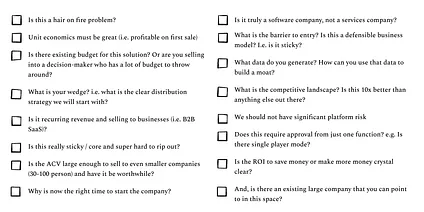 > > Zip’s actual 16-point checklist > > But we were very honest with ourselves. We worked on a bunch of terrible ideas before, and if there’s anything we had learned, it’s that today will be the easiest day to kill the idea and do something better. It’ll always be harder tomorrow because you’ll have more customers if you’re fortunate (or unfortunate). You’ll be more emotionally attached to it; you’ll have more sunk cost.” > > — [Rujul Zaparde](https://www.linkedin.com/in/rujulz/) and [Lu Cheng](https://www.linkedin.com/in/lu-cheng-973b7830/), co-founders The founders of **Stytch** spoke with about 30 people and noticed there was universal hatred (i.e. pain) for the existing solution. Then they started building, and launched quickly, per the advice of their lead investor: > “We talked to about 30 people over the course of a few months, mostly fintech developers, but also friends that weren’t in the fintech space that know how to build authentication. We asked them what they used for authentication and what they thought of it. For most of them, it was either Auth0, Google Firebase, AWS Cognito, or in-house. **And pretty universally, everyone hated whatever they were using.** It turned into a snowball of momentum, where at a certain point it just seemed inevitable that we were going to do this. > > **We specifically didn’t go the design partner route, and instead focused on getting a self-serve product out as soon as possible, specifically an email magic links product.** > > [Chetan](https://www.linkedin.com/in/chetanputtagunta) (our lead investor at Benchmark) gave us advice that selling authentication to large companies would take a long time, since they’d need a lot of features. The advice we had gotten was if they really want just this one product, that’s great. Let them be a design partner and partner with you. More likely, they’re probably going to keep asking for things that aren’t in your ability to serve them right now. So see what you can do to serve that broader long tail of the internet with your wedge and see if you can get that going. If really we had built for only one of those, we probably would’ve waited another year to launch.” > > — [Julianna Lamb](https://www.linkedin.com/in/juliannaelamb/) and [Reed McGinley-Stempel](https://www.linkedin.com/in/reed-mcginley-stempel-17362245/), co-founders The founders of **Gusto** had an extremely similar experience, both in terms of finding real hatred for the existing solution and also talking to exactly 30 potential customers: > “ **I had 30 people I talked to about the original idea. This is before we wrote a single line of code and before we actually committed to the payroll idea. We had a list of 30 people that Josh \[Reeves, co-founder\] and Eddie \[Kim, co-founder\] and I knew one way or another—some from Stanford, some from other networks—and I asked them for the names of friends who had small businesses. And for every call we did, we asked them, ‘Who are your friends who have small businesses?’** I literally was calling people out of Yelp. > > Over time, if you look at the first call transcript and compare that to the 30th call transcript, it’s a very different call. In the beginning, you’re very open, exploratory, lots of different ideas and options. In the end, it was really mostly validating what you’re seeing. > > The thing I was looking for in retrospect is emotional reaction. When you talk with a customer and you’re like, ‘Hey, here’s a new type of mint. The reason why it’s different is because it’s organic and it’s local,’ and then the person says, ‘Oh yeah, that’s cool.’ You say, ‘Would you buy it?’ They’re like, ‘Yeah, yeah, I may buy it.’ That’s not the feedback you’re after. That basically means that, no, they’re not going to buy it. They’re just being nice. > > **What you’re looking for is really, really deep emotion.** So, what I heard from people was extreme frustration with their current payroll providers. The moment you just asked them the simple question of ‘What do you feel about your current payroll provider, your payroll system?’ they started cursing, literally. More than half of people just started cursing and being really upset. **When you hear that strong emotion, then you know you have something.**” > > — [Tomer London](https://www.linkedin.com/in/tomerlondon/), co-founder and CPO Guy Podjarny, the co-founder of **Snyk**,spent time talking to dozens of potential users before building anything, not so much to validate the problem (it was obvious) but to make sure that if he built the solution, companies would embrace it: > “The value in getting security built into the development process was already well recognized, so **I didn’t need to validate the idea. What I needed to firm up was whether if I built the solution, developers would actually embrace it.** Therefore, my early conversations were not with security people but rather with developers and entrepreneurs, especially founders of companies in the DevOps space. > > I had several dozen such conversations in the opening days, and focused not on finding potential customers but rather on deeply understanding what it means to build a dev tooling company, and how it differs from a cybersecurity one. > > DevOps founders were quite supportive of the idea, and agreed with both the need and the opportunity. They’ve all seen or run companies that disrupted incumbents by embracing a DevOps approach. The few security people I spoke to were skeptical, agreeing it’d be valuable but not believing it possible. **This firmed up my conviction that this was the right problem to tackle. I thought, ‘It’s hard, but if I pull it off, it’ll be big.’** ” > > — [Guy Podjarny](https://www.linkedin.com/in/guypo/), co-founder and CEO The founders of **Ramp** spoke to more than 100 potential users before jumping in and building anything (even before building their manual solution): > “ **Before we shipped a single card, we talked to over 100 finance and founder teams.** We’d reach out to old YC batch-mates, or old friends who left companies and went to other companies; also the founders in the New York tech ecosystem.” > > — [Eric Glyman](https://www.linkedin.com/in/eglyman/), co-founder and CEO You may think you’ve talked to enough people, but don’t stop until you’re seeing evidence of real pull (e.g. money, usage, strong emotion, cold inbound). Spenser Skates, the founder of **Amplitude**, stopped at 30 conversations and later realized he should have talked to more: > “We did not talk to nearly enough. We talked to 30 different companies within a month. I should have aimed higher, like 50 companies in a month. But we talked to 30 in a month before building anything at all just to see, ‘Hey, is this something potentially interesting?’ > > **And out of that group, there were probably 10 folks that we identified that could potentially use this, and then five that had so much of a need they might pay money. Out of that group of 30, how many ended up being paid customers? A grand total of zero. We knew there was a need, but we made the mistake after that month of going straight to building, because we were like, ‘Well, instead of having all these speculative conversations, we actually want to have something to show people.’** > > Some of them used it, but were they interested in paying money? Hell, no. I think in retrospect, I should have continued dedicating half of my time to going out and talking to customers. But that’s in retrospect. In the end, though, it worked out.” > > — [Spenser Skates](https://www.linkedin.com/in/spenserskates/), CEO and co-founder -
win-first-10-b2b-customers.md 40.4 KB
### Part four of my seven-part series on kickstarting and scaling a B2B business *👋 Hey, I’m Lenny and welcome to a **🔒 subscriber-only edition 🔒** of my weekly newsletter. Each week I tackle reader questions about building product, driving growth, and accelerating your career.* --- 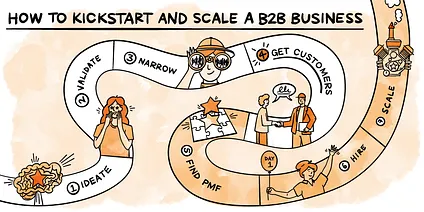 Welcome to part four of our series on how to kickstart and scale a B2B business: - **Part 1:** [How to come up with a great B2B startup idea](https://www.lennysnewsletter.com/p/how-the-most-successful-b2b-startups) - **Part 2:** [How to validate your idea](https://www.lennysnewsletter.com/p/how-to-validate-your-b2b-startup) - **Part 3:** [How to identify your ICP](https://www.lennysnewsletter.com/p/how-to-identify-your-ideal-customer) - **Part 4**: How to find and win your first 10 customers *← This post* - **Part 5:** [How to find product-market fit](https://www.lennysnewsletter.com/p/finding-product-market-fit) - **Part 6:** [How, and when, to hire your early team](https://www.lennysnewsletter.com/p/hiring-your-early-team-b2b) - **Part 7:** [How to scale your growth engine](https://www.lennysnewsletter.com/p/scaling-your-b2b-growth-engine) Let’s get into it. *A huge thank-you to **[Akshay Kothari](https://www.linkedin.com/in/akothari/)** (COO of Notion), **[Ali Ghodsi](https://www.linkedin.com/in/alighodsi/)** (CEO of Databricks), **[Barry McCardel](https://www.linkedin.com/in/barrymccardel/)** (CEO of Hex), **[Boris Jabes](https://www.linkedin.com/in/borisjabes/)** (CEO of Census), **[Calvin French-Owen](https://www.linkedin.com/in/calvinfo/)** (co-founder of Segment), **[Cameron Adams](https://www.linkedin.com/in/themaninblue/)** (co-founder and CPO of Canva), **[Christina Cacioppo](https://www.linkedin.com/in/ccacioppo/)** (CEO of Vanta), **[David Hsu](https://www.linkedin.com/in/dvdhsu/)** (CEO of Retool), **[Eilon Reshef](https://www.linkedin.com/in/eilonreshef/)** (CPO of Gong), **[Eric Glyman](https://www.linkedin.com/in/eglyman/)** (CEO of Ramp), **[Guy Podjarny](https://www.linkedin.com/in/guypo/)** (CEO of Snyk), **[Jori Lallo](https://www.linkedin.com/in/jorilallo/)** (co-founder of Linear), **[Julianna Lamb](https://www.linkedin.com/in/juliannaelamb/)** and **[Reed McGinley-Stempel](https://www.linkedin.com/in/reed-mcginley-stempel-17362245/)** (co-founders of Stytch), **[Mathilde Collin](https://www.linkedin.com/in/mathilde-collin-bb59492a/en/)** (CEO of Front), **[Rick Song](https://www.linkedin.com/in/rick-song-25198b24/)** (CEO of Persona), **[Rujul Zaparde](https://www.linkedin.com/in/rujulz/)** and **[Lu Cheng](https://www.linkedin.com/in/lu-cheng-973b7830/)** (co-founders of Zip), **[Ryan Glasgow](https://www.linkedin.com/in/ryanglasgow/)** (CEO of Sprig), **[Shahed Khan](https://www.linkedin.com/in/shahedkhan/)** (co-founder of Loom), **[Shishir Mehrotra](https://www.linkedin.com/in/shishirmehrotra/)** (CEO of Coda), **[Sho Kuwamoto](https://www.linkedin.com/in/shokuwamoto/)** (VP of Product of Figma), **[Spenser Skates](https://www.linkedin.com/in/spenserskates/)** (co-founder and CEO of Amplitude), and **[Tomer London](https://www.linkedin.com/in/tomerlondon/)** (co-founder and CPO of Gusto) for contributing to this series. Art by [Natalie Harney](https://www.natalieharney.com/).* --- 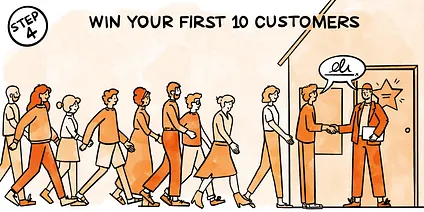 Let’s jump right into it. 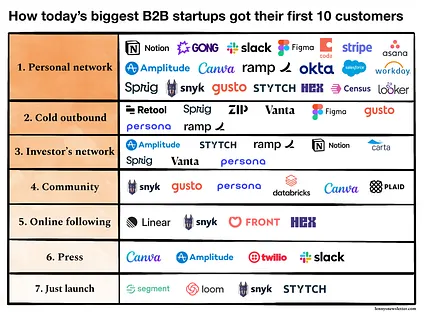 ### Here’s my recommended sequence to find your early customers: 1. Start by reaching out to your network, looking for people who match your ICP 2. Go cold outbound, but be strategic about it 3. Tap your investors’ networks 4. Participate in relevant communities—and network 5. Put out compelling content and build a following online 6. Get press 7. Just launch **If you want to keep it really simple:** 1. Start with former colleagues (yours, and those of your early employees) 2. Collect your investors’ contacts who match your profile and then go cold outbound (creatively)—more on this below 3. Find a community where your ICPs might be hanging out, and go participate ### My biggest takeaways from this step: 1. None of these seven strategies scale. That’s why they work. In B2B, it always starts with hand-to-hand combat. 2. Cold outbound works—if done creatively. 3. PR can work, but rarely does. 4. A surprising number of founders found their early customers by putting out compelling content online and first building a following. 5. Y Combinator (YC) especially is very effective at helping you get early users, but not the way you’d think (as you’ll see below). Also, major shoutouts for First Round Capital. 6. When joining communities, focus first on adding value to the community. No one wants to pay attention to you if you’re there just to pitch your product. 7. For your first set of customers, trust is the key. ## How to find and win your first 10 customers ### 1\. Start by reaching out to your personal network, looking for people who match your ICP Think about your friends—and their friends. Do any fit your ideal customer profile? This group will have the most innate trust (and the lowest amount of skepticism) about your idea. You won’t find a more supportive group to start with (though there’s a downside to this, as you’ll see below). For **Figma**, Dylan Field reached out to design-oriented founders who he knew from previous projects: > “ **The early batch of alpha customers were just mostly friends, and friends of friends, of Dylan.** Dylan’s the kind of guy who’s always been a mover and shaker, with connected people in the industry ever since he was a teenager. He’s just a nice, smart guy. The first company that used Figma is a company that at the time was going by the code name Krypton and now is known as Coda— [Shishir’s](https://www.linkedin.com/in/shishirmehrotra/) company. Dylan and Shishir knew each other from before.” > > — [Sho Kuwamoto](https://www.linkedin.com/in/shokuwamoto/), VP of Product **Gong** ’sfounders found their early customers through connections of theirs, along with connections of their early employees: > “ **All of the first dozen customers were some sort of personal connection, either through \[CEO Amit Bendov\] or myself or other people we later brought on.** Our third or fourth employee was a part-time contractor out of the Bay Area, and he called the people he knew, like at Greenhouse Software, where he had consulted and had buddies, and asked if they wanted to try it out. It wasn’t even about selling to them, since we already knew them. But it worked.” > > — [Eilon Reshef](https://www.linkedin.com/in/eilonreshef/?originalSubdomain=il), co-founder and CPO **Coda** had the same experience—finding their early customers through former colleagues and early employee connections: > “My former colleague Noam Lovinsky was starting a company, and I said to him, ‘Hey, would you use Krypton \[our name at the time\]?’ His company started using it, and for a while, it went well. Eventually, however, this led us to rework the entire product. > > Then we recruited our next set of customers. We called those the ‘Alpha 2’ customers. One was a jewelry shop run by one of our employee’s wives. Another was a tech company that my co-founder, Alex \[DeNeui\], started. Box, which was an early customer, came through our head of recruiting, Kenny. **All were recruited one or two steps out from friends of the company**.” > > — [Shishir Mehrotra](https://www.linkedin.com/in/shishirmehrotra/), co-founder and CEO For **Census**,all of their early customers came through the founders’ networks—mostly one super-connected co-founder: > “ **Most of our early growth had to do with being in San Francisco and from our loose network of friends.** **Half of the first 10 came through Sean \[Lynch, co-founder\].** Everybody knows Sean, and Sean knows everyone. Sean was like, ‘Hey, let’s go talk to all these ex-Dropbox people who are at new companies and see what they think.’ The Dropbox mafia turned out to be the perfect fit for Census because most ended up at new product-led companies and wanted to do it better than Dropbox. Our pitch resonated very easily. > > **The other half was people who I knew. People who were doing B2B that I knew living in the Valley for a while.** Fivetran is one of our earliest customers. They were in the first 10, and the co-founders of Fivetran and I went through Y Combinator 10 years ago. It was an easy conversation to have. You can skip all the niceties of doing customer discovery. And when they look at a janky demo, they’re like, ‘Yeah, dude, I remember. It’s all good.’” > > — [Boris Jabes](https://www.linkedin.com/in/borisjabes/), co-founder Same for **Hex**: > “ **A few of our first 10 customers were from our network. It was people I knew in the data space.** It’s one of the many reasons why I am always so confused by founders who start something that’s far outside their wheelhouse, especially in B2B, because you just have a built-in network if it’s something you know well. Glossier is an example of this. We had friends there.” > > — [Barry McCardel](https://www.linkedin.com/in/barrymccardel/), co-founder And **Okta**: > **“We reached out to our networks, folks we knew in IT from Salesforce and past jobs.** We networked aggressively on LinkedIn with our alma mater networks etc. We asked our angel investors and combed their LinkedIn networks. I had a target of 15 to 18 net new IT folks at different companies to talk to every month for the first six months and probably hit 85%-plus of my quota.” > > — [Frederic Kerrest](https://www.linkedin.com/in/fkerrest), COO and co-founder And **Gusto**: > **“Gusto’s first 10 customers came from friends we knew who were just starting their businesses in California.** **Mostly new tech startups from our YC batch, but also non-tech small businesses** (like a children’s swimming camp) that we happened to know through family and friends. We \[three founders\] basically went around telling everyone we knew that we’re building a modern delightful payroll and HR system and asked if they’d know someone who’d be interested in trying it out.” > > — [Tomer London](https://www.linkedin.com/in/tomerlondon/), co-founder and CPO And **Ramp** (alongside some other strategies we’ll touch on below)**:** > “We got our first 10 customers any way we could, really. The first one was an early employee of our last startup. And they were like, ‘All right, as long as you don’t screw up my business and I can run it, I can make payments, rent it on yourselves for a little bit, but then I’ll try it because I like you.’ And there were a few other people like that, where there was a very close kind of trusting relationship. > > You knew that you had us—we personally were going to go and obsess over saving your company money—and it was small enough scale and they had backups, that it was okay to do it. Later on, a lot of this came from co-building. Candid was one of our early large customers. They were at that time very high-flying direct-to-consumer. [Ro](https://ro.co/) is very much this kind of way, where a relationship developed over time, multiple meetings, talking about the idea and how it would come to life. > > The next 40 came from a combination of friends, entrepreneurs, different people we met in the city, different finance teams, but also some level of cold or semi-cold outreach. Also, VC introductions and co-building. That was the story of the first 10 for sure. One of the first 50 was Truebill, which became Rocket Money. It was a cold email and we had met each other years before.” > > — [Eric Glyman](https://www.linkedin.com/in/eglyman/), co-founder and CEO And **Notion**. Also, it’s fascinating how many of these early stories connect back to Dylan and Figma 🤷♂️ > **“The first 10 were probably just friends and family, and founders of fellow San Francisco startups. Some we got connected to through the investors we had.** > > Figma was an early user of Notion, and we were also heavy users of Figma. Dylan and Ivan \[Zhao, co-founder and CEO\] and I have been long friends, so I know Ivan was sort of a crazy power user of Figma, giving them a ton of early feedback, and I believe that’s probably the case the other way around as well.” > > — [Akshay Kothari](https://www.linkedin.com/in/akothari), co-founder and COO ### 2\. Go outbound, but be strategic about it One of the recurring themes (and biggest surprises) across my interviews is the value, and effectiveness, of going cold outbound in the early stages—cold emails, cold DMs, cold calling. But you need to be clever about how you do this. If you aren’t getting a good response, get more creative and more targeted. Dylan Field at **Figma** built a custom tool to find the most influential designers on Twitter and focused all his energy there: > “We recognized for design software, there’s no choice but to go bottom-up. You cannot go top-down with designers. Designers are the ultimate arbiters of what makes a good design tool. You’re not going to tell a musician, hey, don’t use your violin that you love, use this other violin. People get really attached to their tools. We had to appeal to individual designers. And designers find out about tools not by looking at price and looking for the cheapest thing, but by seeing what other designers are using. > > **So Dylan actually [built a custom script to find the most influential designers on Twitter](https://twitter.com/zoink/status/1566566649712431105?s=20) and cold-DM’d them to show them Figma. That’s how it started.”** > > — [Sho Kuwamoto](https://www.linkedin.com/in/shokuwamoto/), VP of Product David Hsu at **Retool** used Crunchbase in an incredibly clever way: > “We were very tactical. Here’s exactly what we did—and it still works today. We bought a Crunchbase account. (In fact, we actually shared a Crunchbase account with five other companies, because we were very frugal at that point.) > > **We filtered Crunchbase by data points like when was the last time the company fundraised and what verticals they’re in. We didn’t want SaaS, because SaaS companies actually don’t build that many internal tools. We wanted delivery startups, we wanted fintech, we wanted stuff that’s very operationally heavy.** > > And then we emailed the CTO and VP of operations at these companies, because the engineering team experiences the pain of not being able to build tools, but the operations teams experience the pain of not having the tools. These were our ICPs. > > We learned a lot from this outbounding exercise. That’s how we got DoorDash as our customer; that’s how we got Rappi (a few-thousand-person company) as well. Then we got Brex as a customer in this same way.” > > — [David Hsu](https://www.linkedin.com/in/dvdhsu/), founder and CEO Rujul Zaparde and Lu Cheng at **Zip** exclusively used LinkedIn—and focused on getting feedback from people versus trying to sell them right away: > “ **For us, we got our first 10 customers by reaching out for advice on LinkedIn. Truly, it was advice at first, until we had a clear perspective on who to go after.** > > We made an active decision to focus on cold outbound, versus friends. We wanted to know if this was a shitty idea or a good idea. And if we sell to friends, they might buy it because they feel bad or whatever. It’ll confuse us. So we have to get the first 10 essentially cold. They shouldn’t owe us anything. They should buy it because they see value in it, and that’s how we’ll know it’s a good idea. So they were all cold through LinkedIn. > > Our first customer was a company called Deserve. There were 80 people. And I remember we did a bunch of calls with the CFO, and we were in YC approaching demo day, and we were like, ‘Dude, we really need the revenue.’ And he just felt bad, I think. And he was like, ‘All right, I’ll pay you a thousand dollars.’ And we’re like, ‘How about 10?’ And then we landed on seven, I think.” > > — [Rujul Zaparde](https://www.linkedin.com/in/rujulz/) and [Lu Cheng](https://www.linkedin.com/in/lu-cheng-973b7830/), co-founders One common thread is that you just need to hustle, as described by **Gusto** and **Persona**: > “We had a swimming instructor’s company who heard about us from her brother, who was in a startup that we knew. Also, a flower shop that Eddie \[Kim, co-founder and CTO\] went to buy at and asked her, ‘Hey, what are you using for payroll?’ Basically, we hustled all the way.” > > — [Tomer London](https://www.linkedin.com/in/tomerlondon/), co-founder and CPO of Gusto > “We would build anything for anybody. The initial milestone we had was ‘As long as it has something to do with identity, we will do anything.’ I used to joke with Charles \[Yeh, co-founder\], ‘If we get one customer paying us anything, I’d call this a success.’” > > — [Rick Song](https://www.linkedin.com/in/rick-song-25198b24/), co-founder and CEO of Persona ### 3\. Tap your investors’ networks Though it’s not a large bucket, some startups found success leveraging their investors to find their first handful of customers, especially among YC. But not by asking for introductions—instead, by doing the hard work of digging into the investors’ own networks (including batch-mates within YC) and cold-emailing them. And not only pitching these founders but also asking them for intros to other founders who may be a fit. **Vanta** used YC’s resources to source older, more established YC startups: > “ **We got our first 10 customers through YC. This is why we did YC.** But not people in the actual batch, because companies in the batch were so early-stage and did not think about SOC 2s back in 2018. They do now, though. > > I went through the list of old YC companies, worked with our partner to prioritize them, and wrote outbound emails to the founders. I went through Bookface, the YC internal forum, and emailed anyone who’d ever said the word ‘compliance’ on Bookface in the prior decade. Literally. Somewhere in there, we got our first 10 customers.” > > — [Christina Cacioppo](https://www.linkedin.com/in/ccacioppo/), founder and CEO **Amplitude** similarly used YC, but not to get intros to batch-mate founders. Instead, to get into a network of product people who matched their ICP: > **“Our very first few customers were connections through investors and other folks at YC.** One mistake that YC companies make is trying to sell to other people in their batch. Those are not real companies. They don’t have money. A YC company is a speculative investment, not a business yet. You want to go sell someone who’s a real business and figure out how to solve their problems. > > The very first community we got word of mouth in was the ex-Zynga product managers who had gone on to build their own companies. Matt Ocko, who is an investor in us through Data Collective, introduced us to this guy Bret Terrill, who is the CTO and co-founder of Super Lucky Casino and was ex-Zynga. He got excited, and then from that, other folks in the Zynga community heard about us. He posted in their Facebook group or something.” > > — [Spenser Skates](https://www.linkedin.com/in/spenserskates/), co-founder and CEO **Sprig** tapped both YC and First Round’s unique internal resources to go cold outbound: > **“Our first 10 customers were all from cold emails to YC companies.** One of these emails led to a meeting with Thunkable, which ended up being our first customer that I had no connection to. They came over to our office, I did a demo, and they installed right there. A week later, I came back and helped them figure out all these issues and usability challenges, and they asked how much it cost. That was the first full sale where it was not a friend’s friend, or not my friend, or not someone I already knew or might know me. > > This is also where I love First Round Capital. I’ll sing their praises for the rest of my life. They have an SDR program (they don’t call it that; they call it a customer discovery program), but they basically have someone who is sending cold emails to your target customers for you, aiming to get you five meetings a week. Our partner, Bill Trenchard, told us, ‘We’re going to get you five meetings a week for exactly who you want to talk to, and then we’re going to meet with you every two weeks to talk about the feedback. We’re going to talk through the feedback, see what’s working, and you’ve got to get the company to a million ARR. Then you can hire salespeople.’” > > — [Ryan Glasgow](https://www.linkedin.com/in/ryanglasgow/), CEO And **Carta** found lots of success finding customers through their investors (likely because their product was for founders and investors): > “Our very early customers came from two places: > > 1. **The angel investors in our company:** Andy Palmer from [Tamr](https://www.tamr.com/) was an investor in eShares \[now Carta\] and brought it into his company early on. > 2. **Sister portfolio founders**: We had this personal connection to them through our investors. > > Other than that, it was just working the network.” > > — [Josh Merrill](https://www.linkedin.com/in/joshio/), ex-CPO ### 4\. Participate in communities, and network A surprising number of startups found some of their early customers by old-school networking and community building. This includes participating both in offline and online communities, and sometimes creating your own community. The founder of **Snyk** went to where their ICP users were spending time—meetups, events, and online communities: > “Since we were trying to get developers to take on a responsibility they’ve historically not embraced, it was critical to make the product extremely low-friction and focus on getting them using it. > > Therefore, we initially launched a freemium beta product, promoted it across open-source project maintainers and in dev communities, and didn’t have a paid version for nearly a year. **The first** ***users*** **of the product came from meetups and conference-based events, online content, and proactive reach-outs to our networks, dev thought leaders, and open source maintainers. We pretty quickly got to thousands of users, and a year later, the first (tiny) customers came out of that user base.**” > > — [Guy Podjarny](https://www.linkedin.com/in/guypo/?originalSubdomain=uk), founder and CEO **Plaid** similarly found success tapping online forums and meetups where developers and PMs spent time: > “We mostly grew through word of mouth in the developer and product manager community. **We invested in meeting founders of fintech companies, learning their problems, and seeing how Plaid could help. Lots of time spent on forums, IRC, meetups, and working with startup accelerators**.” > > — [Zach Perret](https://www.linkedin.com/in/zperret/), co-founder and CEO The founders of **Databricks** went further and organized their own events and community: > **“In the early Berkeley days, we would put on these events where we would say, ‘Come and do a hackathon with us and use our open source software.’ And we would sort of handhold them and say, ‘Oh, if you want to try to do machine learning, let’s help you figure this out.’** These were called AMP Camps. AMP was the name of the lab we were in at the time: Algorithms, Machines and People, because the lab was focused on using algorithms and then machines and then people, sort of the mix of those three. We put on these AMP Camps and they were popular, and we thought we were world-famous rock stars because we could get 70 people to come to it. About 70 people in the room just here using our software. I mean, it’s like, can you believe it?” > > — [Ali Ghodsi](https://www.linkedin.com/in/alighodsi/), co-founder and CEO **Persona** found great success at First Round Capital’s networking events: > “Our first customer actually was a friend of a friend’s vape shop; they needed help with age verification. > > **Some of our other early customers came through First Round. We would go to every one of their events, and whoever seemed they had some identity needs, we pitched them. Urban Sitter came through this. I had met them at one of these First Round events, and I think their founder had brought up something about identity verification, and all of us jumped on that deal.**” > > — [Rick Song](https://www.linkedin.com/in/rick-song-25198b24/), co-founder and CEO ### 5\. Put out compelling content and build a following online I was surprised by how many founders found their early users from their online presence. Some started sharing content online before they started the company, and some after. The founder of **Front** went big with content: > “We ultimately had 3,000 people signing up for our beta (mostly B2B). My approach was to inundate the market with content—write interesting content, post on Hacker News, post on Twitter, etc.) and see who signs up.” > > — [Mathilde Collin](https://www.linkedin.com/in/mathilde-collin-bb59492a/en/), founder and CEO The founders of **Linear** started building buzz and a following on Twitter early on, building on their existing Twitter following: > “A couple of our first 10 customers were through friends, but really, most of our early growth was building a wait list through Twitter. When we went full-time on the idea, we put out an announcement on Twitter to a landing page with an email signup. We had a good amount of Twitter followers among the three founders, so we were very privileged there.” > > — [Jori Lallo](https://www.linkedin.com/in/jorilallo/), co-founder As **Hex** ’s founder says, it’s never too late: > **“We started putting out a lot of content early on, writing about the problem we were solving and building an audience. That helped us build a wait list. Then we started sending out feature update emails as we were releasing features and got back replies, ‘This looks sweet. I’d love to try it.’ And then we’d spin up accounts for people, and they started using it and went from there.** > > Even with a large wait list, it took us a while to get to 10 customers. With a product that’s technical and complex, it takes a while to build a surface area big enough that you just feel good getting people on. > > Also, at some point, we saw this tastemaker effect where there were certain people who started using the product who would tell people, and so other people started using it. If we got some of the right people using it, we would get sort of a viral adoption effect. That was really cool to see happen.” > > — [Barry McCardel](https://www.linkedin.com/in/barrymccardel/), co-founder ### 6\. Get press Three startups I looked at had meaningful success with early PR. **Amplitude:** > “Soon after, we did a TechCrunch launch in early 2014, and we got a handful of customers through that. Keepsafe came through that. Normally PR is a terrible channel. You need to grow through communities and customers hearing about you through word of mouth.” > > — [Spenser Skates](https://www.linkedin.com/in/spenserskates/), CEO and co-founder **Canva:** > “We had a fair bit of press based on our very first funding round. Press loved writing about funding, so anytime you can talk about funding, it was easy to get a story.” > > — [Cameron Adams](https://www.linkedin.com/in/themaninblue/), co-founder and CPO **Slack:** > **“** With help from an impressive press blitz (based largely on the team’s prior experience—i.e. use whatever you’ve got going for you), they welcomed people to request an invitation to try Slack. On the first day, 8,000 people did just that; and two weeks later, that number had grown to 15,000. The big lesson here: Don’t underestimate the power of traditional media when you launch.” > > — [Stewart Butterfield](https://www.linkedin.com/in/butterfield/), co-founder and former CEO (via [First Round Review](https://firstround.com/review/From-0-to-1B-Slacks-Founder-Shares-Their-Epic-Launch-Strategy/)) ### 7\. Just launch, and wait for users to come to you Sometimes you build it and they do come, like in the case of Segment, Stytch, and Loom. **Segment:** > “We just launched on HN. [You can still read the post](https://news.ycombinator.com/item?id=4912076). In the early days, we got a lot of engineers trying out the product on their side projects. They told us what they’d need to bring it into their companies. We just sort of levered our way up into bigger and bigger markets that way. The short answer is launch, launch, launch.” > > — [Calvin French-Owen](https://www.linkedin.com/in/calvinfo/), co-founder **Stytch:** > “ **The first random (i.e. non-friend) internet user who used the product was a pretty exciting one. Our public beta had not even been released yet.** This one guy, Jon Ma, who ran Public Comps, had reached out on our site and had been one of the few I gave beta access to. We didn’t really expect anyone to deploy it into their production environment on a real product. We had a 20-minute conversation, gave them the API keys, and then eight hours later, we saw production traffic from them. Our eng team was like, did we know somebody was going to go into production?! > > After that, we were approaching launch and somebody was about to leak the story on us, so we just ended up publishing on our blog that we had raised the seed. Chetan \[Puttagunta\], our partner at Benchmark, retweeted it, and we started getting a lot of signups for demos, even if they didn’t have immediate use cases, just out of interest. Something like 40% to 50% converted to demos, and then maybe 20% of those converted to actually onboarding with the product.” > > — [Reed McGinley-Stempel](https://www.linkedin.com/in/reed-mcginley-stempel-17362245/) and [Julianna Lamb](https://www.linkedin.com/in/juliannaelamb/), co-founders **Loom:** > “ **We launched on Product Hunt and had thousands of people who downloaded the extension by day’s end.”** > > — [Shahed Khan](https://www.linkedin.com/in/shahedkhan/), co-founder ### Canva did all of the above 🤣👏 > “We had a big wait list that we had built up over time. That wait list had taken two years to build up, and it was all sorts of random connections, people we’d met at conferences, people that we’d done user testing with, friends, family, everyone. That wait list was probably 10,000 people by the time we launched. > > We’d laid the seeds for it, and then off the back of those seeds, we lined up a bunch of press for launch day, and we’d done a bunch of embargoes and gotten interviews with TechCrunch and ZDNet and a few other outlets. We’d given them a pre-demo of what the product was going to be on launch day, and then scheduled them all to launch at launch night. > > Here in Australia, it’s a bit different dealing with American press, because all these launches are basically at midnight in Australia. We stayed up all night watching the press come out and watching our real-time Google Analytics board as well, expecting all the people to roll in. We also sent out an email to our wait list saying the product was now ready, and we’d set up a big dashboard screen with Google Analytics on it so that we could see the thousands and millions of users rolling in on day one. > > Unfortunately, it didn’t quite happen that way. We had one user drip in, and then another user drip in five minutes later, and the flood of users didn’t quite materialize on day one. I remember feeling slightly dejected that night. > > We had put so much effort into the launch. For the week beforehand, we basically had no sleep as we were crunching bugs and polishing the product. And the number of people we got that night was a bit anticlimactic. I think it is really hard to convert press into actual users of your product, often because the articles don’t necessarily link to your product. People often just read about the product in the press and don’t actually make that leap across to your site. So it was quite a slow burn. It was by no means an overnight success. > > I think in that first week we probably got about a couple thousand signups, and then the week after that we got 5,000, and it slowly grew and grew. > > **Over time, there was never one silver bullet. It’s always just bits and pieces and that slowly agglomerates into a full acquisition channel. I remember one time, one of my old sites on my personal website started getting a huge amount of traffic for some weird reason. It was actually this Daft Punk visualization that I’d created, and it turned out that Daft Punk had released or teased an album at Coachella and someone had linked to my site, and it had started getting millions of visitors. So we actually put up a banner at the top of that which pointed to Canva, and I think we got more visitors via that than we actually got through our TechCrunch article. You try out all these weird and wonderful things to get traffic in the early days.** > > We were quite fortunate in that our early user base was a very talkative user base, so the people who were using Canva and the people who we had user-tested with and built community up with were social media managers and bloggers, so people who love to talk about the tools that they’re using and build an audience based around that. So a lot of our early Canva users were in that mold, and they were our best advocates. They were tweeting about Canva, they were writing blog posts about it, and that enabled the first six to 12 months of Canva’s growth.” > > — [Cameron Adams](https://www.linkedin.com/in/themaninblue/?originalSubdomain=au), co-founder and CPO ## Important takeaway: Trust is your secret weapon If you look back at the sequence above, it’s essentially a series of concentric circles with increasing distance from the founder. Or, put another way, decreasing levels of trust. 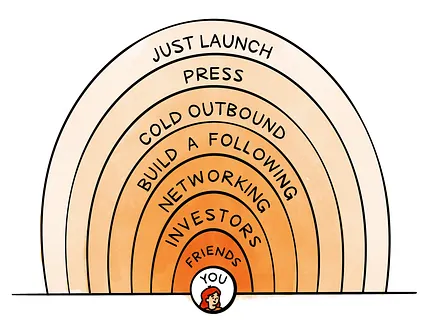 Takeaway: Start with the channels that have the most innate levels of trust, and work your way outward. Here’s [Sho Kuwamoto](https://www.linkedin.com/in/shokuwamoto/) ’s take on the importance of trust for **Figma** ’s early customers: > “ **It’s all a matter of trust. Somebody I trust is going to say, you should use this tool. I’m going to trust it way more than if a marketing team says that you should use this tool.** And so we tried to make sure that we understood those people and so we got them in early, but we also did a good job of trying to listen to them too. They’d give us feedback and they’d say, this is good and this is not good, and we take that seriously. > > As soon as the word got out: oh, there’s this new tool, it’s by this Greylock-funded company, they’re going to change everything about how design works; people are like, oh, I’ll sign up. So we already had a good list of people, and it was a matter of us reaching out to them to say, hey, would you like to be in the beta? And so on. > > They ask other designers, you’re like: hey, I just found this tool, it’s amazing; you should check it out. Or, oh, I hear that Airbnb is seriously using Figma. We should check it out. That’s how it happens. So we deliberately tried to understand, well, who are the people that people listen to the most? We actually dug into Twitter to understand how people are connected to other people on Twitter.” Same story for **Ramp** from [Eric Glyman](https://www.linkedin.com/in/eglyman/) (co-founder and CEO): > “ **They were like, ‘All right, as long as you don’t screw up my business and I can run it, I can make payments, rent it on yourselves for a little bit, but then I’ll try it because I like you.’ And there were a few other people like that, where there was a very close kind of trusting relationship.** > > You knew that you had us—we personally were going to go and obsess over saving your company money—and it was small enough scale and they had backups, that it was okay to do it.” And **Census**, from [Boris Jabes](https://www.linkedin.com/in/borisjabes/) (co-founder and CEO): > “Fivetran is one of our earliest users. They were in the first 10, and the co-founders of Fivetran and I went through YC 10 years ago. **It was an easy conversation to have. You can skip all the niceties of doing customer discovery.** And when they look at a janky demo, they’re like, ‘Yeah, dude, I remember. It’s all good.’” And Salesforce, from Marc Benioff, founder and CEO ([source](https://www.salesforce.com/blog/2013/09/marc-benioff-win-customers.html)): > **“It was challenging to convince prospects to try our service, and it was especially challenging to convince the first one**. Most people don’t want to be the first to take a giant risk. Realizing that truism was pivotal. We finessed our strategy to target pioneers who saw an opportunity to participate in something new and exciting. > > That first pioneer came in the form of [Blue Martini Software](https://en.wikipedia.org/wiki/Blue_Martini_Software), one of the small software companies in which I had previously invested. I knew I was asking for a favor when I called the founder, [Monte Zweben](https://twitter.com/mzweben), but I also knew I was offering something that he really needed.” And finally, [Shishir Mehrotra](https://www.linkedin.com/in/shishirmehrotra/), co-founder and CEO of Coda, who shares a strong perspective on targeting friends early on: > “How important is it that your early customers not be connected to the company? A lot of people tell you it’s super-important for them not to be connected. I don’t buy that. I think that certainly for a product like Coda, you can’t force anybody to use it. If they don’t like it, they will stop using it, regardless of how close they are to you. And I think the ability for them to give you honest feedback is actually higher if they know you.” This problem is especially hard for certain spaces, as [Rick Song](https://www.linkedin.com/in/rick-song-25198b24/) found when starting **Persona**: > “Early on, we knew very quickly that we couldn’t sell to anyone large. We were just too small. Size truly is a consideration, especially for certain types of products like security. They’d have to be insane for a mature company to work with a startup like us to build a PII system, especially one that wouldn’t be hosted on their own system. But this limitation was also very helpful, to be constantly thinking through, ‘Why would this person buy us?’” ### Again, here’s the sequence: 1. Start by reaching out to your network, looking for people who match your ICP 2. Go outbound, but be strategic about it 3. Tap your investors’ networks 4. Participate in communities—and network 5. Put out compelling content and build a following online 6. Get press 7. Just launch ### Next: A guide for finding product-market fit *Have a fulfilling and productive week 🙏* --- ## 📣 Join Lenny’s Talent Collective 📣 If you’re hiring, [join Lenny’s Talent Collective](https://www.lennysjobs.com/talent/welcome) to start getting weekly drops of world-class product and growth people who are passively open to new opportunities. I hand-review every application, and accept less than 10% of candidates who apply.  If you’re looking for a new gig, apply to join! You’ll get personalized opportunities from hand-selected companies. You can join anonymously, hide yourself from companies, and leave anytime. --- **If you’re finding this newsletter valuable, share it with a friend, and consider subscribing if you haven’t already. There are [group discounts](https://www.lennysnewsletter.com/subscribe?group=true), [gift options](https://www.lennysnewsletter.com/subscribe?gift=true), and [referral bonuses](https://www.lennysnewsletter.com/leaderboard) available.** Sincerely, Lenny 👋
-
-
SKILL.md 4.3 KB
---
name: b2b-expert-advisor
description: B2B startup strategy advisor grounded in Lenny Rachitsky's 7-part series and April Dunford's positioning framework. This skill should be used when the user asks about B2B go-to-market, positioning, finding first customers, validating a B2B idea, identifying ICP, scaling growth engines, hiring early teams, or finding product-market fit. Also triggers on B2B pricing, or "how do B2B startups" questions.
---

# B2B expert advisor

## Overview

Provide B2B startup strategy advice grounded in specific frameworks and data from Lenny Rachitsky's 7-part B2B series and April Dunford's positioning methodology. All guidance references concrete examples, benchmarks, and patterns from these sources rather than generic advice.

## Source library

The knowledge base lives in the `resources/` directory alongside this file. Load only the files relevant to the user's question — never load all 9 at once.

### Topic routing

| User question involves... | File to load |
|---------------------------|-------------|
| What successful B2B startups have in common, patterns, benchmarks | `resources/successful-b2b-startups.md` |
| Validating a B2B idea, testing demand, early signals | `resources/validate-b2b-startup.md` |
| ICP, ideal customer profile, who to sell to first | `resources/identify-ideal-customer.md` |
| First 10 customers, early sales, landing first deals | `resources/win-first-10-b2b-customers.md` |
| Product-market fit, PMF signals, when you have PMF | `resources/finding-product-market-fit.md` |
| Hiring, early team, first hires, team building | `resources/hiring-early-team-b2b.md` |
| Growth engine, scaling, channels, B2B growth | `resources/scaling-b2b-growth-engine.md` |
| Positioning (fundamentals), April Dunford, category design | `resources/positioning.md` |
| Advanced positioning, repositioning, positioning pitfalls | `resources/advanced-b2b-positioning.md` |

For questions spanning multiple topics (e.g., "how do I go from idea to first customers"), load 2-3 relevant files max.

## Workflow

1. **Route the question** — Match the user's question to 1-3 files from the topic routing table above.
2. **Load source material** — Read the matched files from `resources/`.
3. **Extract relevant frameworks** — Pull the specific frameworks, examples, benchmarks, or decision criteria that apply.
4. **Advise with citations** — Give concrete guidance. Cite the source article and specific frameworks by name (e.g., "April Dunford's 5-step positioning process" or "Lenny's B2B validation ladder").
5. **Apply to user's context** — When the user shares details about their specific product or market, cross-reference the frameworks against their situation.

## Advisory principles

- Lead with the specific framework or data point from the articles, not generic B2B wisdom.
- When the articles provide concrete numbers (e.g., benchmarks for PMF, typical timelines, conversion rates), cite them.
- When the articles name specific companies as examples, use those examples.
- If the user's situation doesn't match any pattern in the source material, say so explicitly rather than extrapolating.
- Connect advice back to the user's specific context when they share it.
- Distinguish between "the article says X" and "based on the pattern, I'd suggest Y for your case."

## Example interactions

**User**: "How should we think about positioning our product?"
- Load: `resources/positioning.md`, `resources/advanced-b2b-positioning.md`
- Apply April Dunford's framework to the user's specific situation

**User**: "What are the signals we've hit PMF?"
- Load: `resources/finding-product-market-fit.md`
- Extract the specific PMF indicators and benchmarks from the article
- Map them against whatever traction data the user shares

**User**: "How do we find our first 10 customers?"
- Load: `resources/win-first-10-b2b-customers.md`, `resources/identify-ideal-customer.md`
- Pull the specific playbooks and examples for early customer acquisition
- Contextualize for the user's target market

## Quality checks

- [ ] Advice references specific frameworks or data from the source articles
- [ ] Source article cited by name when quoting benchmarks or frameworks
- [ ] Generic B2B platitudes replaced with article-specific guidance
- [ ] User's context applied when they share details about their product/market
- [ ] Gaps in source material acknowledged rather than filled with guesses
Comments (0)
Sign in to join the conversation.
Reviews (0)
No reviews yet.
No comments yet.