67-graphics-desk-gadget-tour
Makes the "Desk Gadget Tour" animated graphic (a title typed on a handheld gadget on a grid desk, a full camera whirl, then a two-line headline typed on the paper) from the user's own text and colours, as a finished 9:16 video. Use when the user wants a gadget screen title reveal
Install
npx skills add https://github.com/pihu26112005/claude-editing-skills/tree/main/skills/67-graphics-desk-gadget-tour
claude plugin marketplace add https://llmmart.ai/marketplace.json && claude plugin install pihu26112005-claude-editing-skills@llmmart
git clone https://github.com/pihu26112005/claude-editing-skills.git
The skills CLI installs just this skill, for any of its supported agents. Claude Code installs the whole pihu26112005/claude-editing-skills collection as a plugin from our marketplace. Git is the plain clone.
README
67 · Desk Gadget Tour
Results
Your content, animated by Claude. A title typed on a handheld gadget over a grid desk, a full camera whirl, then a two-line headline; the demo uses a plant-habit app with a teal gadget.
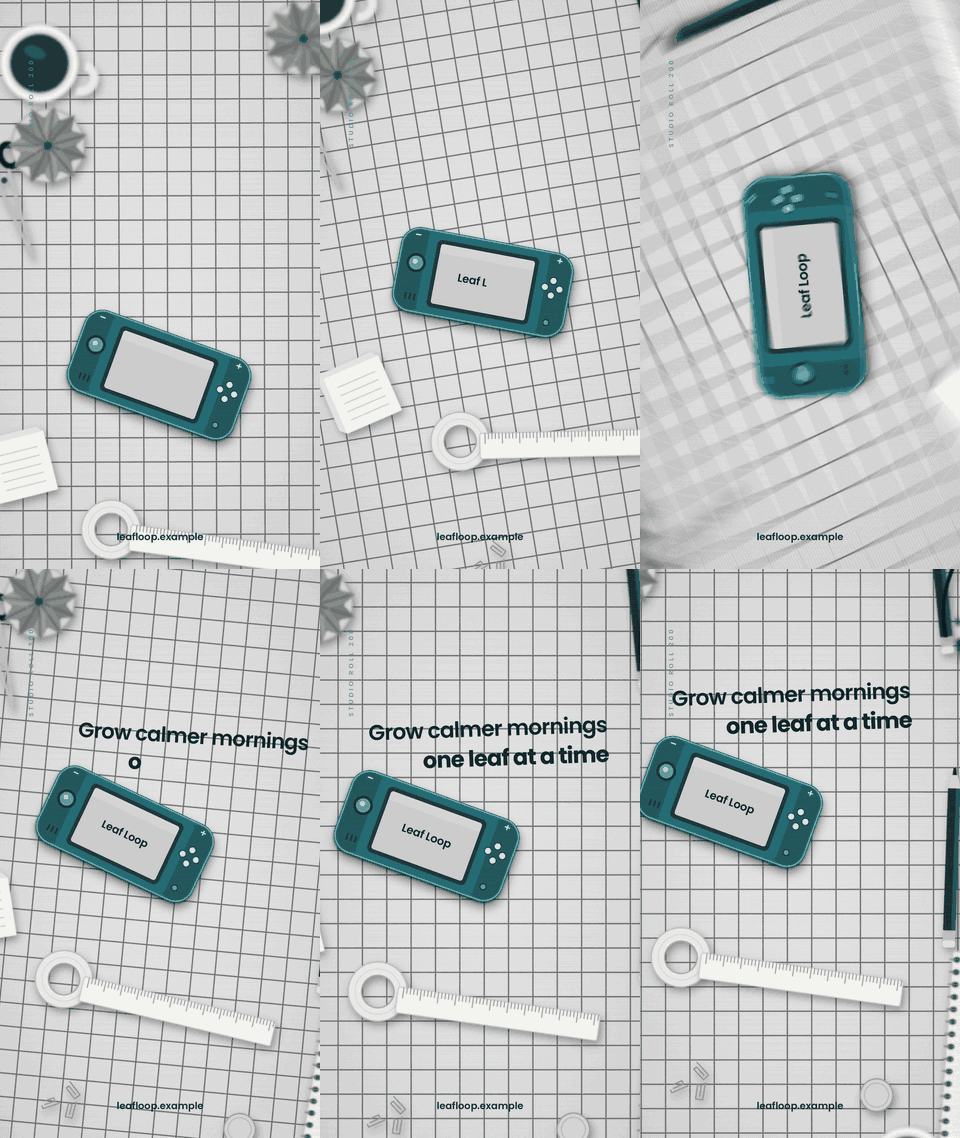
Format: 9:16 · 1080×1920 · 6.5 s
The graphic
A small handheld gadget lies on grid paper among desk props. Your title types onto its screen while the camera zooms in and tilts. The camera then spins one full turn around the desk, and a two-line headline types out on the paper next to the gadget. The camera drifts and holds.
Perfect for app and product teasers, vertical intros, launch announcements and "one-line promise" openers.
Give it:
- the screen text (up to 14 characters);
- a two-line headline (line 1 up to 22 characters, line 2 up to 20);
- optional: footer text, edge label, gadget colour (default charcoal), paper and text colour, grid off, props off.
What you get back: a finished 9:16 video (or a still image), rendered and checked by Claude.
What's inside:
- SKILL.md: how Claude collects your content, checks it and renders the graphic.
- description.md: the full specification: canvas, 11 parameters, every element and beat.
Try it:
/motion-graphics-skills:67-graphics-desk-gadget-tour
Make this graphic. Screen text: "Leaf Loop". Headline: "Grow calmer mornings" / "one leaf at a time".
Skill manifest
67 · Desk Gadget Tour
1. YOUR JOB
You make one animated graphic. Its design is fixed in description.md. Collect the parameter values, check them, render the graphic exactly as specified, check the frames, and deliver. Never change the beats, layout, timing or motion. Never add elements.
2. COLLECT THE PARAMETERS
2.1 Parameters
| ID | Parameter | Required | Default |
|---|---|---|---|
| P1 | Screen text (≤ 14 chars) | yes | none |
| P2 | Headline line 1 (≤ 22 chars) | yes | none |
| P3 | Headline line 2 (≤ 20 chars) | yes | none |
| P4 | Footer text | no | none |
| P5 | Edge label | no | none |
| P6 | Gadget colour | no | #1E1E1E |
| P7 | Paper colour | no | #E4E4E4 |
| P8 | Text colour | no | #0A0A0A |
| P9 | Edge label colour | no | #C9A45C |
| P10 | Grid | no | on |
| P11 | Desk props | no | on |
2.2 Read everything the user gave
Read the message, attached images and documents. Map each piece to parameters using description.md section 2.1. State the mapping in a short list.
2.3 Check completeness
If a required parameter is missing, ask for all missing ones in one numbered message with limits (for example "Screen text (max 14 characters)", "Headline line 1 (max 22 characters) and line 2 (max 20), line 2 finishes the thought"). Mention the optional ones in one line with defaults. Stop and wait.
2.4 Validate
Text length (auto-fit to 70%, else ask to shorten). Colours as hex; text and gadget screen must contrast with the paper.
2.5 Complete input
If everything came in the first message, ask nothing and start. Never ask about anything that is not a parameter.
3. HARD RULES
- Same graphic for every user: beats, timing, layout, motion and camera exactly as description.md.
- Only the user's words on screen.
- Text auto-fits and never overflows the screen or the frame.
- Output: 1080×1920, 30 fps, 6.53 s.
4. WORKFLOW
- Step 1: Collect and validate. Write a table with final values.
- Step 2: Prepare assets: draw props, gadget and text sprites; fit text.
- Step 3: Build every frame from description.md at 1080×1920 (analytic grid, warped sprites, sub-frame motion blur) and encode
libx264 -crf 16 -preset slow -pix_fmt yuv420p -r 30. - Step 4: Check: a contact sheet (4 fps) plus the frames at every beat's end. Look at them. Checklist: every value on screen and spelled exactly; text typed in the right order; nothing clipped; headline clear of props; whirl without banding; motion matches description.md. Fix and re-render.
- Step 5: Deliver
desk-gadget-tour.mp4(claude.ai:/mnt/user-data/outputs/), the final parameter table, and one line on what can be changed.
5. STILL MODE
If the user wants an image, render the final settled frame (description.md section 7) as a PNG at 1080×1920.
6. NO CODE EXECUTION
Give an editor build sheet: layers, camera keyframes from description.md section 4, typing times, text, colours.
7. NEVER DO
Never invent content or use any reference content. Never change the design. Never deliver without looking at the frames. Never ask about anything beyond missing or invalid parameters.
Files (claude-editing-skills)
-
description.md 8.3 KB
Loading… -
README.md 1.5 KB
# 67 · Desk Gadget Tour ## Results **Your content, animated by Claude.** A title typed on a handheld gadget over a grid desk, a full camera whirl, then a two-line headline; the demo uses a plant-habit app with a teal gadget.  **Format:** 9:16 · 1080×1920 · 6.5 s ## The graphic A small handheld gadget lies on grid paper among desk props. Your title types onto its screen while the camera zooms in and tilts. The camera then spins one full turn around the desk, and a two-line headline types out on the paper next to the gadget. The camera drifts and holds. Perfect for app and product teasers, vertical intros, launch announcements and "one-line promise" openers. **Give it:** - the screen text (up to 14 characters); - a two-line headline (line 1 up to 22 characters, line 2 up to 20); - optional: footer text, edge label, gadget colour (default charcoal), paper and text colour, grid off, props off. **What you get back:** a finished 9:16 video (or a still image), rendered and checked by Claude. **What's inside:** - [SKILL.md](SKILL.md): how Claude collects your content, checks it and renders the graphic. - [description.md](description.md): the full specification: canvas, 11 parameters, every element and beat. **Try it:** ``` /motion-graphics-skills:67-graphics-desk-gadget-tour Make this graphic. Screen text: "Leaf Loop". Headline: "Grow calmer mornings" / "one leaf at a time". ``` -
SKILL.md 3.5 KB
---
name: "67-graphics-desk-gadget-tour"
description: "Makes the \"Desk Gadget Tour\" animated graphic (a title typed on a handheld gadget on a grid desk, a full camera whirl, then a two-line headline typed on the paper) from the user's own text and colours, as a finished 9:16 video. Use when the user wants a gadget screen title reveal, desk flat-lay intro, typed headline over graph paper, or a vertical app or product teaser opener."
---

# 67 · Desk Gadget Tour

## 1. YOUR JOB
You make one animated graphic. Its design is fixed in description.md. Collect the parameter values, check them, render the graphic exactly as specified, check the frames, and deliver. Never change the beats, layout, timing or motion. Never add elements.

## 2. COLLECT THE PARAMETERS
### 2.1 Parameters
| ID | Parameter | Required | Default |
|---|---|---|---|
| P1 | Screen text (≤ 14 chars) | yes | none |
| P2 | Headline line 1 (≤ 22 chars) | yes | none |
| P3 | Headline line 2 (≤ 20 chars) | yes | none |
| P4 | Footer text | no | none |
| P5 | Edge label | no | none |
| P6 | Gadget colour | no | #1E1E1E |
| P7 | Paper colour | no | #E4E4E4 |
| P8 | Text colour | no | #0A0A0A |
| P9 | Edge label colour | no | #C9A45C |
| P10 | Grid | no | on |
| P11 | Desk props | no | on |

### 2.2 Read everything the user gave
Read the message, attached images and documents. Map each piece to parameters using description.md section 2.1. State the mapping in a short list.
### 2.3 Check completeness
If a required parameter is missing, ask for all missing ones in one numbered message with limits (for example "Screen text (max 14 characters)", "Headline line 1 (max 22 characters) and line 2 (max 20), line 2 finishes the thought"). Mention the optional ones in one line with defaults. Stop and wait.
### 2.4 Validate
Text length (auto-fit to 70%, else ask to shorten). Colours as hex; text and gadget screen must contrast with the paper.
### 2.5 Complete input
If everything came in the first message, ask nothing and start.
Never ask about anything that is not a parameter.

## 3. HARD RULES
- Same graphic for every user: beats, timing, layout, motion and camera exactly as description.md.
- Only the user's words on screen.
- Text auto-fits and never overflows the screen or the frame.
- Output: 1080×1920, 30 fps, 6.53 s.

## 4. WORKFLOW
- Step 1: Collect and validate. Write a table with final values.
- Step 2: Prepare assets: draw props, gadget and text sprites; fit text.
- Step 3: Build every frame from description.md at 1080×1920 (analytic grid, warped sprites, sub-frame motion blur) and encode `libx264 -crf 16 -preset slow -pix_fmt yuv420p -r 30`.
- Step 4: Check: a contact sheet (4 fps) plus the frames at every beat's end. Look at them. Checklist: every value on screen and spelled exactly; text typed in the right order; nothing clipped; headline clear of props; whirl without banding; motion matches description.md. Fix and re-render.
- Step 5: Deliver `desk-gadget-tour.mp4` (claude.ai: `/mnt/user-data/outputs/`), the final parameter table, and one line on what can be changed.

## 5. STILL MODE
If the user wants an image, render the final settled frame (description.md section 7) as a PNG at 1080×1920.

## 6. NO CODE EXECUTION
Give an editor build sheet: layers, camera keyframes from description.md section 4, typing times, text, colours.

## 7. NEVER DO
Never invent content or use any reference content. Never change the design. Never deliver without looking at the frames. Never ask about anything beyond missing or invalid parameters.
Comments (0)
Sign in to join the conversation.
Reviews (0)
No reviews yet.
No comments yet.