Language: English (canonical). Chinese:
README.zh.md.
cc-tree is a Claude Code plugin that turns open-ended thinking into a tree you can audit.
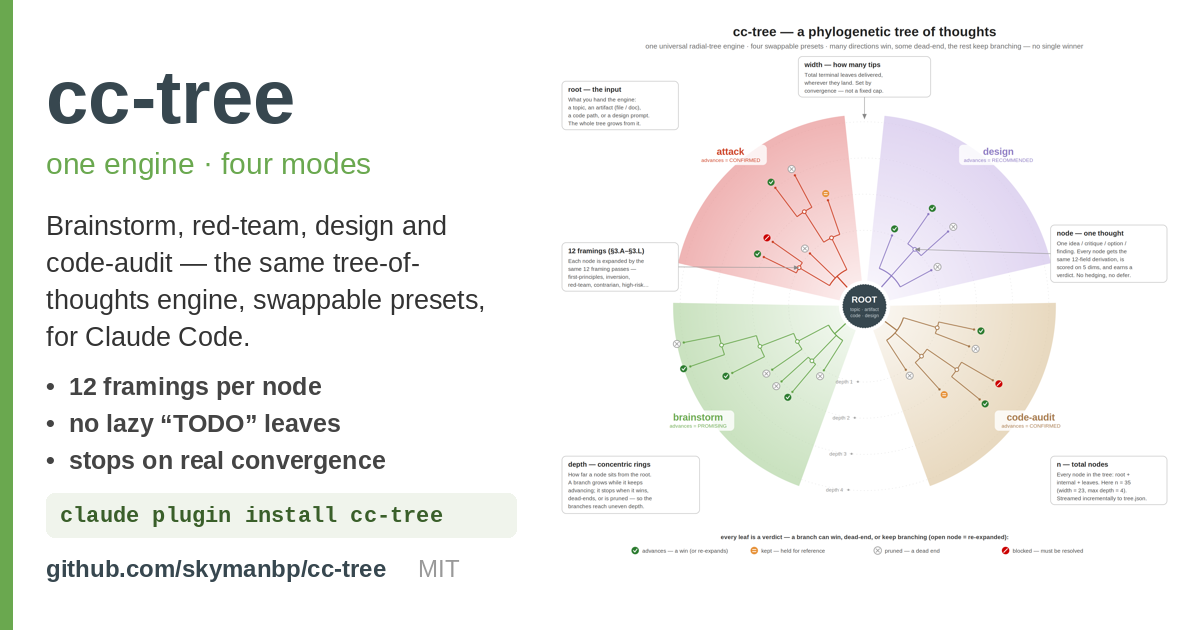
One exploration engine, four presets — brainstorm, adversarial critique, design-space exploration,
code audit. Every node is fully derived with file:line or URL evidence, deferred leaves
(defer / future-work / TODO / NEEDS-MORE-INFO) are banned, and a run stops on substantive
convergence rather than on a node budget.
claude plugin marketplace add skymanbp/cc-tree
claude plugin install cc-tree@cc-tree
1 · The problem, and what cc-tree does about it
1.1 The problem it targets
Ask an LLM to brainstorm, review this critically, compare these designs or audit this file, and the same five failure modes come back:
| Failure mode | What it looks like |
|---|---|
| Shallow coverage | the three most obvious angles, then a summary |
| Deferred leaves | "promising, needs a deeper survey — future work" |
| Pseudo-divergence | six branches that are one branch with the nouns swapped |
| Convenient convergence | "that about covers it", just as new ideas get expensive |
| Unverifiable output | a chat log: nothing cites a line, nothing survives the scroll-back |
cc-tree inverts each row: fixed-breadth coverage, no deferrals, merged duplicates, a convergence
test you can check, and a file:line or URL behind every claim.
1.2 What it does — five capabilities
| # | Capability | Invoke | Deliverable |
|---|---|---|---|
| 1 | Divergent exploration — research directions or solution paths, grown until no new high-value branch appears | /cc-tree:brainstorm |
shortlist.md |
| 2 | Adversarial critique of a document, argument or proposal; every leaf is CONFIRMED / MARGINAL / REFUTED, with the defense the artifact already mounts |
/cc-tree:attack |
confirmed.md |
| 3 | Design-space exploration — options × trade-offs × reversibility × cost, ending in a RECOMMENDED short-list |
/cc-tree:design |
options.md |
| 4 | Code audit — threat-model, contract and cross-file bugs a linter cannot see, each with file:line and a fix |
/cc-tree:code-audit |
findings.md |
| 5 | Chaining — brainstorm → design → attack, top-K piped between stages | /cc-tree:tree-chain |
per stage + handoff log |
All five are the same engine; a preset changes the vocabulary, never the loop
(docs/ENGINE.md §10).
1.3 Working scope — what cc-tree is not
- Not a one-shot tool or a chat. A run is recursive and takes minutes to hours; after the §2.0 glossary grill it runs to convergence without asking (§F6). You steer with flags.
- Not a substitute for a domain expert, and not bundled with a model. It is prompt engineering on your Claude Code model setting; a human decides which leaves to act on.
- Not a linter.
code-audittargets what static analysis structurally cannot.
2 · How it works
2.1 The shape — one root, growing outward
A run is a tree grown outward from one root — your input. Every expansion tries all 12 framings,
so a node that grows gets one child per framing; each child is derived and scored, and only
advances children are expanded again, so branches stop at different depths. The run ends on §6
convergence.

No comments yet.