Pseudolife Mcp
Persistent memory for MCP-compatible agents: memory bank, fact cortex, dreams, graph.
- Transport
- Not stated
- Package
- —
- Registry id
- io.github.Pseudogiant-xr/pseudolife-mcp
No install snippet on purpose. A working MCP config is a command, its arguments and an environment block — the last two are where API keys live, so this catalogue never stores them and cannot publish them. Follow the link above for the authors' own instructions.
简体中文 · 日本語 · 한국어 · Português (BR) · Español
Persistent long-term memory for Claude Code, Codex, and other MCP clients.
An MCP server that gives coding agents a long-term memory that persists across sessions — surviving context compactions and fresh tasks. Your coding agent is the intelligence; this server is its memory on disk.
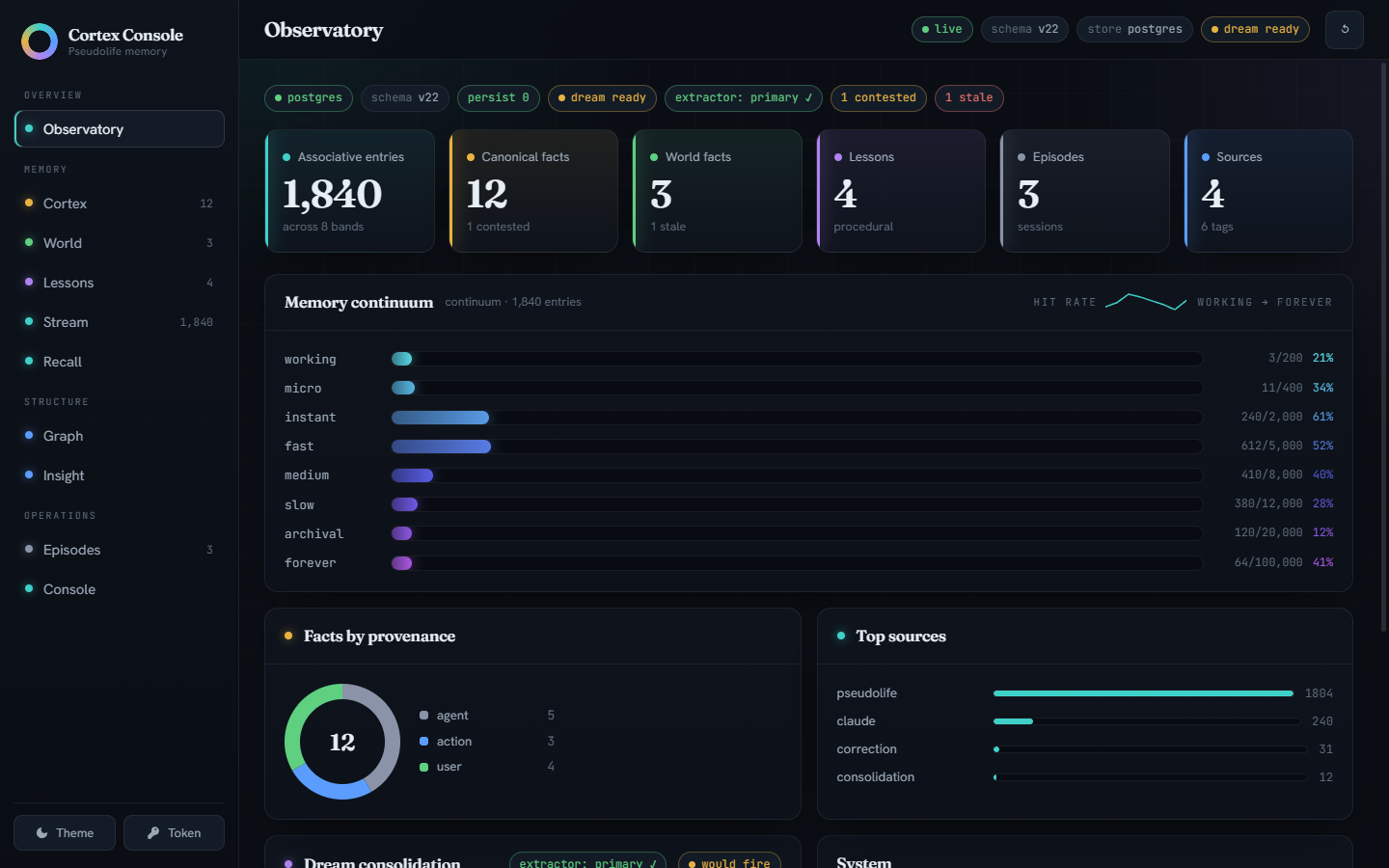
What you get:
- Associative memory with honest forgetting — a flat similarity store ranked by hybrid dense-plus-lexical retrieval, with conflict detection that admits potential updates while preserving earlier source notes; whole-note replacement is explicit. (The measured verdict: a preregistered ablation campaign found the previous 8-band continuum tied a flat store on every gate, so the simpler structure ships; the continuum remains one config line away.)
- Canonical facts, not vibes — one current value per
entity.attributeslot (or a member set, for slots that hold many concurrent values); corrections supersede rather than silently overwrite, and the full version history survives. - Dreams — a bundled local extractor, or any OpenAI-compatible endpoint (a Claude model on your Max plan, a GPT-5.6 model on a ChatGPT plan, LM Studio, Ollama, vLLM), consolidates the memory stream into facts and a knowledge graph while you're not looking.
- Lessons from its own work — successes, dead-ends, and your corrections become do/avoid guidance surfaced at the start of every session.
- A web console to watch it think — the Cortex Console above, plus cited world facts, session episodes, and document RAG.
Measured, with receipts — the full 500-question LongMemEval sweep, all six question types, and every number ships with its committed run artifact:
| LongMemEval oracle, 500 questions | naive RAG | commit-gated cascade |
|---|---|---|
| accuracy, all six question types | 0.688 | 0.690 |
| context tokens per question | ~1210 | ~883 |
| knowledge-update slice (78 of the 500) | 0.859 |
Equal accuracy to naive RAG across the whole benchmark on ~73% of the
context, and better calibrated about what it does not know: on BEAM-100K's
abstention questions the fact spine scores 0.950 against naive RAG's
0.775, unchanged under two independent judges. Read that as calibration,
not recall — in the budget-matched five-arm run of 2026-09-02 (rag 0.725 there;
one replicate, local judge) an arm served no memory at all scores 1.000 on
the same questions, because refusing is the right answer there and an
empty context always refuses. The fact spine loses where an answer has to
be aggregated across sessions. The second claim to survive a judge swap is
a win rather than a wash: re-run on 2026-09-04 with the hybrid arm
budget-matched to the control at 6 turns, the same 500 questions give
hybrid 0.730 against naive RAG's 0.690 under the local judge and
0.736 against 0.694 under claude-opus-5 — paired +0.040 / +0.042,
p 0.015 / 0.013 — bought with more context, ~1229 tokens against the
control's ~1124, not less, and carried mostly by temporal-reasoning
questions. Graded by a local, byte-reproducible judge (the cross-judge check
names its second judge) — compare within rows, never against GPT-judged
leaderboards.
From the project's README.