Crbro Memory
Persistent file-based memory for AI agents: inspectable, versionable, fully local.
- Transport
- Not stated
- Package
- —
- Registry id
- io.github.Octonove/crbro-memory
No install snippet on purpose. A working MCP config is a command, its arguments and an environment block — the last two are where API keys live, so this catalogue never stores them and cannot publish them. Follow the link above for the authors' own instructions.
CRBRO is a local MCP (Model Context Protocol) server that gives your AI assistant persistent long-term memory across sessions. It uses a biological neural architecture — cortex, synapses, hippocampus — to store, connect, and retrieve knowledge automatically.
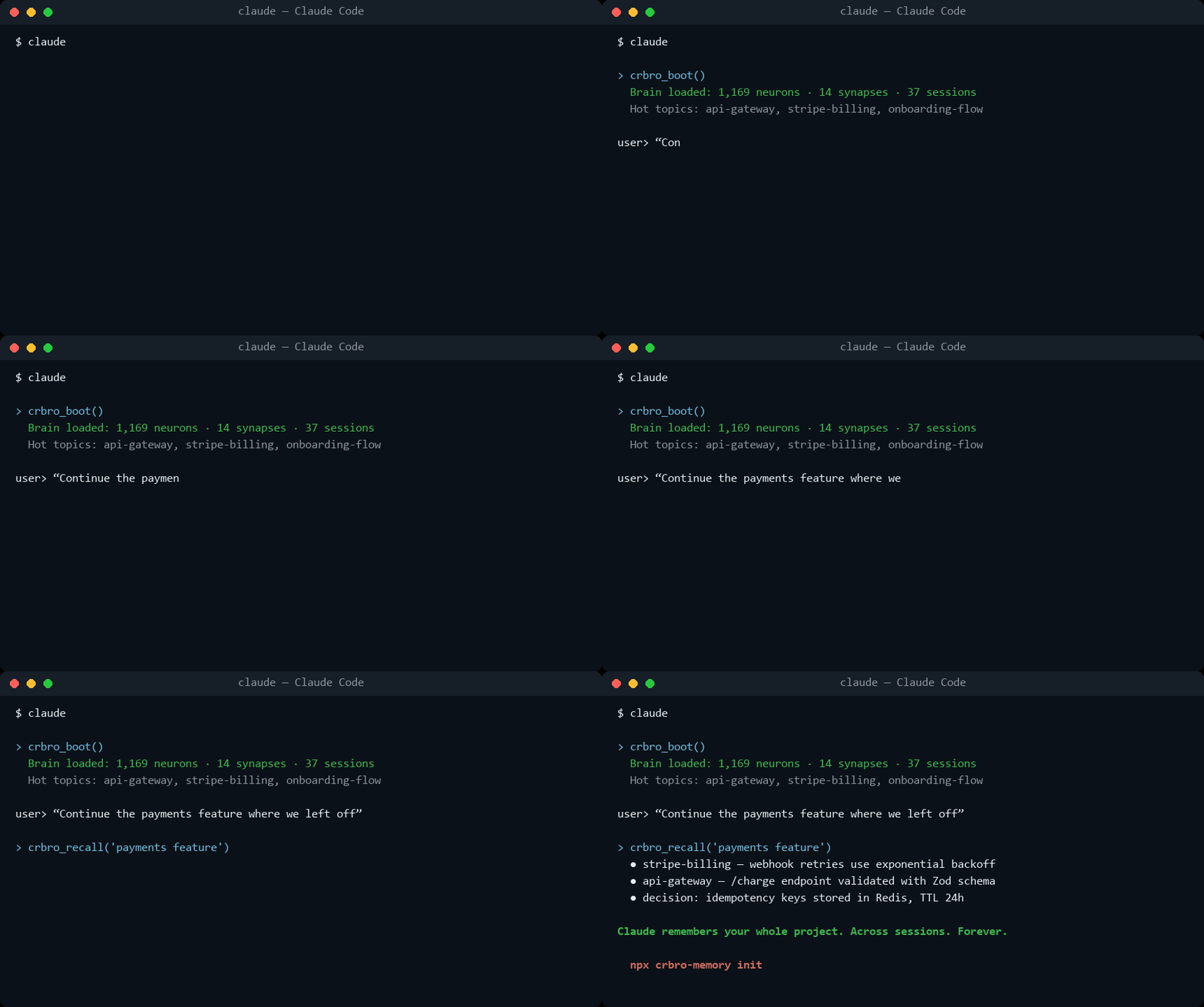
Free and open source (MIT). All 15 tools included — no license, no account, no tiers.
⭐ If CRBRO gives your AI a memory worth keeping, a star on GitHub is the best way to support it.
☕ If this saves you time, buy me a coffee.

Or in USDC. Send USDC only and only on the network shown; on any other network it is lost with no way to recover it.
| Network | USDC address |
|---|---|
| Solana | 5n6Gfosk7SdwbvdtE9xiLWpcGPBBBGDZYRfAkWyCk86g |
| Ethereum (ERC-20) | 0xe176866f9d7fdb498e0d4a983d3e34d84dcd6bfc |
Features
- 🧬 Biological Architecture — Knowledge organized as neurons (cortex), connections (synapses), and session memory (hippocampus)
- 🔍 Fact-Level Search — Powered by Orama. Every fact is indexed on its own, so a topic with hundreds of facts stays as findable as one with three. Each result comes back with the exact line that matched, when it was recorded, a
confidencelabel (weak= little of the question was covered) and, for the top results, the topic's next best lines. A short bilingual synonym table widens the question without inventing terms (v1.13+) - 🎯 Read the entry, not the neuron —
crbro_inspect view=neuronreturns an index: every fact, decision, pattern, preference, error, debt and the map as an id, a kind, a date and a preview.entries=[ids]reads just those; every recall hit carries itsentry_id. The whole-neuron read still exists asdetail=full, behind a declared ceiling. A 307-fact neuron went from 66,952 tokens to 1,887 to open (v2.1+) - 📓 The diary is searchable — every session summary is in the index, as paragraphs.
crbro_recallreturns the days that mention the question in a list of their own,sessions_matched, so narrative never outranks a fact;crbro_inspect view=sessions session=<id>reads one day whole. Lexical only, rebuilt once on upgrade (v2.2+) - 🗣️ The model in the loop — Two levers no embedding model replaces, measured blind: keywords written at save time (the caller knows the synonyms: a line about Hetzner gets hosting, alojamiento, servidor) and several phrasings searched at once, fused by rank. Zero disk, zero RAM; numbers in the table below (v1.15+)
- 🧭 Semantic recall —
npx crbro-memory initinstalls a local embedding model (multilingual-e5-small, int8) fused with the keyword engine, so paraphrases the words do not cover start to land. Measured: +8 points of recall@1 over the keyword engine, +2 to +5 on top of save-time keywords. Costs ~500 MB on disk once per machine and ~0.5 GB of RAM while a server runs;init --no-semanticskips it,CRBRO_SEMANTIC=0turns it off (v1.14+, installed by default since v1.16) - 🔥 Heat Scores — Automatic relevance tracking based on frequency, recency, and connectivity. Topics written in the same session are linked at consolidation, so the graph fills itself in (v1.13+)
- ✏️ Correctable — Knowledge can be superseded or retracted, not just piled up — facts, and since 2.0 decisions, patterns, errors and debts too. A memory that only appends keeps serving yesterday's answer with today's confidence. What was retired stays in the file and can come back (
status=active); what must not exist on disk goes throughcrbro_forget, quarantine copy first - 🔐 Credential-aware —
From the project's README.